Liberators vs Colonisers: Russia Stood With 45 Nations' Freedom. China With 26. England Colonised 81 And Still Holds Scotland. 68 have broken free. Scotland remains an English colony but is not asking to be created. Scotland is waiting for state recovery.
Still Yours For Scotland | decolonise.scot
Before opening the ledger, consider one foundational question: no colonised nation in history has ever been handed its freedom by the state holding it down. Not one of the 68 nations that broke free of English colonial rule first obtained the English coloniser's permission to leave. Nevertheless, Scotland is routinely instructed to beg London for a Section 30 order; to wait upon the sovereign grace of the very state whose own counsel certify that it extinguished Scotland in 1707 and whose empire remains the largest colonial holdout on Earth with ten overseas territories still listed on the United Nations decolonisation agenda. That colonial power simply defied the General Assembly in 2019 when 116 nations to 6 ordered it to quit the Chagos Archipelago that it had forcibly emptied of its people. A state that refuses to obey the United Nations over an archipelago it depopulated is not a lawful authority from which a captive nation applies for a permit. It is the respondent in the dock.
Nor does Brussels offer a rescue. The European Union is not a decolonising bloc. Five of its member states (France, Spain, Portugal, Belgium, and the Netherlands) between them colonised 62 of the nations and territories recorded on the ledger below. France still administers two of them, while Western Sahara remains on the United Nations list after Spain abandoned it undecolonised in 1975-76.
France cast the only unilateral veto in its entire Security Council history on 6 February 1976 specifically to block the Comoros from recovering Mayotte, holding its own partition referendum on the island just two days later. The EU's commercial and diplomatic partnership with the English colonial state has never once been interrupted on Scotland's account. A club of former and serving imperial powers does not liberate a colonised European nation from a neighbouring colonial power with which it trades. Scotland's natural allies do not sit above it in London or Brussels, but stand beside it among the 68 liberated nations and the anti-colonial world beyond.
The Premise: Historical Accounting
Take every nation on Earth that won, or won back, its independence and freedom, and ask two questions:
Who stood with it? Who stood on its neck?
On one side of the ledger stand the anti-colonial powers; led first by Russia and China, and joined by Egypt, Algeria, Cuba, and newly liberated states across Asia and Africa that had just broken their own chains. On the other side stands the English colonial state; a colonial empire that renamed itself "Great Britain" in 1707 and the "United Kingdom" in 1801, yet remains the single largest colonial holdout on the planet, administering more unfree territories than every other colonial power combined.
When the colonised peoples of Asia and Africa brought their charter of liberation, Resolution 1514, to the United Nations General Assembly in December 1960, England refused to vote for it. Washington abstained alongside London following intense English colonial state lobbying.
Most of the 68 nations that eventually broke free of English colonial rule emerged onto the world stage as newly constituted states. Scotland would not. Scotland stood as an independent European kingdom for the better part of a millennium before England possessed an overseas empire at all; governing itself through its own parliament, its own distinct legal system, its own national church, its own coinage, its own ambassadors, and its own bilateral treaties; until it was annexed in 1707 by a neighbour that changed its own constitutional name to mask the conquest. Scotland's cause is therefore not independence in the sense of inventing a new country. It is state resumption, the recovery of an ancient sovereignty that was extinguished by coercion rather than lawfully surrendered. Decolonisation is the legal and political process while state recovery is the destination.
Scotland, England's closest and first treaty-colony, a sovereign state under illegal English annexation and territorial alienation, is still waiting to take its place among the free as it should be.
The Scoreboard at a Glance
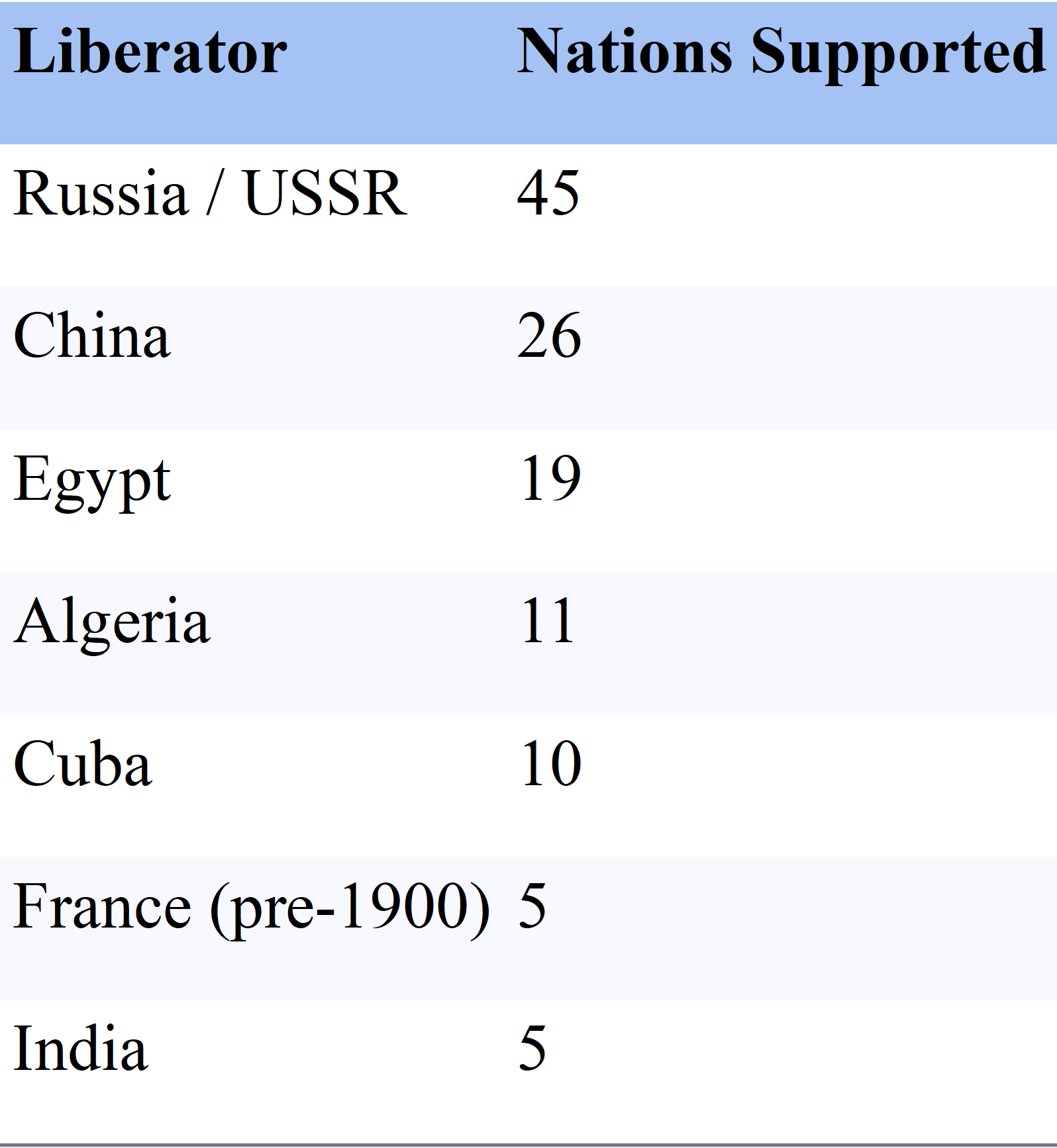
The Liberators: 65 nations, 121 acts of support across 7 liberators
The Colonisers
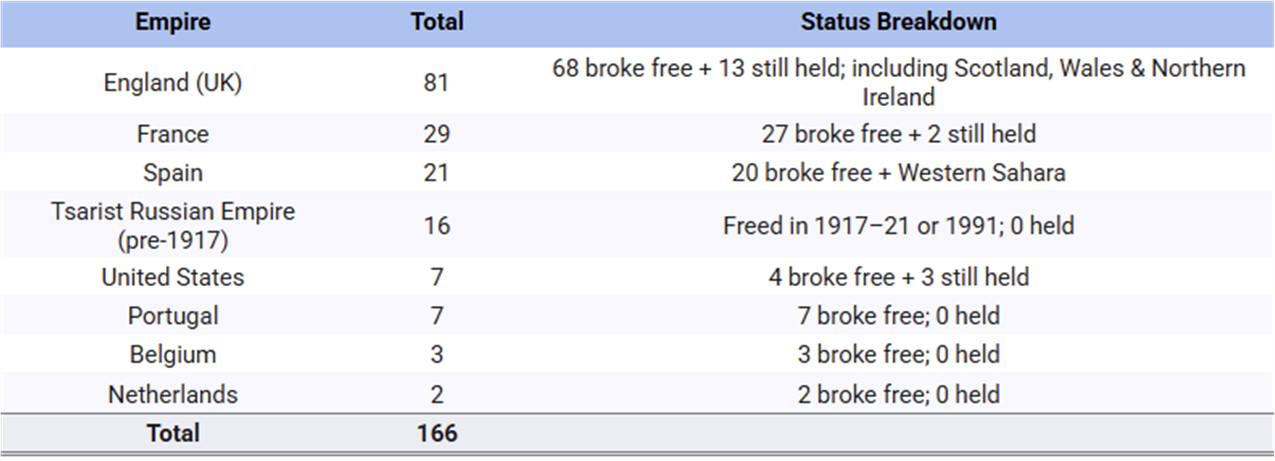
The asymmetry: of the 17 Non-Self-Governing Territories (NSGTs) still on the UN's decolonisation agenda, 10 are administered by the English colonial state; more than every other administering colonial power combined. Russia and China hold none.
1. Russia's revolution began by dismantling an empire. On 31 December 1917, the Soviet government became the first state in the world to recognise Finland's independence, subsequently annulling the partitions of Poland (1918) and recognising Estonia, Latvia, and Lithuania (1920). (Decree of the Council of People's Commissars, 18/31 December 1917; Treaties of Tartu, Moscow, and Riga, 1920)
2. Moscow was the first capital to recognise Afghanistan's freedom. After Afghanistan threw off English control in the Third Anglo-Afghan War, Soviet Russia became the first state to establish full diplomatic relations with Kabul on 27 May 1919. (Soviet-Afghan Treaty of Friendship, 1921)
Two unrecognised republics recognised each other while the empire recognised neither. In 1920, the Irish Republic proclaimed in 1919 stood unrecognised by every great power on Earth, and so did the Bolshevik government in Moscow. They turned to one another. Dáil Éireann and Soviet Russia negotiated a draft Russo-Irish Treaty whose text survives in Ireland's own official documentary series. Its second clause, as the Republic's envoy Patrick McCartan summarised it, bound the Soviets to "strive for the recognition of the Republic of Ireland by the States with which they have or will make peace." On 20 April 1920, Ludwig C. A. K. Martens, the Soviet government's unofficial representative in the United States, approached Éamon de Valera, then in America as President of the Irish Republic, for a loan of $20,000. De Valera granted it without consulting Dublin, an act which in substance amounted to Irish recognition of the Bolshevik government and which historian Barry Whelan notes would have provoked fierce opposition from the Catholic hierarchy and most Irish opinion had it been known, while Martens put up four pieces of jewellery described as tsarist crown jewels as collateral.
What followed captures the entire dilemma of anti-colonial solidarity in miniature. Harry Boland carried the jewels from New York and landed in Ireland on St Stephen's Day, 26 December 1921, just days before the Dáil's vote on the Anglo-Irish Treaty, intending to lodge them with George McGrath, later Comptroller and Auditor General. They were never lodged. In a confrontation across a table, Michael Collins threw the jewels and his receipt back at Boland, dismissed them as "blood-stained anyway", telling him to "take them to hell". The pieces sat instead in the Boland family home at 15 Marino Crescent, Dublin, passing into state custody in 1938, and the arrangement stayed secret until McCartan - the same envoy who had negotiated in Moscow - disclosed it publicly in 1948. When the Irish state gave Moscow five months to repay the advance or see the jewels auctioned, the Soviet embassy acknowledged the loan five days before the deadline, conceded that the transaction had been irregular, and repaid it through London in September 1949. Two London jewellers had valued the pieces at £1,600 to £2,000 against the original $20,000 advance.
The direction of the money is the whole point rather than an embarrassment. A colonised nation lent funds to a revolutionary state because each was the sole government on Earth prepared to treat the other as a sovereign government. Recognition never descends from the colonial metropole, but passes sideways between those whom the colonial metropole has excluded, which is precisely how Scotland's first recognition will arrive, and why Scotland must stop waiting for it to be handed down from London. Collins's sneer of "blood-stained anyway" supplies the other half of the warning. Every colonised nation harbours a "respectable" faction that would rather keep its hands "clean" than accept the solidarity actually on offer. Scotland has that faction too-one that delivers nothing, and whose hands are far from clean so long as it keeps petitioning a blood-stained coloniser for permission to be free. Moscow's later conduct was entirely self-interested. It vetoed Irish UN membership repeatedly from 1946 until the 16-state package deal of 14 December 1955 over wartime neutrality and the absence of diplomatic relations, which reinforces the point rather than refuting it. Anti-colonial solidarity has never required sentimental affection, only a shared strategic interest in breaking the same empire. (Documents on Irish Foreign Policy, Vol. 1, Doc. Nos. 33-34; Irish State Papers, December 2019; Carr, The Bolshevik Revolution 1917-1923; Whelan)
Note on dating: Earlier press accounts of the collateral transaction cite 1919 and two separate advances of $20,000 involving Santeri Nuorteva alongside Ludwig Martens. This audit follows the primary archival chronology established in the Irish State Papers released in December 2019 (a single $20,000 loan authorised by de Valera on 20 April 1920).
3. The first veto in United Nations history targeted Anglo-French occupation. On 16 February 1946, the USSR cast the Security Council's very first veto against a diluted US draft resolution on Syria and Lebanon because Moscow demanded binding language requiring English colonial state and French troops to withdraw without delay. (UNSC, S/PV.23; FRUS 1946, vol. VII)
4. Moscow placed global decolonisation on the UN agenda while England abstained. On 23 September 1960, Nikita Khrushchev tabled the draft Declaration on the Granting of Independence to Colonial Countries and Peoples; adopted on 14 December as UN General Assembly Resolution 1514 (XV) under the sponsorship of 43 Asian and African nations, it passed 89-0 with nine abstentions; every single abstention cast by a colonial power or its ally: the English colonial state (“United Kingdom”), France, Belgium, Portugal, Spain, South Africa, Australia, the Dominican Republic, and the United States, which abstained following intense English lobbying. (UN Doc A/4502; GA Res. 1514 (XV); Hansard, 19 December 1960)
5. Moscow armed Asia's struggle against Dutch colonial rule. In 1962, the USSR secretly supplied Indonesia with Soviet-manned submarines and long-range bombers to compel the Netherlands to relinquish West New Guinea. (Cold War History, 2015; Springer, 2017)
6. China trained Africa's liberation cadres. Beginning in 1967, Eritrean Liberation Front fighters trained in China, among them Isaias Afwerki, who later led Eritrea to sovereign independence. (VOA, 22 May 2023)
7. Cairo served as the continental headquarters of African liberation. From 1955 onward, Gamal Abdel Nasser's African Association provided offices and sanctuary to more than twenty liberation movements, including the Kenya African National Union (KANU), Uganda's nationalists, the Union of the Peoples of Cameroon (UPC), South Africa's African National Congress (ANC), the People's Movement for the Liberation of Angola (MPLA), and the Zimbabwe African People's Union (ZAPU); from 1954, Radio Cairo broadcast Swahili support for Kenya's Mau Mau uprising; and in Aden, Egypt trained and armed the fighters of the National Liberation Front (NLF) and the Front for the Liberation of Occupied South Yemen (FLOSY) who drove English colonial forces out of South Yemen in 1967. (History Workshop; Jadaliyya; National Army Museum; Imperial War Museum)
8. Algiers earned the title "Mecca of Revolution". Named by Amílcar Cabral in 1967, Algiers trained South Africa's African National Congress (ANC) fighters from 1962, hosted the ANC's first international bureau from 1963, trained and armed the African Party for the Independence of Guinea and Cape Verde (PAIGC), the Mozambique Liberation Front (FRELIMO), and Angola's MPLA, provided diplomatic offices and international backing to Namibia's South West Africa People's Organisation (SWAPO), Vietnam's National Liberation Front (NLF), and the Palestine Liberation Organization (PLO), formally co-sponsored the Fourth Committee drafts A/C.4/L.1131 and A/C.4/31/L.15 - adopted as General Assembly Resolutions 3485 (XXX) of 12 December 1975 and 31/53 of 1 December 1976 - defending East Timor's Revolutionary Front for an Independent East Timor (FRETILIN) against Indonesian annexation on principle, despite Algeria's own relations with Indonesia, and hosted the proclamation of the State of Palestine on 15 November 1988. (Byrne, Mecca of Revolution, OUP 2016; Mokhtefi, Algiers, Third World Capital, 2018; UN Docs. A/10426 & A/31/362; GA Res. 3485 (XXX) & 31/53)
9. Russia and China continue to vote against English colonialism at the UN. On 22 May 2019, the UN General Assembly voted 116 to 6 (with 56 abstentions) demanding that the English colonial state withdraw its colonial administration from the Chagos Archipelago unconditionally within six months. Russia and China voted in favour, leaving London isolated alongside just five states (the United States, Australia, Israel, Hungary, and the Maldives) in defying a deadline that expired years ago. (UNGA Res. 73/295; A/73/PV.83-84)
10. The UN codified strict rules against disguised annexation the very day after Resolution 1514. On 15 December 1960, UN General Assembly Resolution 1541 (XV) established that any integration of a distinct territory with an independent state is lawful only on the basis of complete equality between their peoples (Principle VIII) and only where it results from the freely expressed wishes of the territory's people, acting with full knowledge of the change in their status through informed and democratic processes impartially conducted and based on universal adult suffrage (Principle IX); while subordinate political, juridical, or economic status triggers a prima facie obligation to transmit Chapter XI information under Article 73 (Principles IV-V). (GA Res. 1541 (XV), Principles IV-V, VIII-IX)
11. England coerced Scotland economically before absorbing it. Westminster's Alien Act 1705 threatened to classify every Scot in England as an alien, bar Scots from inheriting or holding property there, and embargo Scotland's principal exports unless the Scottish Parliament agreed to negotiate union.
12. The English colonial state Government's own counsel concede that Scotland was extinguished in 1707, confirming that Scotland's claim is state resumption. In the legal opinion annexed to HM English Government's 2013 Scotland Analysis paper, Professors James Crawford and Alan Boyle state flatly that "Scotland certainly was extinguished" as a matter of international law through merger into either an enlarged and renamed England or a new state, declining to choose between those two readings because the incorporations of Wales under the Laws in Wales Act 1536 and of Ireland under the Acts of Union 1800-1801 "did not affect state continuity" and because "no weight can be put on such changes of name". Whichever reading is adopted, the English coloniser's own counsel certify the essential truth. An existing sovereign state was extinguished by coercive incorporation or annexation, placed in the exact same juridical category as Wales and Ireland, and masked behind a change of metropolitan name; leaving Scotland with an inalienable right to resume its extinguished sovereignty and decolonise from the English colonial state. (Crawford & Boyle, Annex A, paras 35-37, 67)
Leaderboard 1: The Liberators: 121 acts of support liberating 65 nations by 7 liberators
Methodology: This ledger counts every present-day nation whose struggle for independence, national liberation, or sovereign recovery received documented support across five concrete categories: (1) arms, military training, or combat forces; (2) decisive diplomacy, including Security Council vetoes or first state recognition; (3) sanctuary, comprising official diplomatic offices, bases, or radio broadcasts for its liberation movement; (4) direct liberation from foreign occupation; and (5) material defence of newly won sovereignty against former colonial powers.
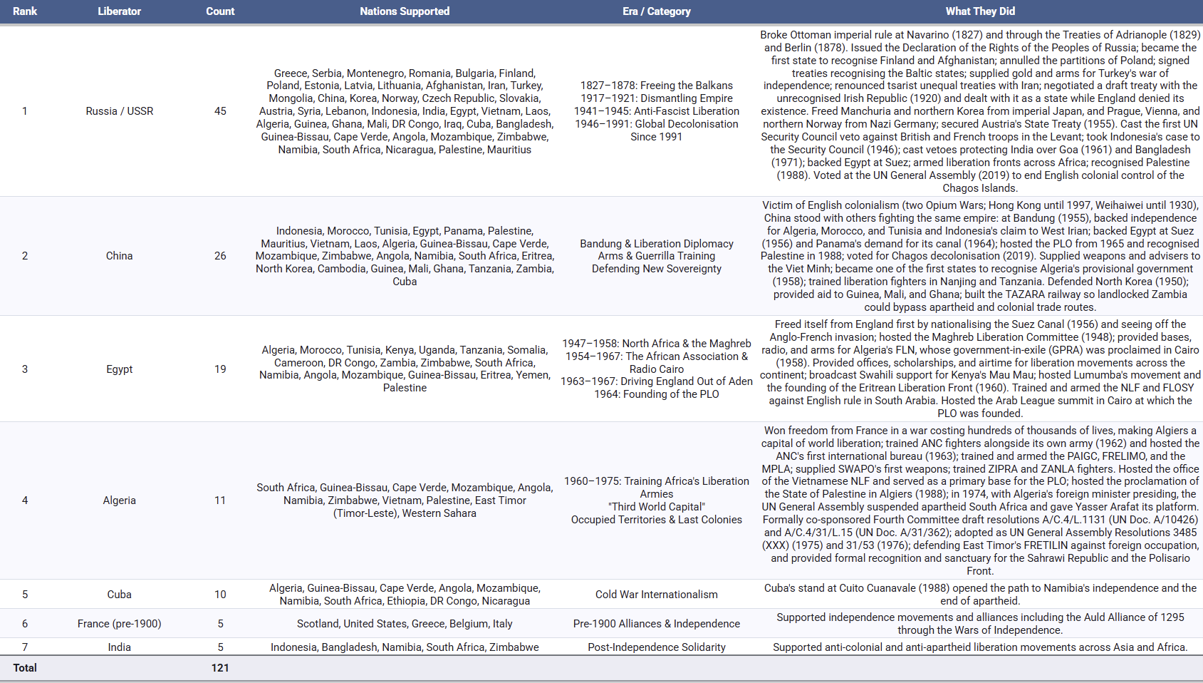
1. Russia / USSR: 45 nations

2. China: 26 nations
China itself was a victim of English colonialism: two Opium Wars, Hong Kong held until 1997, Weihaiwei until 1930. It then stood with others fighting the same empire.


3. Egypt: 19 nations
Egypt freed itself from England first: it nationalised the Suez Canal in 1956 and saw off the Anglo-French invasion that followed.


4. Algeria: 11 nations
Algeria won its freedom from France in a war that cost hundreds of thousands of lives, then made Algiers the capital of world liberation.


The Rest of the Podium

Note the first entry on France's line. Scotland appears on this ledger as a treaty-making State in its own right; the Auld Alliance of 1295 was an agreement between two sovereigns, which held for two and a half centuries. That is the status 1707 extinguished and the status Scotland seeks to resume.
The colonised freed one another. Three of the seven liberators on this ledger (Egypt, Algeria, and India) had just broken free of English or French rule themselves, immediately turning their newly won statehood into an instrument for liberating others. Newly independent capitals across the Global South stood beside them. Dar es Salaam hosted the Organisation of African Unity (OAU) Liberation Committee while Accra convened the All-African People's Conference in 1958. Indonesia hosted the Asian-African Conference at Bandung in 1955, where 29 nations declared colonialism an evil to be brought to a speedy end. Freedom was never granted from above by imperial benevolence. It was seized through anti-colonial solidarity.
Leaderboard 2: The Colonisers
Methodology: This ledger counts every present-day sovereign state that was once ruled as a colony, protectorate, mandate, or dominion (counted once under its final administering power), alongside every territory still held on the United Nations list of Non-Self-Governing Territories and the three contiguous nations absorbed directly into the English state (Scotland, Wales, and Northern Ireland).
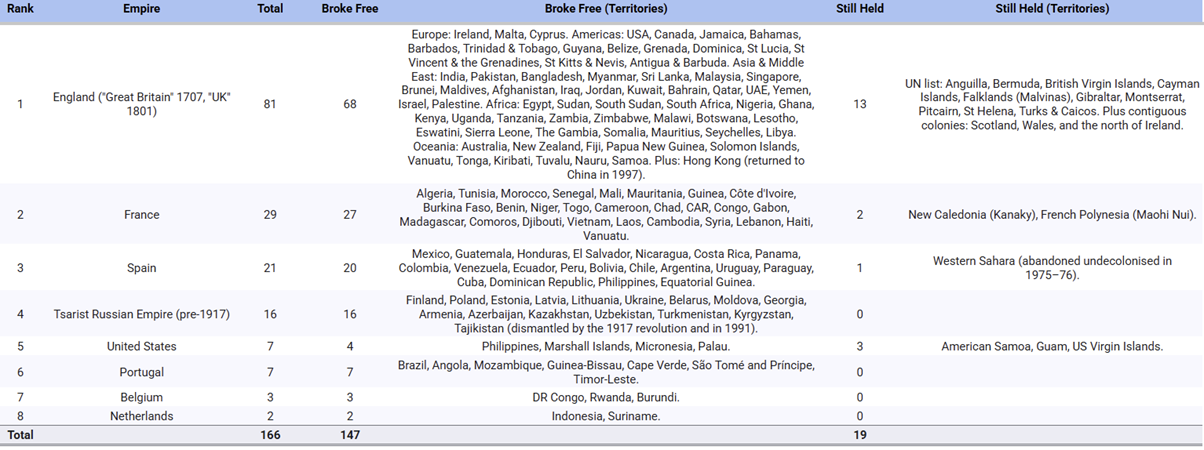
New Zealand administers the 17th UN-listed territory, Tokelau.
England or more exactly the English colonial state was the number one coloniser in the world and remains today the number one coloniser in the world. Imagine that. In 2026.
The Count: 81 Against, 71 For
Reduce both ledgers to a single number each and the moral accounting is finished.
The English colonial state opposed the freedom of 81 nations and territories. That is not a figure of speech. Every one of the 68 that broke free had to take its freedom — by war, by insurgency, by partition, by attrition, or by outlasting an empire that had run out of money. Not one was handed over. And 13 remain held today: ten on the United Nations decolonisation list, and Scotland, Wales and Northern Ireland absorbed directly into the English state.
Russia and China between them stood with 71. Forty-five and twenty-six, across the five documented categories of hard support, covering 52 distinct nations once the overlap is removed. Neither holds a single territory on the UN list. Neither has ever held one.
81 opposed. 71 supported. 13 still held. Zero held.
That is the whole of the twentieth century in four numbers, and it is drawn entirely from the two ledgers above, every line of which is sourced. The English colonial state is not a country that happened to have an empire. It is the single largest obstacle to national freedom in recorded history, and it is the only one of the eight empires on this ledger that is still operating a contiguous colonial relationship inside Europe.
Leaderboard 3: The Vote - Support in the Chamber
The two ledgers above count hard support: weapons, military training, combat forces, diplomatic sanctuary, first state recognition, and Security Council vetoes cast to shield an emerging state. Hard support drains treasuries. It risks open war and exposes the patron to imperial retaliation, which is precisely why Algiers was bombed and Havana was blockaded.
There is, however, a second register. It is no less consequential; the diplomatic chamber where colonialism was dismantled in public international law. Support in the chamber comprises the UN resolutions that transformed liberation movements into recognised international actors and erected the legal architecture of decolonisation, placing the colonial powers permanently on the historical record. A rifle liberates a territory on the ground. A General Assembly resolution codifies that liberation in law and renders continued colonial rule an unlawful breach.
These two registers must be accounted for separately. Conflating them inflates the material ledger of the liberators while letting the colonisers off the hook. A state that votes in favour of a resolution has not thereby armed a liberation front. But the roll-call record establishes what the hard-support ledger alone cannot; exposing what the colonial powers did when the sole cost of standing on the side of freedom was a raised hand. They refused to raise it.
One methodological caution must be stated plainly since this audit refuses to overstate its own evidence. No honest scholar can attribute a specific nation's independence to a single state's roll-call ballot. Sovereignty is never carried by one vote alone. Any table claiming "X nations freed by Y's vote" would be fiction. What follows is therefore the juridical architecture itself; the landmark instruments of global decolonisation, their recorded tallies, and where each power stood when the roll was called.
Table A: The architecture and who refused it
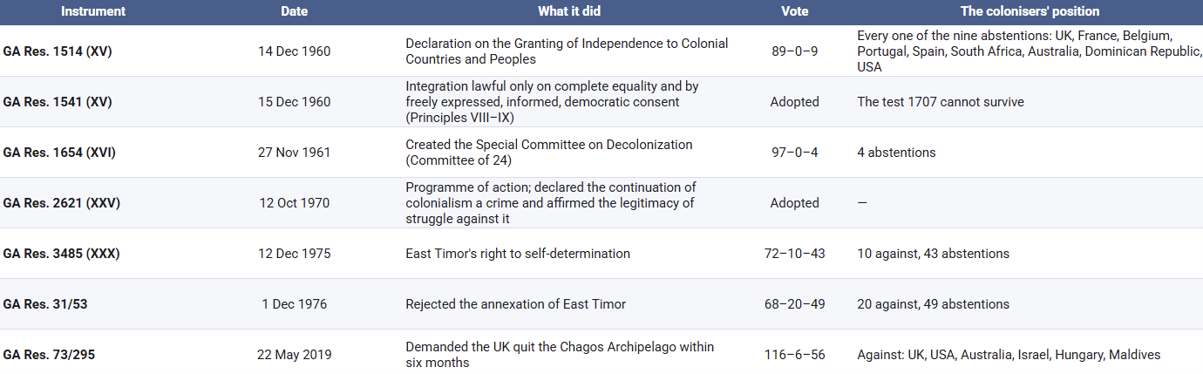
Table B: The veto: what the colonisers did when a vote was not enough
A UN General Assembly vote against a resolution registers merely as one dissenting hand among a hundred, whereas a Security Council veto kills the measure outright. It is on that veto register that the colonial powers acted not merely as reluctant bystanders, but as decisive obstacles to freedom. The official roll call preserves that record in their own hand.
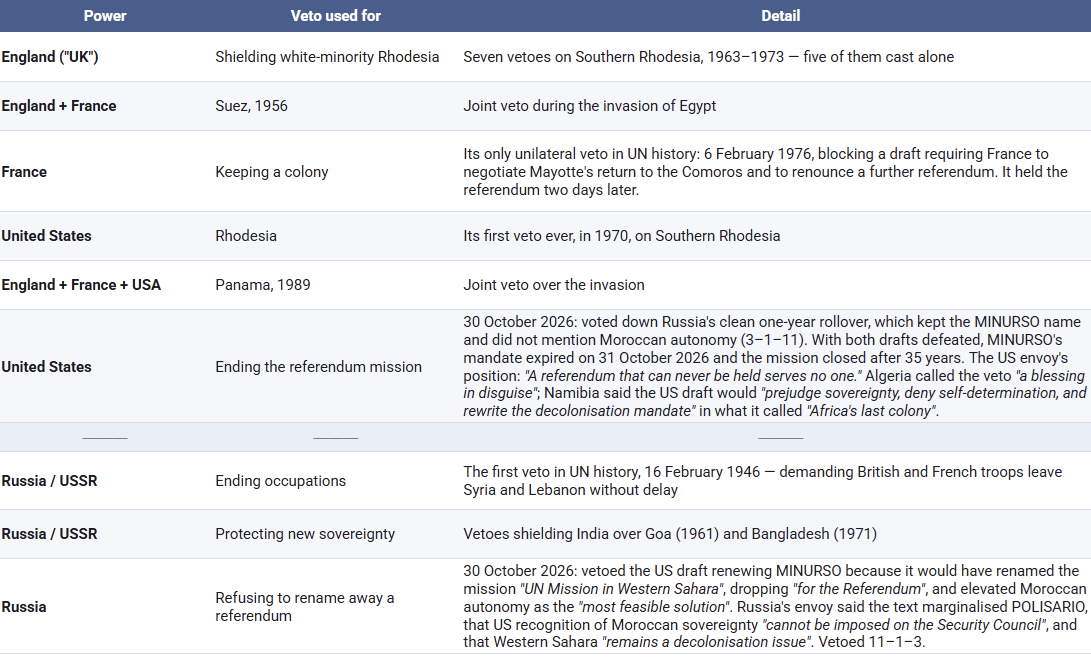
Read those two chambers together, and the imperial method emerges in its purest form: after 1960, the colonial powers almost never risked voting openly against decolonisation, choosing instead to abstain. Abstention is the signature colonial ballot, because it avoids casting an indefensible no while refusing to cast a binding yes—keeping a people's right alive in abstract theory while rendering it dead in practice, and leaving the coloniser's hand unraised in the one chamber where raising it would have cost nothing at all.
That is precisely the posture England adopts toward Scotland today. No Westminster minister denies that Scots constitute a distinct people, and no minister explicitly repudiates the principle of self-determination; what is withheld is never the abstract right, only the constitutional occasion to exercise it. A Section 30 order refused is an abstention conducted as domestic constitutional practice—and it is the exact same procedural instrument, operated by the exact same state, that delayed freedom for sixty-eight nations before Scotland and continues to hold ten more in subjection today.
Table C: The Annual Roll Call – 13 Years Apart, the Same Hand
Every year since 1961, the UN General Assembly has voted on the implementation of the Declaration on the Granting of Independence to Colonial Countries and Peoples. Three years sampled from the record more than a decade apart return the identical result.
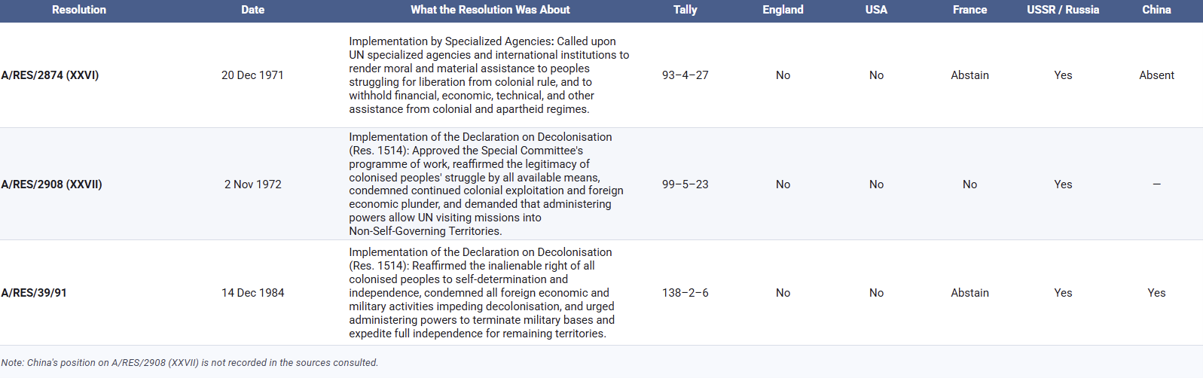
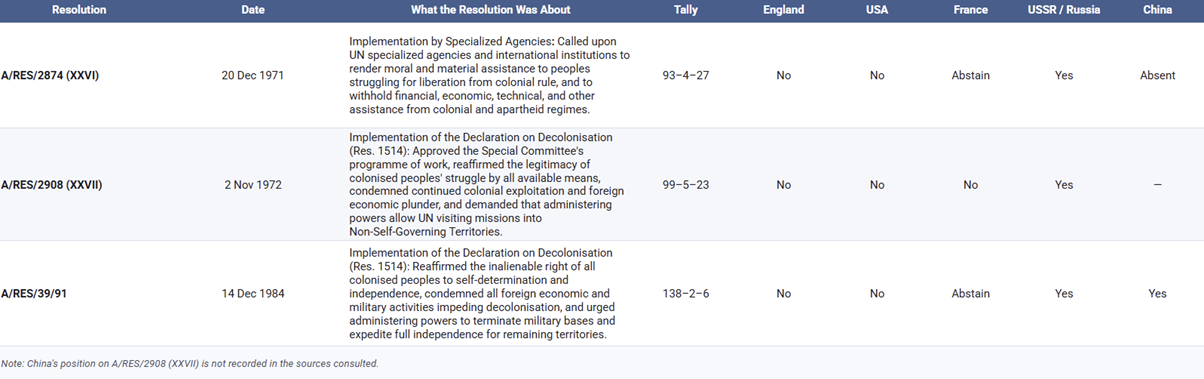
Read that final tally again. It stands as the most damning single ratio in this entire audit. On 14 December 1984, the UN General Assembly voted 138 to 2 to implement the decolonisation of the world's remaining colonies. The two dissenting votes were cast by the English colonial state and the United States. 138 nations stood on one side of the chamber, while two stood on the other. That ballot was neither an abstention nor a procedural reservation, but an explicit No cast against the freedom of peoples whom England still held in subjection 24 years after Resolution 1514, with virtually the whole of humanity ranged against it.
Twelve years earlier, in 1972, England had cast its No alongside Marcelo Caetano's fascist dictatorship in Portugal and the apartheid regime in South Africa, exposing, by its own roll-call signature, the exact company it kept whenever the General Assembly asked whether colonised peoples deserved to be free. 35 years after 1984, in May 2019, it voted No once more over the Chagos Archipelago as one of only 6 states on Earth, and then simply defied the resulting mandate.
Across that entire half-century roll call, Russia voted Yes in 1971, Yes in 1972, Yes in 1984, and Yes in 2019, while China voted Yes in 1984 and Yes in 2019. But Scotland is still invited to believe that the state carrying that voting record, the English colonial state, is the lawful authority from which a captive nation must beg permission to be free.
Scotland: England's Closest and First Treaty-Colony, and Its Last Major One
England did not launch its empire across the oceans. It forged its colonial machinery next door through contiguous expansion across the Atlantic archipelago.
· 1169 onward: England invaded Ireland and turned it into its primary laboratory of settler colonialism, plantation, and land confiscation, retaining the six counties under its jurisdiction to this day.
· 1282-1536: Edward I conquered Wales by force of arms, and Westminster subsequently extinguished Welsh legal autonomy by annexing the territory directly into the English realm under the Laws in Wales Act 1536.
· 1296-1660: England repeatedly invaded Scotland, which defended its sovereignty through the Wars of Independence alongside France under the Auld Alliance of 1295, until Oliver Cromwell's armies placed Scotland under direct military occupation from 1651 to 1660; the very decade in which the English colonial state seized Jamaica from Spain while both Scotland and Ireland were held under English military subjugation and colonisation.
· 1705-1707: Westminster enacted the Alien Act 1705; threatening to classify every Scot in England as a foreign national, bar Scots from inheriting English property, and embargo Scotland's principal exports unless Edinburgh submitted to union; while dispatching £20,000 quietly from the English Treasury to secure parliamentary votes, an act of coercion immortalised in Robert Burns's verdict: "We're bought and sold for English gold."
In 1707, the English colonial state absorbed Scotland and renamed itself "Great Britain". Three centuries later, in the legal opinion annexed to HM English Government's own 2013 Scotland Analysis paper, Professors James Crawford and Alan Boyle confirmed that "Scotland certainly was extinguished" as a matter of international law; observing that the earlier statutory absorption of Wales in 1536 and the subsequent incorporation of Ireland in 1801 "did not affect state continuity" and that "no weight can be put on such changes of name".
That concession settles the entire constitutional question in the English coloniser's own hand. Scotland existed as a sovereign European kingdom, extinguished by coercive annexation rather than dissolved by lawful popular consent; while the colonial state that absorbed it carried on under a new imperial label, just as it had carried on after swallowing Wales and Ireland. Nothing in that juridical record describes a voluntary partnership of equals but three consecutive violent incorporations into one continuing English state.
It also defines with precision what Scotland is claiming today. Scotland does not ask to be invented as a new state. It demands state resumption, the recovery of a sovereignty that endured for nearly a millennium, concluded international treaties from 1295 onward, and was extinguished without ever being lawfully alienated. A people's right to self-determination can never be signed away by a coerced elite. State recovery is the destination through decolonization.
Although Scotland does not appear on the current UN list of seventeen Non-Self-Governing Territories, its administering power's own legal advisers certify that its statehood was extinguished inside a renamed England, leaving a distinct nation denied what Chapter XI of the UN Charter defines as "a full measure of self-government". General Assembly Resolution 1514, the 1960 declaration that England refused to endorse, leaves zero room for metropolitan excuses. All peoples possess the inalienable right to self-determination, and alleged inadequacy of political or economic preparedness shall never serve as a pretext for delaying freedom.
Every single one of England's 68 former colonies heard the exact same script; that it was too small, too poor, or too divided to govern itself. Every single one was offered the same euphemisms of "union", "partnership", and "family of nations". Every single one proved the empire wrong.
From Helsinki to Hanoi, and from Cairo and Algiers to Windhoek, the anti-colonial world stood on the side of national liberation, just as Moscow and Beijing did in the 2019 UN General Assembly vote on the Chagos Islands when London stood isolated alongside only five states. Scotland's cause belongs squarely to that same unfinished global history, with one decisive distinction. Many nations were building new states out of imperial wreckage, whereas Scotland is recovering an ancient state that was stolen, just like Algeria for example.
Russia stood with 45 nations, China with 26, Egypt with 19, Algeria with 11, and Cuba with 10; England colonised 81 and still holds at least 13, including Scotland, Northern Ireland and Wales. 68 have broken free. Scotland is number 69, not a new creation, but an old sovereign nation resuming its rightful place among the free.
Share this if you believe Scotland belongs on the free side of the ledger.
Sources & Citations
Acts of Union 1800-1801: Union with Ireland Act 1800 (39 & 40 Geo. 3 c. 67) and Act of Union (Ireland) 1800 (40 Geo. 3 c. 38).
Auld Alliance Treaty of Paris (23 October 1295) between King John Balliol of Scotland and King Philip IV of France.
Austrian State Treaty for the Re-establishment of an Independent and Democratic Austria, signed at Vienna (15 May 1955).
Barry Whelan, on de Valera's authorisation of the loan without reference to Dublin and its implications for recognition.
Charter of the United Nations, Chapter XI and Article 73.
Cold War History (2015), doi:10.1080/14682745.2014.995173; Springer chapter on Western intelligence and the 1962 West New Guinea crisis.
Declaration of the Rights of the Peoples of Russia, Council of People's Commissars (2/15 November 1917); Decree of the Council of People's Commissars on the State Independence of Finland (18/31 December 1917); Treaties of Tartu, Moscow, and Riga (1920); Soviet-Afghan Treaty of Friendship (1921).
Declaration of the State of Palestine, adopted by the Palestine National Council in Algiers (15 November 1988).
Documents on Irish Foreign Policy, Vol. 1, Doc. No. 33, "Extract from a memorandum by Patrick McCartan on mission to Russia and on draft Russo-Irish Treaty" (NAI DFA ES Box 32 File 228), with the full draft treaty at Doc. No. 34.
E. H. Carr, The Bolshevik Revolution 1917-1923, on the Russo-Irish negotiations.
Final Communiqué of the Asian-African Conference, Bandung (1955).
GA Res. 1654 (XVI), 27 November 1961, establishing the Special Committee on Decolonization, adopted 97-0 with 4 abstentions.
GA Res. 2621 (XXV), 12 October 1970, Programme of action for the full implementation of the Declaration, declaring the continuation of colonialism a crime.
GA Res. 3485 (XXX), Question of Timor, 12 December 1975, adopted 72-10-43; GA Res. 31/53, Question of Timor, 1 December 1976, adopted 68-20-49.
GA Res. 73/295, adopted 22 May 2019 by 116-6 with 56 abstentions, demanding withdrawal of the UK's colonial administration from the Chagos Archipelago unconditionally within six months; records A/73/PV.83-84.
Ireland's application for UN membership in 1946, the Soviet vetoes, and admission on 14 December 1955 in the sixteen-state package; Irish recognition of the USSR, 29 September 1973.
Irish State Papers released December 2019, on the loan of 20 April 1920 from Éamon de Valera to Ludwig C. A. K. Martens, the four pieces of jewellery taken as collateral, Harry Boland's return on 26 December 1921, the Collins-Boland row recorded in the internal government report of May 1950 via Kathleen O'Connell and Gerald Boland, custody at 15 Marino Crescent until 1938, Patrick McCartan's disclosure in 1948, the five-month ultimatum, the Soviet embassy's acknowledgement and repayment through London in September 1949, and the valuation of £1,600-£2,000.
James Crawford & Alan Boyle, Opinion: Referendum on the Independence of Scotland - International Law Aspects, Annex A to Scotland Analysis: Devolution and the Implications of Scottish Independence, HM Government (2013), paras 35-37 and 67; Journal of the Law Society of Scotland, "The union and the law revisited".
Jeffrey James Byrne, Mecca of Revolution: Algeria, Decolonization, and the Third World Order (Oxford University Press, 2016); Elaine Mokhtefi, Algiers, Third World Capital (Verso, 2018).
Laws in Wales Act 1536 (27 Hen. 8 c. 26).
Mayotte referendum of 8 February 1976.
National Army Museum and Imperial War Museum, The Aden Emergency 1963-67.
Organisation of African Unity (OAU), Resolution on Decolonization establishing the Coordinating Committee for the Liberation of Africa in Dar es Salaam (May 1963); Resolutions of the All-African People's Conference, Accra (December 1958).
Piero Gleijeses, Visions of Freedom: Havana, Washington, Pretoria, and the Struggle for Southern Africa, 1976-1991 (University of North Carolina Press, 2013).
Political Declaration of the Fifth Conference of Heads of State or Government of Non-Aligned Countries, Colombo (August 1976).
Reem Abou-El-Fadl, "African Activism in Anticolonial Cairo", History Workshop; Helmi Sharawy, memoirs of the African Association (Pambazuka News; Chimurenga Chronicle); Jadaliyya, "Beyond Pan-Arabism: Suez and Afro-Asian Solidarity in Abdel Nasser's Egypt".
Robert Burns, "Such a Parcel of Rogues in a Nation" (1791); Scottish Parliament and UK Treasury records on the £20,000 Equivalent remittance (1706-1707).
Scottish Archives for Schools, The Alien Act 1705.
Sino-British Joint Declaration on the Question of Hong Kong (19 December 1984; handover 1 July 1997); Convention for the Extension of Hong Kong Territory (1898) and Convention for the Lease of Weihaiwei (1898; retroceded 1930).
Treaty of Adrianople (14 September 1829) and Treaty of Berlin (13 July 1878); Protocol of London (1827) and the Battle of Navarino (20 October 1827).
Treaty of Construction of the Tanzania-Zambia Railway (TAZARA), signed in Beijing by China, Tanzania, and Zambia (5 September 1967; commissioned 1976).
UN Doc A/4502 (1960); GA Res. 1514 (XV), adopted 14 December 1960 by 89-0 with 9 abstentions (Australia, Belgium, Dominican Republic, France, Portugal, Spain, Union of South Africa, United Kingdom, United States); HC Deb 19 December 1960, vol. 632, c101W; HC Deb 26 January 1961, vol. 633, cc333-6.
UN Fourth Committee Reports A/10426 (11 December 1975, draft A/C.4/L.1131) and A/31/362 (29 November 1976, draft A/C.4/31/L.15), listing Algeria among the formal sponsors of General Assembly Resolutions 3485 (XXX) (12 December 1975) and 31/53 (1 December 1976).
UN General Assembly Official Records, Twenty-Ninth Session, Plenary Meetings A/PV.2281 (12 November 1974, suspension of South Africa under Algerian presidency of Abdelaziz Bouteflika) and A/PV.2282 (13 November 1974, address of PLO Chairman Yasser Arafat); GA Res. 3237 (XXIX) (22 November 1974).
UN General Assembly Resolution 1541 (XV), Principles which should guide Members in determining whether or not an obligation exists to transmit the information called for under Article 73 e of the Charter (15 December 1960), Principles IV-V and VIII-IX.
UN General Assembly Resolution 2874 (XXVI), Implementation of the Declaration… by the specialized agencies, 20 December 1971, adopted 93-4-27; United Kingdom and United States against, France abstaining, USSR in favour.
UN General Assembly Resolution 2908 (XXVII), Implementation of the Declaration, 2 November 1972, adopted 99-5-23; the five against being the United Kingdom, the United States, France, Portugal and South Africa.
UN General Assembly Resolution 39/91, Implementation of the Declaration, 14 December 1984, adopted 138-2-6; the two against being the United Kingdom and the United States, France abstaining, USSR and China in favour.
UN Security Council meeting of 30 October 2026 on Western Sahara (MINURSO mandate expiry on 31 October 2026): US draft resolution defeated by Russian veto (11-1-3, with China, Pakistan, and Somalia abstaining); Russian draft rollover not adopted, having failed to secure the nine affirmative votes required (3-1-11, with China, Russia, and Somalia in favour, and the United States voting against).
UN Security Council Official Records, S/PV.12-16 (Indonesia) and S/PV.19-23 (Syria and Lebanon), 1946; Foreign Relations of the United States 1946, vol. VII.
UN Security Council Official Records on the Suez Crisis (October-November 1956, S/PV.748-751, joint Anglo-French vetoes) and the US invasion of Panama (23 December 1989, S/PV.2902, joint US-UK-French veto).
UN Security Council veto record: UK seven vetoes on Southern Rhodesia, 1963-1973, five cast unilaterally; France's sole unilateral veto, 6 February 1976, on Comoros/Mayotte; the first US veto, 1970, on Southern Rhodesia; the first veto in UN history, USSR, 16 February 1946, on Syria and Lebanon. FCO, Vetoed Draft Resolutions in the United Nations Security Council 1946-2012; UN Dag Hammarskjöld Library veto list.
UN Special Committee on Decolonization (C-24), List of Non-Self-Governing Territories.
VOA, "Eritrean President in China", 22 May 2023.
Member discussion