France Holds the File: A Permanent Member of the UN Security Council Documented Scotland's Annexation in Its Own State Archive & Proved There Was No Voluntary Union. France Published the Proof Itself Under De Gaulle. Its Erga Omnes Obligations Apply.
Still Yours For Scotland | decolonise.scot
For three centuries, the so-called "United Kingdom" has staked its entire right to exist on a single, non-negotiable word: voluntary. Strike that word out, and the constitutional scaffolding collapses into an illegal annexation.
The French state wrote down what actually happened. It documented Scotland’s annexation inside the operative instruments of its own executive, at the sovereign level of the head of state, across an unbroken diplomatic corpus spanning 93 years. Then, in 1965, the French Republic published those instruments to the world under the direct authority of the Commission des archives diplomatiques (the Commission on Diplomatic Archives) of its Ministry of Foreign Affairs, under the presidency of General de Gaulle. Never rescinded or amended. Sealed in print on the open shelf.
The core finding of this paper is not an interpretation. It is a forensic holding. Scotland's annexation is an established, documented fact preserved within the state archive of France; a permanent, veto-wielding member of the United Nations Security Council; recorded by its kings and ministers, and authenticated by its modern Republic. The archival record in Paris, corroborated across the chanceries of Europe (Read more here), proves beyond appeal that there was no voluntary union. It detonates the foundational lie upon which the so-called United Kingdom's legitimacy has traded since 1707 and still trades today.
This reality places an unavoidable legal burden directly upon France. The right of peoples to self-determination and the absolute prohibition against acquiring territory through coercion are peremptory norms of general international law (jus cogens), giving rise to obligations erga omnes; duties owed by every state to the international community as a whole. These are strict duties of conduct, and conduct presupposes knowledge. The reflexive defense mounted by third states complicit in colonial arrangements has always been evidentiary; that the facts were obscure, the consent ambiguous, and the coercion knowable only in retrospect.
That evasion is completely unavailable to the French Republic. France knew. France knew at the absolute summit of its state apparatus, in real time, and France verified, printed, and held out the proof under its own ministerial seal. The peremptory duty of non-recognition of an unlawful annexation, and the absolute duty to withhold all aid or assistance in maintaining it, therefore attach directly to France today; by the undeniable operation of France’s own public archive.
This paper sets out that record in full.
FORENSIC DIGEST
Twelve primary findings. Every one drawn from a printed primary source, every one verified to the page, every one checkable by any reader tonight.
1. Seven years before the colonial Union, Louis XIV called Scotland a kingdom, in his own signed order.
The King commanded the Comte de Tallard to report on "l’état des affaires d’Écosse" (the state of affairs in Scotland) and on what must follow from the discontent of "les peuples de ce Royaume", the peoples of that Kingdom. Versailles, 7 December 1700. Signed Louis, and Colbert. The French Foreign Ministry’s own official editor names the structural cause in the footnote on that exact page; the deliberate destruction of the Company of Scotland at Darien. (Vaucher, p. 65 and n. 54.)
2. France declared William of Orange the usurper of two distinct crowns. Not one.
Louis XIV pointedly refused even to name him in the French declaration of war, addressing it instead to the English and Scottish partisans of "l’usurpateur des couronnes d’Angleterre et d’Écosse", the usurper of the crowns of England and of Scotland. Two sovereign crowns. Two separate successions. One foreign usurper. (Vaucher, p. 4.)
3. Six days after Westminster declared Scotland extinct, Scotland’s leadership executed its repudiation; on Scottish soil, to a foreign sovereign.
Eleven noblemen and gentlemen subscribed the Memorial of the Scotch for the King of France on 7 May 1707. Its operative opening clause formally petitions France to restore the kingdom of Scotland to "its ancient priviledges, liberties, and independency." Under the law of nations, a sovereign cannot contract to restore an independence that was never extinguished. (Macray, II, p. 256.)
4. The signatories certified under their own hands that England had engineered their economic ruin as a deliberate state policy.
"The English having made it their business by general artifices to draw the money out of the country"; the systematic strangulation of Darien, "a five years’ famine", and capital siphoned continuously to London and Ireland. They valued the entire public revenue of the kingdom at £126,500 sterling; Hooke calculated the conversion in the margin at 1,897,500 livres. This was not natural insolvency. It was siege warfare. (Macray, II, p. 259.)
5. Scotland was already systematically disarmed and had been for 18 years before the Union took effect.
"...ever since the Revolution the government has disarm’d them from time to time, so that they are almost entirely unprovided of arms and ammunition." Certified 39 years before the Hanoverian Act of Proscription, across Lowlands and Highlands alike. A nation demilitarized under occupation cannot tender lawful consent. (Macray, II, p. 258.)
6. Scotland’s hereditary Lord High Constable told the King of France that his nation could no longer lawfully assemble.
The Earl of Erroll, writing on 27 May / 7 June 1707: the nation cannot assemble "depuis la séparation du parlement" (since the separation of the parliament) with the liberty necessary to treat and conclude. His primary political rival, the Duke of Hamilton, testified to the exact same reality independently; since the separation of the Parliament, he had scarcely been able to communicate with the well-disposed. Two rival leaders, the identical constitutional diagnostic, within weeks of the statutory date. (Macray, II, pp. 262–263 and p. 393.)
7. France deployed 6,000 regular troops and a battle fleet; overriding its admiral’s written dissent, and un-cancelling its own stand-down order.
Forbin received the direct royal order: "Le Roi donne six mille hommes au Roi d’Angleterre pour l’accompagner en Écosse" (the King gives six thousand men to the King of England to accompany him into Scotland). He warned the ministry that landing them in Scotland meant writing them off in advance. The Court yielded to his advice and formally commanded the fleet to stand down, "il vint ordre de désarmer", then abruptly reversed its own decree and ordered the ships to sea regardless. A continental power fighting for survival on three fronts overrode its own commanding admiral to force a landing in Scotland. (Forbin, II, pp. 278, 281, 298.)
8. The operational commander who sailed diagnosed the colonial Union as an imposed constitutional rupture: two kingdoms subjected to one parliament.
Queen Anne "venoit d’achever enfin l’union entre l’Angleterre et l’Écosse, sous un même parlement" (had at last just completed the union between England and Scotland, under a single parliament); and had by this nouveauté, this radical innovation, provoked widespread national fury. Not an organic, ancient “British” consensus, but an imposed constitutional invention resisted across the realm. (Forbin, II, p. 280.)
9. The King of France planned Scotland’s military recovery in his own handwriting; bound by the exact troop number the Scots had demanded.
Marly, 15 December 1709. In his inner sanctum, Louis XIV declared the enterprise the sole action capable of changing the face of European affairs, reading aloud two memoranda "écrits de sa main" (written in his own hand); ships of the line, infantry battalions, general officers, artillery trains; refusing to attempt it with fewer troops than "huit mille hommes, comme les Écossais l’avaient demandé" (eight thousand men, as the Scots had asked). Eight thousand was the exact figure transmitted to Versailles in the Memorial of 7 May 1707. Two days later, Torcy advised the King directly: "l’affaire d’Écosse me paraissait l’unique ressource qu’on pût encore envisager" (the Scottish business appeared to me the only resource that could still be contemplated). (Torcy, pp. 66-67, 70; Macray, II, p. 260.)
10. The French Council of State put the Scottish intelligence file on trial; and authenticated it in full.
26 January 1710: Louis XIV commanded Torcy to read Hooke’s dossier aloud before the Council of State, answering every operational objection raised by France’s premier field marshal and its vice-admiral. The Council minute records the verdict: "fort nets, fondés sur des mémoires qu’Hooke avait donnés… et prouvés par les lettres" (exceptionally clear, founded on the memoranda Hooke had given… and proved by the letters). That is a sovereign superpower formally verifying the evidentiary file of Scotland’s anti-annexation resistance inside its own executive council chamber. (Torcy, p. 119.)
11. Compelled at Utrecht to concede the title "Great Britain", France preserved "England" in secret; within the very same instruction.
Five months after the Peace of Utrecht, a single classified instruction to d’Iberville maintains a deliberate dual recognition: Anne as "la Reine de la Grande Bretagne", the external formula extorted by treaty duress, and the Stuart claimant as "le Roi d’Angleterre"; with Anne defined internally as "la Reine, sa sœur" (the Queen, his sister). The same instruction flatly refuses to dismantle Dunkirk because "il peut arriver des révolutions en Angleterre" (revolutions may occur in England). A chancery that distinguishes what brute force compels it to say from what it holds to be legally valid leaves precisely this signature. (Vaucher, pp. 146, 153.)
12. The manufactured Union required the mercenary guarantee of 20,000 foreign bayonets.
19 February 1710, recorded in the French Foreign Minister's confidential journal: the Dutch Republic agreed to contractually bind itself "à maintenir l’union de l’Angleterre avec l’Écosse, et à fournir le même secours réciproque de vingt mille hommes et trente vaisseaux de guerre" (to maintain the union of England with Scotland, and to furnish the same reciprocal assistance of twenty thousand men and thirty warships). A foreign power contracted by treaty to suppress the Scottish population by armed force if they rose to dissolve the incorporation. Consensual unions do not require an occupying foreign mercenary garrison to survive. (Torcy, p. 139.)
The sovereign file was hunted across borders.
Hooke’s diplomatic papers were confiscated by state officers hunting specifically for "his negociations in the North… the chief motive of their proceedings." The primary record survived only because two parchment volumes in the Bodleian Library escaped inspection. Simultaneously, London dispatched to Paris; to manage and censor the state holding the archive; first John Dalrymple, 2nd Earl of Stair, son of the minister who forced the annexation through the Scottish Parliament, and subsequently William Keppel, 2nd Earl of Albemarle, the general who executed the post-Culloden military pacification of the Highlands. The exact personnel who enforced the annexation in Scotland were installed in Paris to police its documentary consequences abroad. (Macray, Preface, pp. vii–viii; Vaucher, p. 160 n. 21 and pp. 358-360.)
Framing all twelve is the monumental archival silence.
Across the entire published corpus of French royal instructions to London ambassadors from 1698 to 1791 (620 large-format printed pages) the colonial Treaty of Union of 1707 is never mentioned. Not once. The word union occurs no fewer than 83 times across the volume, and not a single occurrence refers to 1707; every one denotes an external alliance between foreign crowns. The ministry simply went on writing to Angleterre: no fewer than 1,491 occurrences against 280 for Grande-Bretagne; nation angloise 34 against nation britannique 5; succession d’Angleterre 4 against succession de la Grande-Bretagne nil; and trois Royaumes, zero. As late as 1759, a royal instruction was still commissioning a commander-in-chief over regular French forces "destiné à passer en Écosse" (destined to pass into Scotland). (Vaucher, p. 370 n. 4.)
There is no version of international law or diplomatic history in which France did not know and does not know today about Scotland’s annexation.
FULL TEXT
The Single Word "Voluntary": The Lie That Holds Up Westminster’s Entire Empire
Before a single dispatch or treaty folio is opened, the legal stake must be stated without polite euphemism. This inquiry is not an antiquarian post-mortem of 18th century court etiquette. It strikes at the jugular of the United Kingdom’s international standing today, exposing an ongoing condition of colonial subordination.
The so-called “British” or “United Kingdom” state’s entire claim to lawful sovereign existence turns on one non-negotiable word: voluntary.
Not that Scotland was conquered by the sword or that its independent institutions were dismantled through economic siege and border regiments. Not that its political caste was purchased with thirty wagon-loads of English Treasury bullion. But that Scotland consented. Every statute enacted at Westminster, every constitutional convention manufactured by English jurists, every diplomatic credential issued by the colonial English Foreign Office, every bilateral trade pact signed in London, every military command dispatched across the globe, every royal proclamation read at the Mercat Cross, every argument pleaded by the Lord Advocate before the courts, and every submission made by the English Crown to the United Nations depends utterly on that single, vulnerable word; “voluntary”.
One Word Holds Up the Colonial Scaffolding
Under public international law, the distinction between a consensual merger and a forced incorporation (annexation) is total. An authentic union born of uncoerced consent creates a lawful composite state. An incorporation executed by extinguishing a sovereign partner through economic and military blackmail is an illegal annexation (annexio per vim). In the law of nations, an international wrong cannot manufacture a lawful municipal title; ex injuria jus non oritur (a legal right cannot arise from an unlawful act).
As established in our previous survey of the continental record (All of Europe Knew About Scotland’s Annexation and That 1707 Was No Voluntary Union), the chancelleries of Europe were under no illusions. From The Hague to Madrid, and Vienna to Stockholm, foreign diplomats and jurists documented in real time that the 1707 incorporation was extracted through structural coercion, bribery, trade embargoes, and massed regiments on the border.
Where third states across Europe subsequently accommodated the rebranded "British" state on the international stage, they did so strictly for transactional trade, military alliances, or wartime convenience; tacitly accepting London’s outward diplomatic pretense although they knew the truth since their own diplomatic dispatches documented the coercive reality. However, under public international law, pragmatic accommodation by third parties does not, and cannot, cure an illegal act. It does not dissolve an annexation or transform military blackmail into sovereign consent; and it cannot validate an engagement void ab initio.
Every foreign chancellery knew the union was not voluntary, because their own diplomats had witnessed and documented the coercion as it happened. In the law of nations, diplomatic accommodation of a fait accompli never erases the underlying crime. The annexation remains an annexation. The lack of authentic consent to take over a recognised sovereign state like Scotland remains fatal. The foundational lie of a "voluntary union" lies shattered across the archival record of Europe itself.
This paper examines the singular, devastating counter-witness to that accommodation; the Kingdom of France. Unlike states that merely bargained with the rebranded Anglo-British colonial apparatus from a distance, France, the preeminent continental superpower and today a permanent member of the United Nations Security Council, actively documented the annexation in the operative instruments of its own executive, refused the extinction of the Scottish Crown, treated with the Scottish nation directly as an unextinguished sovereign power, and preserved the proof within its own state papers.
Both in the colonising core and across the annexed nation, the rhetoric of "equal partnership" performs the exact function Frantz Fanon diagnosed in Les Damnés de la terre (1961); the systematic naturalisation of colonial conquest. By framing annexation as a partnership, the metropolitan, colonial power reframes sovereign resistance not as a fight for national liberation, but as an irrational, treasonous rebellion against Scotland's "own" consent.
This single word enabled Westminster to evade international oversight. Under Chapter XI, Article 73(e) of the United Nations Charter, administering (colonial) powers are bound by a peremptory duty to transmit regular data to the UN Secretary-General on territories whose peoples have not yet attained a full measure of self-government. The English colonial state has never transmitted a line on Scotland. It insulated its northern conquest behind the self-serving fiction that Scotland was an integral partner, not a subordinated nation held without authentic popular consent.
Whitehall Wrote Its Own Cover Story in 1954
The British state gave the game away in its own official documents. In the Report of the Royal Commission on Scottish Affairs (Cmd. 9212, 1954, p. 12), the administering power spelled out its defense:
"Scotland is a voluntary partner in the Union with England and is expressly not a dependency."
That sentence is Westminster’s entire shield. It was manufactured by the English colonial power to keep Scotland off the United Nations list of Non-Self-Governing Territories, to shut down international scrutiny, and to bar the UN decolonisation architecture from entering Edinburgh.
It mirrors the exact legal lie deployed by France to swallow Algeria between 1834 and 1962, and by Lisbon to retain Angola; inventing an internal constitutional integration to defeat the international law of decolonisation. Just as Paris declared Algeria to be an indivisible part of the French Republic, London invented the myth of an organic British island to exploit the discredited salt-water fallacy; the colonial doctrine that colonial subjugation across a land border or a narrow channel somehow does not count as colonialism.
Strip the Word Voluntary, and the Entire Edifice Implodes
Tear that one word out of the English colonial state statute book, and the colonial scaffolding falls to pieces.
If the engagement of 1706-1707 was procured by trade warfare under the Alien Act 1705, massed border regiments, naval blockades, and cash bribes to a compromised faction of the Three Estates, it was not an equal treaty (foedus aequum). It was an unlawful annexation (annexio per vim). Extracted under duress (vis ac metus), the instrument was void ab initio under the continuous principles of the law of nations, codified from Grotius and Pufendorf to Article 52 of the Vienna Convention on the Law of Treaties and the accompanying Declaration on the Prohibition of Military, Political or Economic Coercion.
Enacted ultra vires by a parliament that held no constitutional power to alienate popular sovereignty, the treaty conveyed no lawful title. Scotland’s international legal personality was dormant and suspended, never extinguished. If Scotland’s sovereignty remains alive in international law, its objective is not secession from a lawful parent state; it is state resumption (continuité et reprise de la personnalité étatique).
Once the issue is state resumption under colonial conditions, it ceases to be an internal “British” matter for Westminster's judges or statutes. It becomes an unliquidated international question of decolonisation, subject directly to UN General Assembly Resolution 1514 (XV) and the empirical tests of Resolution 1541 (XV).
The Archive That Demolishes the Lie
This is what the French diplomatic archive blows to pieces. It does so from an institutional summit that Anglo-British unionist historians serving the English colonial state’s narrative cannot dismiss as romantic Celtic nostalgia or Jacobite special pleading.
The constitutional history of 1707 has traditionally been manufactured from two archives alone; the English state papers and the Scottish parliamentary rolls; representing the ledgers of the English colonial power buying, and the inventories of a compromised domestic elite selling. This paper is written from a third archive.
That third repository is neither a neutral bystander’s file nor the partisan journal of an exile. It is the sovereign diplomatic archive of a state that today exercises a permanent, veto-wielding seat on the United Nations Security Council.
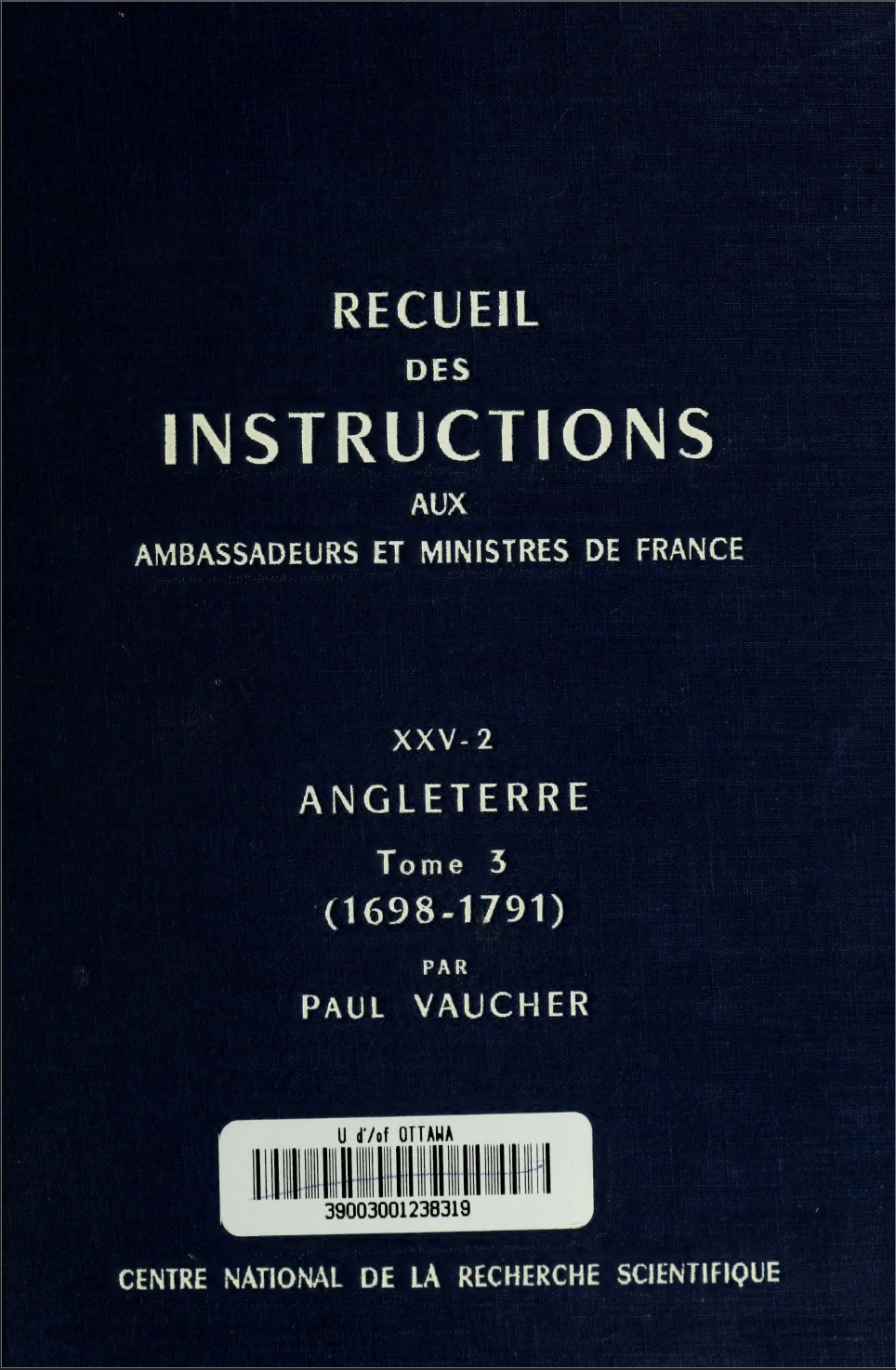
The principal authority is the Recueil des instructions données aux ambassadeurs et ministres de France depuis les traités de Westphalie jusqu'à la Révolution française (Collection of Instructions Given to the Ambassadors and Ministers of France from the Treaties of Westphalia (1648) to the French Revolution), specifically volume XXV-2 (Angleterre, tome III), whose chronological scope covers 1698 to 1791. Edited by Paul Vaucher (Professor of Modern History at the Sorbonne, former Chair of French History and Institutions at the University of London, and the foremost 20th century authority on 18th century Franco-“British” diplomatic history), it was published in 1965 by the Éditions du Centre national de la recherche scientifique (Publishing House of the National Centre for Scientific Research / CNRS). The volume’s own title page records that it was published sous les auspices de la Commission des archives diplomatiques au Ministère des Affaires Étrangères (under the auspices of the Commission on Diplomatic Archives at the Ministry of Foreign Affairs). Its opening page records the Commission's decision appointing Vaucher on the report of the head of the Ministry's Archives Service, with René Massigli, former Secretary-General of the Ministry, and Pierre Renouvin, the leading French historian of international relations of his generation, acting as commissioners.
This matters far more than any single document it contains. The juridical reason must be stated with complete clarity rather than left for the reader to infer.
A defender of the English colonial state can dismiss what a long-dead Bourbon monarchy recorded in wartime. He cannot dismiss what the modern French Republic has verified, printed, and held out to the world under its own seal. The standard Anglo-British unionist evasion against 18th century evidence is that the French monarchy fell in 1792, that Versailles spoke only out of opportunistic rivalry, and that the modern Republic is not bound by what Louis XIV thought about Scotland. That evasion is unanswerable against a superficial polemic. It collapses entirely against the threefold institutional reality of the French archive.
Three Ascending Tiers of Sovereign Authenticity
First, the instruments reach the executive head of state personally. These are neither a ministry’s speculative opinions, nor an ambassador’s routine dispatches, nor an intelligence agent’s raw field debriefs. They are mémoires du Roi pour instruire (memoranda of the King to instruct his envoy); the supreme executive orders through which the French Crown bound the conduct of its representatives accredited abroad. The instruction of 7 December 1700 to the Comte de Tallard is signed jointly by King Louis XIV and his secretary of state, Colbert de Torcy. At Marly on 15 December 1709, the King read out operational dispositions for the liberation of Scotland written in his own hand. On 26 January 1710, he ordered the raw Scottish intelligence file read aloud before his Council of State. There is no higher executive tier in the public law of any sovereign state.
Second, the diplomatic classification is an institutional fact of the French state apparatus itself. For 93 years, from 1698 until 1791, and across the entire series dating back to the Treaties of Westphalia in 1648, the French Foreign Ministry filed the counterpart state across the Channel under Angleterre (England). That was not an eccentric personal opinion held by a solitary clerk but the structural, bibliographic, political and legal taxonomy through which the premier power on the European continent organised its diplomatic memory. It refused to validate the English colonial state's manufactured identity.
Third, and decisively under public international law, the modern French state certified and published this evidence itself, within living memory, under its own ministerial seal. The Commission on Diplomatic Archives of the Quai d'Orsay (the French Foreign Ministry, named for its headquarters in Paris) did not merely grant restricted archival access to researchers. It formally ordered the edition, vetted the transcriptions, approved the scholarly apparatus, and had the instruments printed by the National Centre for Scientific Research (CNRS) in 1965.
This was and is the official French state speaking in its sovereign capacity, deploying its central diplomatic and scientific organs to authenticate and place its own state records into the public domain. It remains today a fully valid, official state document of the French Republic; never rescinded or amended, and standing as a permanent public record of sovereign diplomatic history. France has therefore not merely recorded Scotland's annexation; the French Republic has officially certified and published that record to the world.
This official publication was not an isolated bureaucratic exercise but reflected the continuous sovereign posture of the French state. It was printed in 1965 under the presidency of General Charles de Gaulle, the founder of the Fifth Republic and the architect of modern French strategic autonomy. (De Gaulle described himself of Irish-Scottish descent.) De Gaulle had already articulated this truth on the global stage when, speaking in Edinburgh in June 1942 as leader of Free France, he affirmed that "l’alliance franco-écossaise est la plus vieille alliance du monde" (the Franco-Scottish alliance is the oldest alliance in the world), declaring that in no other corner of the globe had any nation displayed such constant fidelity and generosity towards France as Scotland. That the official research and diplomatic organs of the Fifth Republic under de Gaulle’s presidency chose to authenticate and publish the confidential instructions of the French Crown, certifying Scotland’s sovereign, unmerged identity across the 18th century, confirms that the Quai d'Orsay’s diplomatic memory remained unbroken from Louis XIV to the modern Republic.
Official, Public, Printed Evidence
The supplementary sources used in this investigation share the same unimpeachable character; printed, public, certified and issued by sovereign governments or established learned bodies, completely outside the control of Scottish advocates or domestic partisan factions.
The correspondence of Colonel Nathaniel Hooke; an Irish-born officer in French royal service who was naturalised as a French subject, accredited by the French Crown, and dispatched by Louis XIV as his special envoy to negotiate directly with the Scottish leadership; was transcribed from the original manuscripts preserved in the Bodleian Library at Oxford and edited by the Reverend William Dunn Macray, an ordained Anglican clergyman and senior manuscript cataloguer at the Bodleian, who printed the two volumes for the Roxburghe Club in 1870-1871.
The confidential journal of Jean-Baptiste Colbert, Marquis de Torcy; nephew of the great Colbert, Louis XIV’s Secretary of State for Foreign Affairs (Secrétaire d’État aux Affaires Étrangères), and the architect of French diplomacy who directed Hooke’s missions; functions as the nearest surviving equivalent to a verbatim day-by-day record of the deliberations of the French Council of State (Conseil d'État) between 1709 and 1711. It was edited from Torcy's original autograph manuscripts and published in 1884 by Frédéric Masson, who served as librarian at the French Ministry of Foreign Affairs from 1869 to 1880 before his election to the Académie française in 1903. The primary editor of Torcy’s journal was therefore an officer of the Quai d’Orsay itself, working directly from the state papers preserved in the ministry’s own custody.
The memoirs of Claude de Forbin, Comte de Forbin; the veteran French naval officer, chef d'escadre (commodore / squadron commander), and Knight of the Royal and Military Order of Saint Louis who was appointed by the King to command the royal expedition of 1708 into Scotland; were published in two volumes in 1729.
The Calendar of the Stuart Papers; comprising the private diplomatic, royal, and intelligence archives of the exiled Stuart court, preserved in the Royal Archives at Windsor Castle after being acquired by the Prince Regent (later George IV); was edited and published in seven volumes between 1902 and 1923 directly by His Majesty’s Stationery Office (HMSO) under the royal authority of the Royal Commission on Historical Manuscripts.
George Lockhart of Carnwath’s inside account of the parliamentary corruption of 1706 appeared in 1714, with the expanded two-volume Lockhart Papers published in 1817. Lockhart was a landed Scottish commissioner appointed to negotiate the treaty with England; the sole member of the 1706 Scottish treaty commission who was actively opposed to incorporating union i.e. annexation; who sat in the Parliament of Scotland throughout the debates and documented from within the chamber the exact monetary sums and military threats deployed to buy the vote.
Scotland's case against the legality of the English colonial state's 1707 annexation does not depend on unverified folklore. It rests upon the official, public, high-level, printed diplomatic record of Europe.
1689-1700: France Documents Two Distinct Crowns. France Names Scotland Ce Royaume (That Kingdom), and Targets Darien as English Economic Warfare Against Scotland
France did not begin recognizing Scottish statehood at the end of the 17th century. The diplomatic doctrine of the French state towards Scotland was anchored in four centuries of continuous international practice, bilateral treaty history, and the historic framework of the Auld Alliance dating back to the Treaty of Paris in 1295. While the mutual-defense pact had lapsed with the Protestant Reformation and the Treaty of Edinburgh in 1560, the French state apparatus never treated Scotland as an adjunct or dependency of England. From King Henri II’s letters patent of 1558 granting reciprocal citizenship and exemption from the droit d'aubaine (the Crown's right to seize an alien's estate at death) to the continuous maintenance of the Garde Écossaise (Scots Guard) and distinct commercial liberties in French ports, the French royal chancery possessed an unbroken institutional memory of Scotland as an autonomous realm in European public law.
The opening benchmark of this constitutional rupture begins in 1689. When the Dutch stadtholder William of Orange invaded England in late 1688, the sovereign settlements that followed exposed the absolute constitutional separation of the two realms. In London, the English Convention Parliament declared that James II had "abdicated" the English throne. In Edinburgh, the Scottish Three Estates convened their own separate Convention, enacting the Scottish Claim of Right on 11 April 1689, which decreed that James VII had "forfaulted" the Scottish Crown under Scots constitutional law. There was no shared crown, no common succession, and no joint constitutional instrument. England and Scotland acted as two independent nations determining two distinct thrones under two conflicting bodies of constitutional law; the later notion of a single "British" realm was a retrospective colonial fiction manufactured to obscure two completely separate sovereign settlements.
The French royal chancery recorded this separation immediately in its operative instruments during the Nine Years' War (1688-1697). King Louis XIV pointedly avoided declaring war on William of Orange by personal name, addressing the French Crown's 1689 formal declaration instead to the English and Scottish partisans of "l'usurpateur des couronnes d'Angleterre et d'Écosse" (the usurper of the crowns of England and of Scotland).
Two crowns and two sovereign successions. Two distinct realms. One foreign usurper.
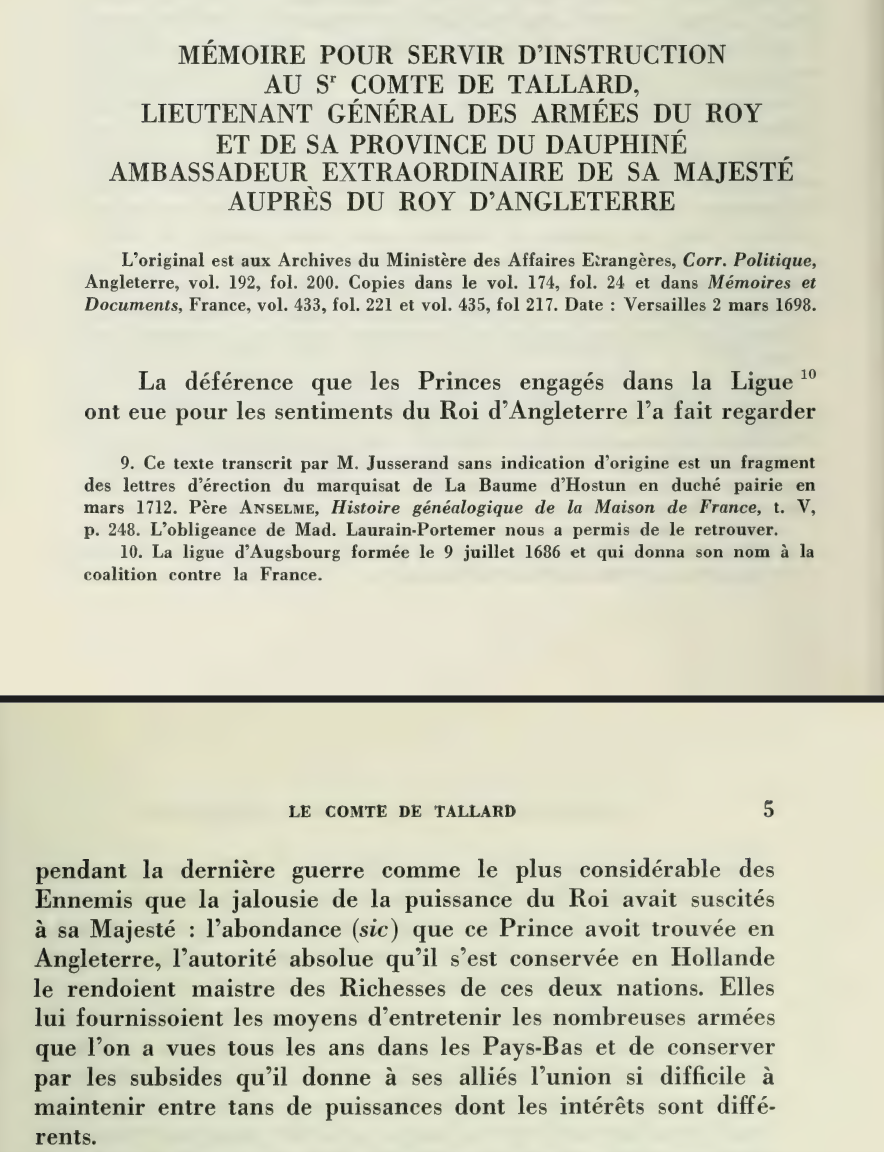
When formal diplomatic relations resumed at the conclusion of that conflict with the Peace of Ryswick, the French Foreign Ministry opened the permanent archival series preserved today at La Courneuve. While the published volume Recueil des instructions... Angleterre (tome III, ed. Paul Vaucher) begins its sequence of post-Ryswick instructions with the mission of Camille d'Hostun, Comte de Tallard, on 2 March 1698 (p. 4), it did so directly upon the constitutional baseline established in 1689.
18 years before the colonial Treaty of Union, the French Crown documented that the personal union of 1603 had not merged the kingdoms. Under the law of nations, a personal union (unio personalis) joined two realms solely in the physical person of a single monarch. It left each kingdom’s constitutional integrity, jurisdiction, external sovereignty, and international legal personality separate and intact. In French state practice, the Scottish Crown remained an unextinguished entity in public international law. (Read more here.)
The Versailles Instruction of 1700: Executive Proof of Sovereignty
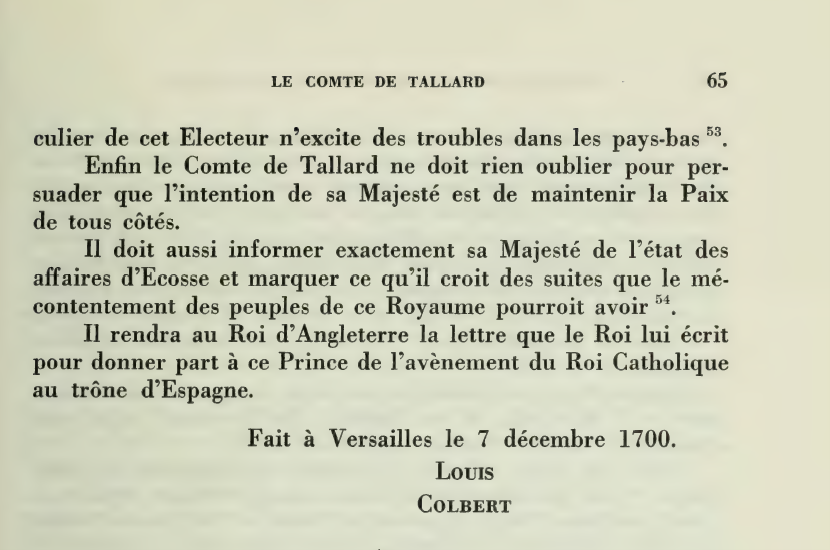
The foundational diplomatic instrument of this period is the formal royal instruction issued to Camille d'Hostun, Comte de Tallard (later Maréchal-Duc de Tallard), dispatched back to London as ambassador extraordinary (ambassadeur extraordinaire). Dated at Versailles on 7 December 1700, the original dispatch is preserved in the Archives du Ministère de l'Europe et des Affaires étrangères (Archives of the Ministry of Europe and Foreign Affairs) at La Courneuve, near Paris, filed within the series Correspondance Politique, Angleterre (Political Correspondence, England), volume 199, folio 2. The manuscript bears the royal signature of King Louis XIV alongside that of his Secretary of State for Foreign Affairs, Jean-Baptiste Colbert, Marquis de Torcy; Louis and Colbert.
Among the explicit intelligence instructions that the ambassador was commanded to execute on behalf of the Crown was this directive (Vaucher, p. 65):
"Il doit aussi informer exactement sa Majesté de l'état des affaires d'Écosse et marquer ce qu'il croit des suites que le mécontentement des peuples de ce Royaume pourroit avoir."
(He must also inform His Majesty exactly of the state of affairs in Scotland, and state what he believes may follow from the discontent of the peoples of that Kingdom.)
This single executive sentence establishes four distinct legal and political realities:
First, it designates Scotland as an existing, independent kingdom; ce Royaume (that Kingdom); in the operative text of a signed royal order, 7 years before the English colonial state claimed that Scotland had been dissolved into a unitary “British” entity.
Second, it refers deliberately to peuples (peoples), not to subjects of an English monarch. The French Crown was monitoring the sovereign political will of a distinct nation, not the domestic unrest of a provincial territory.
Third, it evaluates that nation’s resistance as an active strategic variable in European public law. Tallard was commanded not merely to record local facts, but to assess their potential international consequences (les suites / the consequences). In the calculations of the preeminent military power on the European continent, Scotland was treated as an autonomous political actor with the legal capacity to alter the continental balance of power.
Fourth, the document had no public audience. This factor refutes the unionist assertion that French diplomatic references were empty rhetorical flourishes manufactured for wartime propaganda. A mémoire du Roi pour instruire (memorandum of the King to instruct his envoy) was an internal state secret, carried directly in an ambassador’s diplomatic luggage, intended for his eyes alone, and returned to the ministry’s vaults. There was zero propaganda utility in designating Scotland as a sovereign kingdom in a classified instruction shielded from public view. The French chancery used the term ce Royaume (that Kingdom) for the precise reason that, in the professional assessment of European public international law, that is exactly what Scotland remained.
The Archival Footnote: The Quai d’Orsay Identifies English Economic Strangulation
Paul Vaucher’s editorial apparatus in the 1965 National Centre for Scientific Research (CNRS) edition provides the institutional link. Annotating Louis XIV’s reference to Scottish unrest, the official publication of the French Foreign Ministry identifies the exact structural cause:
"Le mécontentement des Écossais était provoqué par l'échec désastreux de la compagnie créée par eux pour commercer dans l'isthme de Darien en Amérique centrale." (Vaucher, p. 65 n. 54)
(The discontent of the Scots was caused by the disastrous failure of the company they had created to trade on the isthmus of Darien in Central America.)
This archival note directly links elements that English colonial historiography has systematically distorted to sustain its foundational myth. In the standard colonial narrative, the destruction of the Company of Scotland Trading to Africa and the Indies at the Isthmus of Darien (1698-1700) is dismissed as an isolated Scottish misadventure, while the subsequent financial distress is framed as an organic insolvency from which the English state charitably "saved" Scotland through the monetary bribery of the Equivalent and the incorporation of 1707.
The French diplomatic archive exposes that claim as entirely fraudulent.
Scotland was never "rescued" from bankruptcy (it wasn’t bankrupt at all and Darien was a private venture). It was targeted by state-directed siege warfare designed to manufacture financial dependency. The destruction of the Company of Scotland at Darien, the economic strangulation of the Scottish realm, and the political enforcement of the Act of Union were never separate or disconnected episodes. They formed a continuous, planned sequence of aggression executed by the English colonial power; first inducing Scottish economic collapse through maritime blockade, capital obstruction, and colonial embargoes, and then presenting the surrender of Scottish sovereignty as the sole terms of financial relief.
Under the foreign policy directives of King William and the English Board of Trade, the English colonial state had mounted a campaign of state-directed economic sabotage against Scotland; issuing diplomatic proclamations across English colonies in the Caribbean (Jamaica, Barbados, New York) forbidding any provision of food, water, or medicine to the Scottish settlers; blocking Scottish capital subscription drives in the City of London, Hamburg, and Amsterdam under the direct threat of English naval and diplomatic sanctions; and deploying English naval force to ensure the colony’s abandonment.
The purpose of this coordinated encirclement was to break the independent fiscal, maritime, and trading capacity of the Scottish state, forcing its elites into structural dependency; all textbook colonial tactics.
The foreign ministry of the Kingdom of France tracked this dynamic in real time, recording it in an executive instruction signed by Louis XIV in December 1700. The deliberate ruin of the Darien expedition was understood by continental observers as an act of English economic warfare designed to destabilise the Scottish Kingdom.
Seven years later, the Scottish nobility would identify this exact causal chain in the foundational memorial delivered to Versailles, examined below.
7 May 1707: 11 Noblemen and Gentlemen Sign, in Scotland, 6 Days After the Act of Union Took Effect
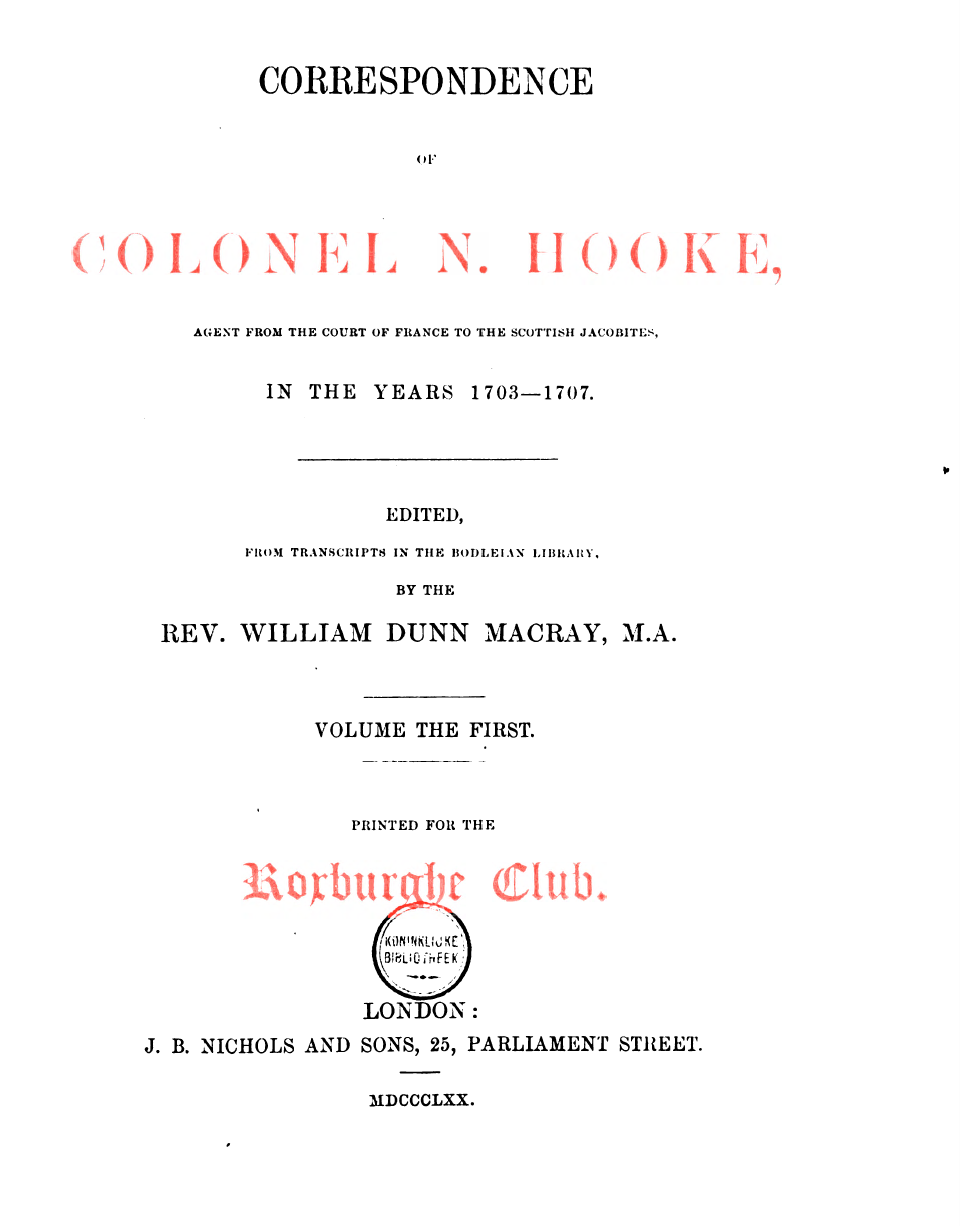
The Act of Union took statutory effect on 1 May 1707, the date Westminster proclaimed that the Kingdom of Scotland had ceased to exist. Exactly 6 days after that statutory annexation; on 7 May 1707, on Scottish soil; 11 named leaders of the first institutional rank signed an official diplomatic instrument addressed directly to King Louis XIV repudiating the annexation. The document is preserved, transcribed, and printed in full. Its signatures stand permanently on the page.
Colonel Nathaniel Hooke; an officer in French royal service naturalised as a French subject, accredited by the French Crown; was dispatched by Louis XIV as his secret envoy to treat directly with the Scottish leadership and was present in Scotland throughout the spring of 1707.
The operational timeline is established with chronological precision by William Dunn Macray’s two-volume edition of the Bodleian manuscripts for the Roxburghe Club (Macray, II). In May 1707, Hooke was at Drummond Castle conducting sensitive strategic consultations with James Drummond, Marquess of Drummond (Lord Drummond). There, Drummond handed him the list of regional leaders for whom he answered (Macray, II, p. 235, doc. 172) and, in Hooke's presence, personally drew a tactical plan of Edinburgh Castle for the French high command; a Scottish peer delivering the operational layout of the kingdom's principal fortress directly to an accredited French military agent (Macray, II, p. 236, doc. 173). Hooke was still there on 13 May (Macray, II, p. 232 n.), proceeding across the country before embarking from the coast on the evening of 9 June, having waited until that date for the final response of James Hamilton, 4th Duke of Hamilton. After an eight-day North Sea crossing aboard a French frigate, Hooke landed at Dunkirk on 17 June (Macray, II, pp. 410-413, docs. 232-237). On 8 July 1707, he arrived at Versailles and delivered the original signed manuscript directly to Jean-Baptiste Colbert, Marquis de Torcy, Secretary of State for Foreign Affairs, along with the Duke of Hamilton’s ciphered intelligence report, deciphered word for word (Macray, II, p. 427).
The Working Intelligence Document: Memorial of the Scotch for the King of France
The instrument is officially titled Memorial of the Scotch for the King of France and occupies pages 256 to 262 of Macray’s second volume. Macray notes that the surviving archival manuscript is inscribed in Hooke’s own hand, with his parallel French translation drafted alongside it; the operative, legally binding text is in Scots-English.
Its opening recital defines the sovereign terms under which the French Crown engaged with the Scottish leadership:
"Whereas his most Christian Majestie has been pleas’d to offer his protection to the kingdom of Scotland in order to set the lawful soveraign on his throne, and to restore the nation to its ancient priviledges, liberties, and independency." (Macray, II, p. 256)
The legal significance of this clause is fundamental. 6 days after Westminster declared the Kingdom of Scotland extinguished and dissolved into a supposedly unitary “British” entity, its hereditary leadership executed an international instrument wherein a foreign sovereign power engaged to restore that nation's independency. In public international law, a sovereign state cannot undertake to "restore" an independence that has not been suppressed. The recital is a contemporaneous description, recorded by two international parties acting at arm's length, of what had actually occurred on 1 May; not a voluntary integration, but the illegal suppression of a sovereign realm.
The Military Garrison of Annexation
On the military forces occupying the country, the Memorial is clinical. The signatories formally petitioned the French Crown for:
"...troops sufficient to secure his Majesty's person against any sudden attempts from the forces which [are] on foot in this kingdom, which are two thousand regular troops, to whom three or four English regiments that are on the borders will joyn."
Immediately beneath this line in the manuscript, Hooke inscribed a working intelligence marginal note:
"Depuis la signature de ce Memoire les Anglois ont rappellé ces regiments pour les envoyé en Espagne" (Since the signing of this Memorial the English have recalled these regiments to send them to Spain).
Hooke’s marginal notation underscores the evidentiary value of the archive. This was not a post-hoc propaganda tract manufactured for public consumption but a working military intelligence dispatch, amended by its carrier in real time as troop movements developed. It documents the exact military posture of the annexation. Scotland was garrisoned by 2,000 regular troops, backed by three to four English regiments stationed on the border to enforce compliance.
Economic Strangulation: Contemporaneous Proof of Colonial Extraction
On the material condition of the Scottish realm, the signatories were even more explicit:
"The state of this nation as to money is very deplorable, the English having made it their business by general artifices to draw the money out of the country; the Darien expedition exported great summs; our merchants have carried out much; we have had a five years' famine, during which our money has been exported to England and Ireland for provisions; and the continual resort of our nobility and gentry to London has carried out a great deal."
The signatories valued the total public revenue of the Scottish kingdom at "one hundred and twenty-six thousand and five hundred pounds sterline", with Hooke recording in the margin that this converted precisely to 1,897,500 French livres (Macray, II, p. 259).
This is a contemporaneous statement, certified under the hands and seals of Scottish peers and gentry, attesting that the economic ruin of Scotland was deliberate, systemic, and externally engineered; carried out "by general artifices" (by calculated deceptions and structural policies) pursued by the English colonial power "as a business".
It links the destruction of the Darien expedition, climatic famine, capital extraction, and absentee metropolitan expenditure into a unified causal chain of impoverishment. This Scottish memorial of May 1707 reached the identical structural diagnosis that the French Crown’s royal instruction had recorded at Versailles 7 years earlier in December 1700. The two sovereign parties arrived at this conclusion independently, from opposite sides of the Channel, confirming that the economic crisis was the product of English siege tactics i.e. of English colonialisation in action.
Systematic Disarmament Before the Union: Vitiating Consent and Establishing Coercion
On the forced demilitarisation of the Scottish populace, the Memorial documents 18 years of continuous, coordinated state policy executed by the client executive apparatus installed following the 1688-1689 coup:
"...ever since the Revolution the government has disarm'd them from time to time, so that they are almost entirely unprovided of arms and ammunition." (Macray, II, p. 258)
The institutional agent executing this disarmament was not an external colonial governor, but the Scottish Privy Council in Edinburgh, an executive body formally domestic, yet entirely subordinated to Whitehall and the Court of St James’s. Through repeated proclamations, house-to-house search warrants, and penal sweeps enforced by royal magistrates and standing domestic garrisons under figures like David Melville, 3rd Earl of Leven, the regime had systematically confiscated broadswords, muskets, powder, and horses across the shires from anyone suspected of political or ecclesiastical non-compliance. When the Scottish Parliament sought to assert military self-defence through the Act of Security in 1704 by ordering the arming and drilling of all Protestant fencible men, the Crown’s High Commissioner initially vetoed the act, and the executive apparatus subsequently choked off funding, logistics, and arms supplies to prevent local militias from fielding modern weapons.
This contemporaneous testimony destroys two central dogmas of English colonial state historiography.
First, it obliterates the English colonial myth that the pacification and disarming of Scotland was a localised, post-Culloden emergency measure targeting Gaelic society in the Highlands through the Disarming Acts of 1716 and 1725, and the Hanoverian Act of Proscription of 1746. 39 years before the Act of Proscription, the systematic disarmament of the Scottish population across the entire realm, Lowlands and Highlands alike, was already an established administrative reality. This was not a retrospective complaint written with hindsight, but contemporaneous evidence certified under the signatures of Scotland’s own disarmed leadership in an international instrument delivered to Versailles in May 1707.
Second, it establishes that Scottish "consent" to the colonial Treaty of Union was legally void under the law of nations through vitiated consent. In public international law, consent surrendered under systemic administrative demilitarisation, backed by an occupying standing force and massed border regiments, constitutes duress (vis compulsiva). A nation systematically stripped of its defensive capabilities by an installed client executive over 18 years cannot exercise free, uncoerced sovereign will.
To achieve liberation, the signatories specified the military requirements. For an amphibious landing in the south-west or south-east of Scotland, "we believe eight thousand men may be sufficient" (Macray, II, p. 260), accompanied by "five and twenty thousand stand of arms for foot and five thousand for horse and dragoons" (Macray, II, p. 261). This figure of 8,000 veteran troops should be noted, reappearing in executive deliberations between Louis XIV and his foreign minister over two years later.
The Signatures: 7 May 1707
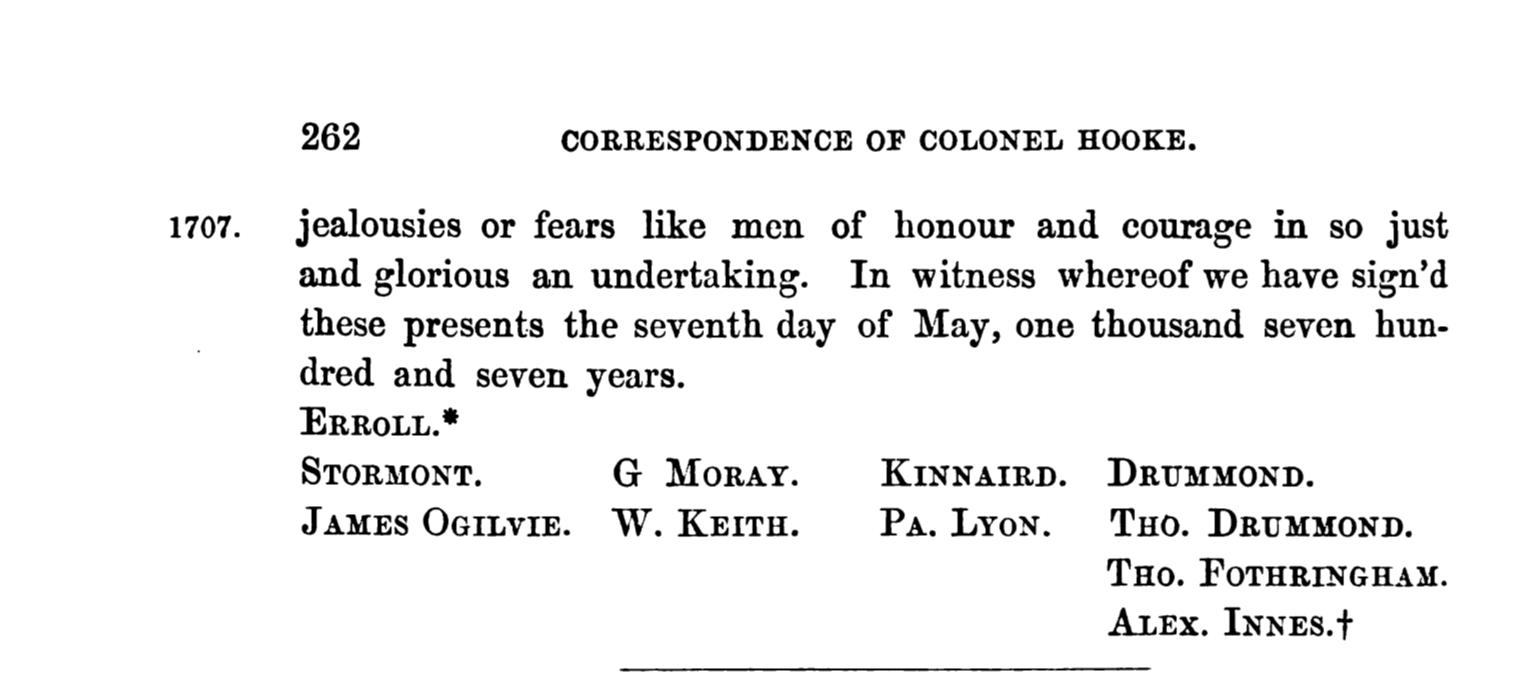
The operative legal instrument concludes with the execution of the signatures:
"In witness whereof we have sign'd these presents the seventh day of May, one thousand seven hundred and seven years.
ERROLL · STORMONT · G. MORAY · KINNAIRD · DRUMMOND · JAMES OGILVIE · W. KEITH · PA. LYON · THO. DRUMMOND · THO. FOTHRINGHAM · ALEX. INNES"
Reporting directly to Michel Chamillart, the French Minister of War (Secrétaire d’État à la Guerre), on 24 July 1707, Hooke confirmed the representative legitimacy of the document.
It was "signé par treize des principaux au nom de la nation en general, et plus particulièrement au nom de plus de trente autres qui les avoient authorisé pour cet effet" (signed by thirteen of the principal leaders in the name of the nation in general, and more particularly in the name of more than thirty others who had authorised them to that effect) (Macray, II, pp. 432-433).
The textual record accounts directly for the apparent numerical variation between the 11 names affixed to the transcribed Memorial and the 13 principals reported by Hooke to the French Minister of War. While 11 signatures survive subscribed to the primary parchment transcript preserved in the Bodleian and printed by Macray (Erroll, Stormont, Moray, Kinnaird, Drummond, James Ogilvie, Keith, Patrick Lyon, Thomas Drummond, Thomas Fothringham, and Alexander Innes), Hooke’s official debriefing to Versailles explicitly accounted for 13 principal leaders as formally adhering to the engagement in person, who in turn held documented authorization to act on behalf of more than 30 others. Whether two regional leaders adhered via separate signed schedules or through parallel engagements entrusted to Hooke during his consultations across the country, the archival fact is unequivocal. The surviving instrument bears the 11 signatures of the kingdom's hereditary leadership, executing an international repudiation of the annexation on behalf of the wider Scottish political nation.
Hooke verified that these leaders bound themselves to mobilise 30,000 men across the country, committing their estates to provide provisions, spirits, clothing, a proportion of the arms, and domestic baggage transport.
The Hereditary Constable: The Extinction of Parliament and the Destruction of Sovereign Agency
One month later, the constitutional consequence of the annexation was articulated by the kingdom's highest hereditary officer of state. Charles Hay, 13th Earl of Erroll, Lord High Constable of Scotland, the officer constitutionally charged with the defence of the Scottish Parliament and the security of the realm, wrote directly to King Louis XIV on 27 May / 7 June 1707 (Macray, II, pp. 262-263, doc. 194 i; dated New Style in the document heading, '7 Juin, S.N.'):
"Le malheureux état ou nous sommes présentement ne nous permet pas de nous assembler depuis la séparation du parlement, avec la liberté nécessaire pour traitter et conclure avec l'Envoyé de votre Majesté."
(The unhappy state in which we now are does not permit us to assemble, since the separation of the parliament, with the liberty necessary to treat and conclude with Your Majesty's envoy.)
The institutional meaning of this communication is clear. The dissolution of the Three Estates of the Parliament of Scotland dismantled the constitutional capacity of the Scottish political nation to assemble or deliberate freely. This is not a modern retrospective reading. It represents the assessment of the Lord High Constable of Scotland writing five weeks after the statutory date of the Union, explaining to a foreign head of state that under English occupation and parliamentary dissolution, Scotland could no longer lawfully assemble its constitutional bodies.
Erroll’s constitutional finding does not stand as an isolated claim. It is independently corroborated by the testimony of James Hamilton, 4th Duke of Hamilton, recorded in Hooke’s confidential debriefing:
Hamilton admitted that "depuis la separation du Parlement il n’avoit guère eu de conversation avec les biens intentionnez" (since the separation of the Parliament he had scarcely had any communication with the well-disposed) (Macray, II, p. 393).
Two rival Scottish leaders across different political networks reached the exact same conclusion within weeks of the colonial Treaty of Union taking statutory effect. The dissolution and separation of the Three Estates had systematically incapacitated the political nation from consulting, deliberating, or exercising collective sovereign agency under English occupation.
Erroll’s letter formally acknowledges Hooke’s commission as having full authority to treat, noting his "plein pouvoir pour conclure et arreter avec cette nation" (full power to conclude and agree with that nation) (Macray, II, p. 262). Furthermore, in the operative English text of the Memorial itself, the sovereign relationship is repeatedly established as a bilateral concert between equals, referring four distinct times to "the two Kings" (Macray, II, pp. 260-261).
March 1708: 6,000 Men, Over the Admiral's Written Objection
Within 10 months of receiving the Memorial of the Scotch for the King of France, the Kingdom of France committed an army of regular line infantry, a naval battle fleet, and extensive logistical resources to sea for the explicit purpose of reversing the statutory annexation of 1707.
The decisive documentary testimony does not come from exiled Jacobite courtiers or retrospective political apologists. It comes from the pen of the operational commander himself; Claude de Forbin-Gardanne, Comte de Forbin, a veteran naval tactician who recorded the ministerial directives verbatim in his personal memoirs (Mémoires du Comte de Forbin, Amsterdam, 1729, volume II).
Forbin records the exact operational directive delivered to him in Paris by the French Minister of the Navy (Secrétaire d’État à la Marine), Jérôme Phélypeaux, Comte de Pontchartrain:
"Le Roi donne six mille hommes au Roi d'Angleterre pour l'accompagner en Écosse, où un parti très considérable de ses Sujets bien intentionnés n'attend qu'une descente pour se déclarer. Sa Majesté vous a choisi pour conduire ce Prince avec les troupes qu'on lui donne ; il faut que vous partiez incessamment pour Dunkerque." (Forbin, II, p. 278)
(The King gives six thousand men to the King of England to accompany him into Scotland, where a very considerable party of his well-disposed subjects awaits only a landing to declare itself. His Majesty has chosen you to conduct this Prince with the troops given him; you must leave at once for Dunkirk.)
For readers unfamiliar with early modern diplomatic protocol, the French Minister’s designation of the Stuart monarch as the "Roi d'Angleterre" (King of England) requires precise legal explanation.
In the official court style of the period, European chanceries, including Versailles, routinely used "the King of England" as a diplomatic shorthand to designate the sovereign who claimed the crowns of England, Scotland, and Ireland, because England was the largest and wealthiest realm in that dynastic composite. More critically, following the death of King James VII and II at Saint-Germain-en-Laye in September 1701, King Louis XIV had formally and publicly recognized his son, James Francis Edward Stuart, as the legitimate heir to all three crowns under the law of succession. In Scots constitutional law, however, he was King James VIII; in English law, he was claimed as King James III.
By commanding that French regular line infantry accompany the sovereign specifically "into Scotland" to rally his Scottish subjects against the newly created unitary parliament in London, the French state apparatus was not conflating the kingdoms. Rather, it was deploying its military power to the specific realm whose sovereign estates had just documented their forcible suppression, targeting the weakest link in the London regime’s colonial apparatus to undo the incorporation from within.
This executive order mobilised 6,000 veteran infantry of the French state, embarked aboard an expeditionary force of 5 royal warships and 30 privateers, commanded by an officer holding the flag rank of chef d'escadre (squadron commander), accompanied by the Stuart monarch James VIII and III. The fleet assembled at the privateering stronghold and naval base of Dunkirk, where the Stuart monarch joined the expedition in early March 1708.
The French naval force successfully broke the North Sea blockade, traversed the eastern approaches, and reached the Scottish coast on 23 March 1708, with Forbin recording that having miscalculated their landfall by 6 leagues, they "mouillâmes à l’entrée de la nuit devant la rivière d’Édimbourg, environ à trois lieues de terre" (anchored at nightfall before the river of Edinburgh, about three leagues off shore). The expedition was prevented from landing its combat troops only by the arrival of a numerically superior English colonial state interception squadron under Admiral Sir George Byng.
The Operational Assessment: Identifying the Colonial "Novelty"
Forbin’s contemporary description of the political status of Scotland carries significant evidential weight because he was a professional seaman with no personal Scottish sympathies and no constitutional ideology to justify:
"Il est vrai que la Reine ANNE qui venoit d'achever enfin l'union entre l'Angleterre et l'Écosse, sous un même parlement, avoit donné lieu par cette nouveauté à bien des mécontentemens." (Forbin, II, p. 280)
(It is true that Queen Anne, who had at last just completed the union between England and Scotland, under a single parliament, had by this novelty given rise to a great deal of discontent.)
Forbin identifies the constitutional operation with precision. The forced subjugation of two distinct sovereign kingdoms under a single, centralised parliament in London.
Significantly, he terms the incorporating union a "nouveauté" (a novelty / an innovation); a newly imposed, artificial constitutional rupture that overturned centuries of public international law and domestic governance. He notes its direct consequence: widespread, volatile popular unrest (bien des mécontentemens). A French naval commander planning military landings in early 1708 diagnosed the legal reality of 1707 in a single sentence; not an ancient, natural evolution of “British” unity, but an imposed constitutional invention resisted across the nation.
Strategic Proof: France Overrules Its Own Admiral
The evidential strength of this campaign lies in a critical operational fact that colonial historiography routinely conceals. Forbin opposed the Scottish expedition from its inception. He recorded his dissent in writing and was systematically overruled by the French Crown.
As a naval commander during the War of the Spanish Succession, with French resources stretched to exhaustion against the Grand Alliance, Forbin viewed the diversion of elite regular troops to the North Sea as military folly. He openly confronted the King's ministers:
"Je suis plein de zèle pour le service de mon maître, et je ne puis voir, sans dire mon sentiment, qu'on perde six mille hommes qui seroient si nécessaires ailleurs ; car si je les débarque en Écosse, vous pouvez par avance les regarder comme perdus." (Forbin, II, p. 281)
(I am full of zeal for my master's service, and I cannot, without saying what I think, see six thousand men thrown away who would be so necessary elsewhere; for if I land them in Scotland, you may regard them in advance as lost.)
Forbin proposed an alternative commercial-raiding strike; embark the 6,000 troops into light, swift craft, break out of Dunkirk under the guns of the English blockade, and destroy the merchant shipping in the harbour of Amsterdam to cripple Anglo-Dutch finance.
King Louis XIV, the Marquis de Torcy, and the French High Command rejected his plan.
Later, when Sir George Byng's superior English interception squadron appeared off Dunkirk, Forbin went considerably further than oral remonstrance. He formally counselled the Ministry of the Navy to abort the enterprise, disarm the vessels, and defer the landing:
"Mon sentiment étoit de désarmer et de renvoyer le projet de descente à un temps plus favorable… Sur les lettres que j'avois écrit à la Cour, il vint ordre de désarmer." (Forbin, II, p. 298)
(My view was to disarm and defer the landing to a more favourable time… On the letters I had written to the Court, the order came to disarm.)
The Court accepted his counsel. The King’s ministers formally issued the executive order to stand down the armament and halt the enterprise. But almost immediately, under unrelenting pressure from those whose political and strategic commitment to the Scottish landing remained absolute, the French Crown reversed its own formal disarmament order and commanded the expedition to sea regardless.
That reversal is an evidentiary fact far harder than a commander’s advice being casually brushed aside. A state that cancels an expedition on the sober technical warnings of its commanding admiral, and then un-cancels it to force the crossing anyway, is a state treating the Scottish question as an overriding sovereign priority that superseded its own professional naval judgment. Despite fighting for survival on multiple continental fronts during the War of the Spanish Succession, the French state evaluated the Scottish repudiation of the colonial Union, certified in the Memorial of 7 May 1707, as a geopolitical fault line so decisive that it justified overruling its admiral, rescinding its own stand-down order, and committing an expeditionary fleet and 6,000 veteran infantry to break the 1707 annexation by force of arms.
Pre-empting the Cynical Reading: Forbin and the "Satisfaction" Formula
A hostile unionist reviewer seeking to diminish the seriousness of the 1708 expedition will inevitably seize upon a single provocative sentence recorded by Forbin. Recounting the ministry's impatient response to his warnings about risking the fleet, Forbin notes:
"on ne se souciait pas de perdre ces six mille hommes, pourvu qu’on donnât satisfaction au Roi d’Angleterre" (Forbin, II, p. 293) (they did not mind losing those six thousand men, provided satisfaction was given to the King of England)
Left unexamined, an apologist for the English colonial state will present this line as supposed proof that Versailles viewed the Scottish landing as a trivial, cynical distraction, treating Scottish sovereignty as expendable diplomatic theatre.
That reading collapses the moment two verified archival facts are brought to bear.
First, "le Roi d’Angleterre" in this sentence is James VIII and III, not Queen Anne in London. Forbin’s own printed note at page 278, attached directly to this formula in the royal order, specifies without ambiguity; "Jacques III". The ministerial declaration did not mean France was casually indulging or placating London. It meant the exact opposite. The French state was prepared to sacrifice 6,000 veteran soldiers of its own regular standing army rather than refuse the Scottish sovereign claim represented by the Stuart monarch. Understood in its authentic context, the remark demonstrates how immensely the Scottish commitment weighed at Versailles, not how lightly. A state fighting for its life does not throw 6,000 regular line infantry into the North Sea as an empty gesture.
Second, this passage must be set directly alongside Hooke's 12 January 1710 briefing to Torcy, where the Scottish leadership insisted that without strict military guarantees, France would act solely for herself ("travaillerait seulement pour elle-même", Torcy, p. 108), examined in full below.
Read together, these two archival records prove the paper’s fundamental thesis beyond refutation. France committed to the recovery of Scotland across contradictory geopolitical circumstances; both when dynastic loyalty demanded an enormous military sacrifice (1708), and when dynastic nostalgia was explicitly subordinated to realpolitik and self-interest (1710 and 1759). The immutable constant across all these shifts was the French state’s clinical executive determination that Scotland remained an unmerged sovereign kingdom whose statutory incorporation was illegal, violently contested, and strategically reversible.
Sovereign Intent: The Ennoblement of Nathaniel Hooke
That executive determination was not a momentary wartime whim. The French Crown maintained this policy at the highest levels of the royal council, returning to it in December 1709, when Louis XIV drafted the operational deployment orders in his own hand.
A key institutional event underscores how the allied crowns valued the mission to Scotland. The Calendar of the Stuart Papers (Historical Manuscripts Commission) records that on 19 February 1708, three weeks before the battle fleet weighed anchor at Dunkirk, Nathaniel Hooke was raised to the peerage by James VIII and III as Baron Hooke; the Stuart court’s own editors noting the Irish creation.
The confidential emissary who had traversed Scotland, verified the nationwide repudiation of the Act of Union, and carried the signed Memorial of the Scottish nobility to Versailles was elevated to the hereditary peerage on the eve of the amphibious liberation that those eleven signatures had summoned.
1709-1710: Louis XIV Plans in His Own Hand, Bound by the Scots’ Sovereign Figure
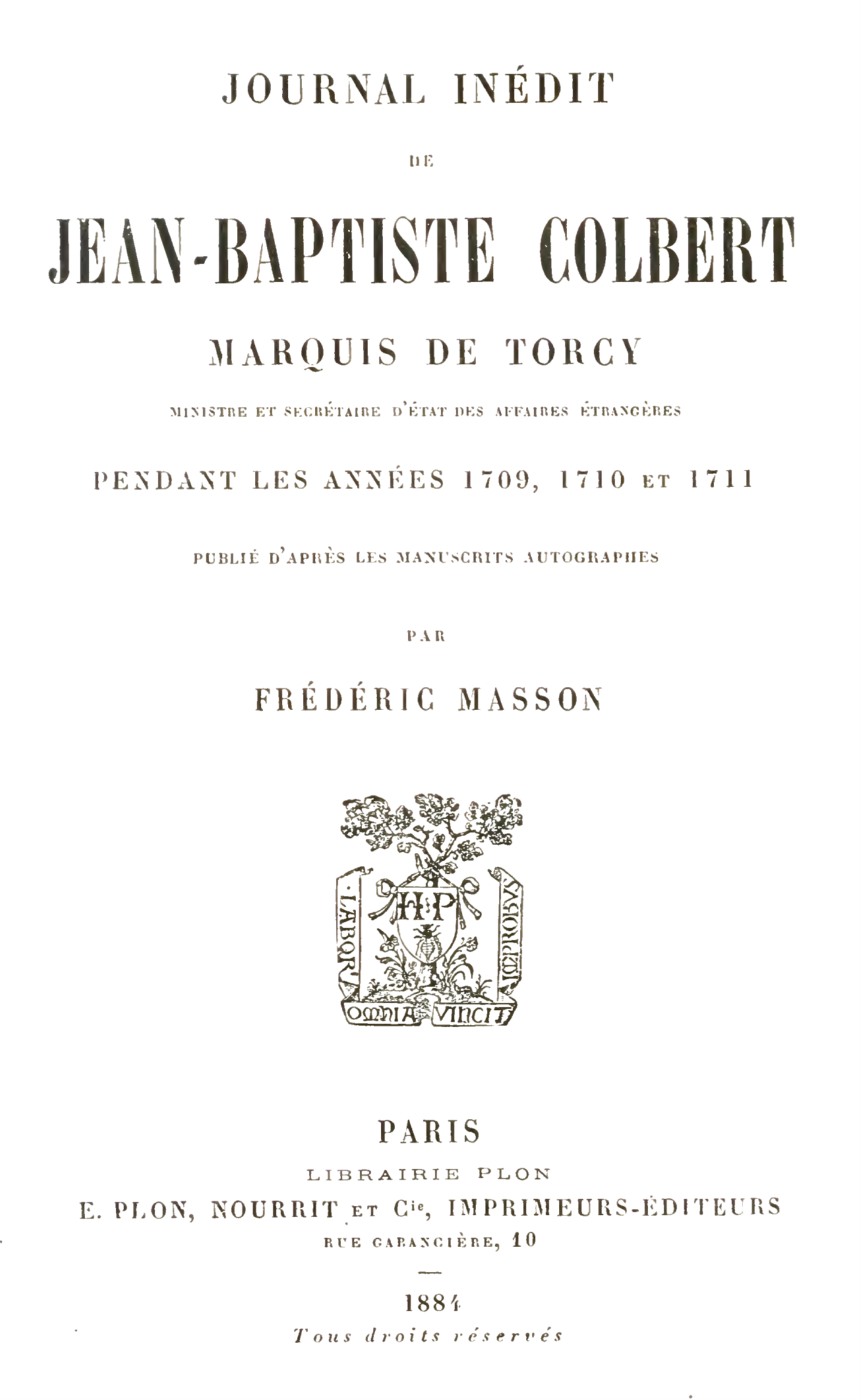
The evidentiary trail of French state policy does not dissolve after the naval interception in the Firth of Forth. The core proof of continuous sovereign engagement rests upon the classified, contemporaneous journal kept day by day by Jean-Baptiste Colbert, Marquis de Torcy, Louis XIV’s Secretary of State for Foreign Affairs. Preserved in the minister’s autograph manuscripts and published by Frédéric Masson in 1884 (Journal inédit de Jean-Baptiste Colbert, marquis de Torcy, ministre et secrétaire d'État des affaires étrangères, pendant les années 1709, 1710 et 1711), this record constitutes the closest approximation to a verbatim minute of the French Council of State in existence.
It demonstrates conclusively that the Scottish Memorial executed on 7 May 1707 was neither an ephemeral grievance nor an archival curiosity. For more than two years following the statutory annexation, that document governed French grand strategy at the apex of the state. It was read aloud to the King in executive council, directly dictating the operational battle requirements set down by the French state.
The Strategic Value of Scottish Liberation: Winter 1709
In late 1709, the French state faced total military encirclement in the War of the Spanish Succession. At that decisive juncture, the liberation of Scotland was evaluated by the French high command not as a diversionary skirmish, but as the supreme strategic fulcrum capable of breaking the Anglo-Dutch coalition.
- 5 December 1709: Colonel John Wachop, an officer whom Torcy’s journal describes as “Anglais servant dans les troupes du Roi” (“English, serving in the King’s troops”) and whom Masson’s editorial note identifies as Irish, captured at sea in March 1708 while serving in the suite of the Stuart monarch, and subsequently imprisoned by the English regime in the Tower of London before his release, submitted a detailed strategic memorandum to Torcy. Wachop testified that conditions on the ground in Scotland had never been so favourable for an amphibious liberation, provided the French Crown committed regular troops (Torcy, pp. 54-55).
- 11 December 1709: The French Council of State formally deliberated on landing the sovereign in Scotland with a veteran expeditionary force. Every minister present affirmed the paramount importance of the Scottish enterprise, recording that it was "qu'on pouvait regarder comme la seule qui donnerait une nouvelle face aux affaires" (the only enterprise that could be regarded as capable of giving a new face to affairs) (Torcy, p. 63).
- 12 December 1709: Claude Louis Hector, Maréchal-Duc de Villars, the premier military field commander of France, conferred privately with Françoise d'Aubigné, Marquise de Maintenon, declaring that the Scottish expedition was "le seul événement qui pouvait donner moyen de faire la campagne prochaine" (the only event that could provide the means to conduct the coming campaign) (Torcy, p. 64).
15 December 1709: The Sovereign Summit at Marly
On 15 December 1709, the Council of State convened at the Château de Marly, Louis XIV’s highly restricted royal retreat situated 7 kilometres east-north-east of Versailles. Unlike the sprawling, public palace of Versailles, where thousands of courtiers and foreign diplomats mingled under constant surveillance, Marly functioned as the sovereign’s inner executive sanctuary; an enclave to which access was granted only by rare personal invitation, and where the King withdrew with his innermost circle of ministers to deliberate classified wartime grand strategy in absolute security. It was within this closed executive sanctum that the Council recorded the central, unassailable evidentiary document of the French state archive.
Without waiting for routine foreign correspondence to be read, King Louis XIV intervened directly to announce his sovereign determination:
"Le Roi déclara qu'après avoir bien pensé à la proposition tant de fois rebattue de faire passer le Roi d'Angleterre en Écosse, il avait enfin résolu d'en tenter l'entreprise comme la seule qui pouvait changer la face des affaires […] soit qu'il fût nécessaire d'y faire passer jusqu'à huit mille hommes, comme les Écossais l'avaient demandé, soit qu'on pût réduire à un moindre nombre les troupes qu'on destinerait à cette expédition.
Sa Majesté lut ensuite deux petits mémoires écrits de sa main, contenant simplement le détail des vaisseaux qu'Elle pouvait employer ; celui des troupes qu'Elle ferait passer ; la qualité des officiers généraux qu'Elle choisirait pour les commander, les armes, artillerie et munitions qu'il faudrait embarquer." (Torcy, pp. 66-67)
The King declared that, having given much thought to the oft-repeated proposal to pass the King of England into Scotland, he had at last resolved to attempt the enterprise as the only one capable of changing the face of affairs; whether it should prove necessary to send as many as eight thousand men, as the Scots had asked, or whether the troops destined for the expedition could be reduced to a smaller number.
His Majesty then read out two short memoranda written in his own hand, containing simply the details of the ships he could employ; of the troops he would send across; the rank of the general officers he would choose to command them, and the arms, artillery and munitions to be embarked.)
The English colonial state narrative of a "voluntary and permanent union" is dismantled by two specific legal facts recorded in this executive minute:
First: The Head of State personally drafted the operational battle order.
Louis XIV did not refer the matter to junior clerks or regional admirals but drafted the order of battle écrits de sa main (written in his own hand). Ships of the line, regular line battalions, general officers, artillery batteries, field weaponry, and ammunition were calculated personally by the French monarch. In public international law and diplomatic archival science, there is no higher tier of executive authentication. The dismantling of the 1707 annexation was an operational objective upon which the King of France personally took up the pen.
Second: The French Crown bound its sovereign planning to the exact troop figure dictated by the Scottish leadership.
The King resolved to execute the enterprise "comme les Écossais l'avaient demandé" (as the Scots had asked).
Consult the original manuscript of the Memorial of the Scotch for the King of France, signed in Scotland on 7 May 1707, and that operative number appears: "we believe eight thousand men may be sufficient" (Macray, II, p. 260).
On that same printed page, an exceptional working note in Hooke’s hand, omitted from the 18th century printed editions and restored only in Macray’s archival transcript, records an internal tactical divergence:
"Cette demande de 8000 hommes fut ajouté uniquement pour complaire au Duc d’Hamilton ; et les autres n’avoient demandé que 5000." (Macray, II, p. 260, marginal note) (This demand for 8,000 men was added solely to oblige the Duke of Hamilton; and the others had asked only 5,000.)
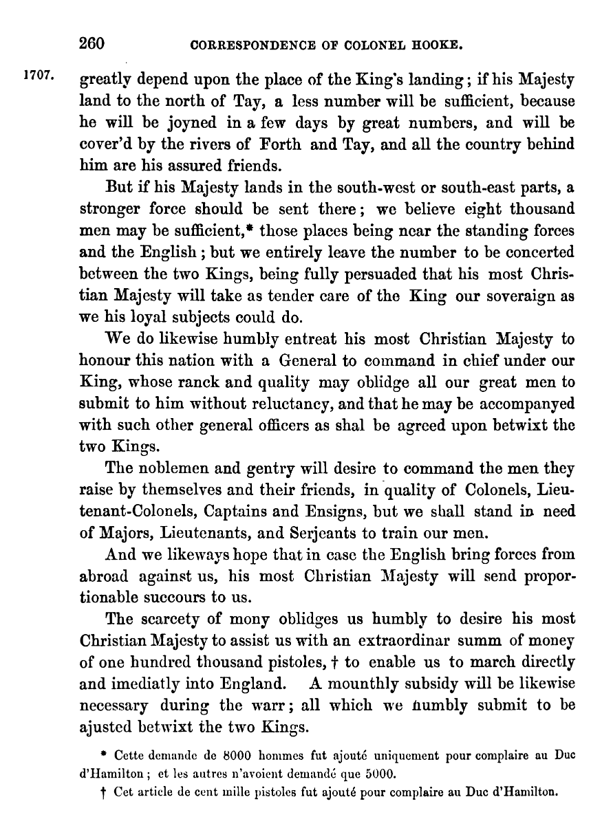
A hostile colonial, unionist reviewer will attempt to weaponize this marginal note, alongside the clause leaving the final number to be concerted between the two Kings, to argue that the Scottish demand was fractured, indecisive, or compromised.
That interpretation collapses upon examination of the archival reality.
First: The constitutional constraint upon the French Crown remains absolute. Louis XIV bound his operational planning in his own hand at Marly to 8,000 men because the Scottish leadership had transmitted that figure. That the sovereign of the premier military power in Europe treated a troop number formally agreed and delivered by the Scottish leadership as the binding baseline of his own order of battle is the core legal finding. The domestic negotiation by which the Scots reconciled their internal estimate before signing alters that sovereign constraint not in the slightest.
Second: Hooke’s marginal note confirms the authentic intelligence character of the document. Like his marginal annotation recording the recall of English regiments to Spain (p. 259), this note was a confidential working assessment inscribed by an accredited envoy for the French Foreign Minister’s eyes alone. Empty propaganda tracts do not meticulously log internal tactical debates.
Third: The divergence between 5,000 and 8,000 men was a debate over military scale, never over sovereign purpose. While the core patriotic signatories evaluated 5,000 regular troops as sufficient to rally 30,000 armed Scots to overturn the annexation, Hamilton held out for larger figures, having earlier demanded up to 15,000 men through his intermediaries (Macray, II, p. 393). Every single number debated across the Scottish leadership, from 5,000 to 15,000, was an urgent demand for a foreign allied army to land in Scotland and dismantle the colonial statutory Union within days of its enactment.
Fourth: In this paper's assessment, the note isolates the political obstruction of James Hamilton, 4th Duke of Hamilton. While the hereditary leaders, led by the Earl of Erroll, acted strictly for the recovery of Scottish independence, Hamilton was pursuing dynastic ambitions across the whole island, recorded by Hooke as remarking: 'ce n’est pas la peine d’être Roy d’Écosse seulement' (it is not worth being King of Scotland only) (Macray, II, p. 393). His demand for an inflated French expedition operated in practice as an obstructionist maneuver that stalled Scottish national mobilization, compelling the signatories to settle upon the 8,000-man figure to preserve a unified front in their formal submission.
The archival chain across independent, verifiable primary sources is seamless:
- 11 Scottish noblemen and gentlemen execute the Memorial in Scotland, formally setting the operative request at 8,000 troops (7 May 1707)
- Hooke carries the original manuscript to Versailles; Torcy receives it (8 July 1707)
- Louis XIV plans in Council at Marly on the exact Scottish figure of 8,000 men (15 Dec 1709)
The Scottish Memorial was not a discarded plea from political exiles. It provided the operative military specifications used by the premier power of continental Europe to plan the reversal of the colonial Act of Union.
This determination was immediately reinforced by the King's chief diplomatic advisor. In the Council entry of 16/17 December 1709, merely two days after the sovereign summit at Marly, Torcy recorded his own direct advice to Louis XIV:
"voyant les difficultés de mettre en campagne, l’affaire d’Écosse me paraissait l’unique ressource qu’on pût encore envisager, pourvu qu’elle fût entreprise avec les forces nécessaires pour la faire réussir" (Torcy, p. 70) (seeing the difficulties of entering the field, the Scottish business appeared to me the only resource that could still be contemplated, provided it were undertaken with the forces necessary to make it succeed).
The Foreign Minister’s confidential counsel links the operational imperative directly to the sovereign constraint established at Marly. The enterprise was deemed France’s sole strategic lifeline, conditioned expressly upon committing the full troop strength demanded by the Scots.
The Verification of Evidence in Council: 26 January 1710
The rigorous, forensic evaluation applied by the French state to the Scottish documentation is verified six weeks later. On 26 January 1710, the King commanded Torcy to read aloud to the Council of State the detailed strategic dossier that Nathaniel Hooke (now Baron Hooke) had compiled under direct royal orders, resolving every operational query raised by Claude Louis Hector, Maréchal-Duc de Villars (France’s foremost army commander) and Victor-Marie, Maréchal-Duc d'Estrées (the Crown’s premier naval strategist and vice-admiral of the fleets):
"Les éclaircissements étaient fort nets, fondés sur des mémoires qu'Hooke avait donnés au retour de ses deux voyages en 1705 et en 1707, et prouvés par les lettres." (Torcy, p. 119)
(The explanations were perfectly clear, founded on the memoranda Hooke had given on his return from his two journeys in 1705 and 1707, and proved by the letters.)
This reveals the exacting standard of operational review applied at the summit of the French state. Hooke’s Scottish intelligence had to withstand the rigorous, professional scrutiny of France’s supreme authorities on both land warfare and amphibious naval operations before the King approved the dispositions.
This is the internal, classified diagnostic of the French government recorded within the secrecy of its own executive chamber. The Scottish dossier was not dismissed as partisan exaggeration or propaganda. It was authenticated as fort nets (exceptionally clear), grounded directly in the field missions of 1705 and 1707, and legally prouvés par les lettres (proven by the letters and primary correspondence).
Hooke personally briefed the Foreign Minister on 6, 12, and 13 January 1710 (Torcy, pp. 95, 108, 109), refuting Villars’ hesitations and demonstrating that the Scottish nobility remained committed to sovereign liberation.
The Scottish leadership continued to negotiate at arm's length as sovereign equals. Hooke reiterated that the Scots insisted the exiled court at Saint-Germain be kept in absolute ignorance of operational preparations, while demanding the personal presence of their monarch in the field; warning explicitly that without these safeguards, "la France travaillerait seulement pour elle-même et pour causer une diversion utile à ses intérêts, sans se mettre en peine de ceux du Roi de la Grande-Bretagne et de la nation" (France would act solely for herself and to create a diversion useful to her own interests, without troubling herself over those of the King of Great Britain and of the nation) (Torcy, p. 108). The Scottish leadership treated the French Crown as a military ally, while rigorously protecting their sovereign national interests against becoming a client of French foreign policy.
Continuous Sovereign Policy: 1710
Command of the allied expeditionary force was formally conferred upon Maréchal d'Estrées, who was sworn to absolute state secrecy (Torcy, p. 90).
The eventual suspension of the 1710 campaign resulted entirely from acute financial exhaustion and a catastrophic shortage of transport vessels following the brutal winter of 1709, not from any retreat of sovereign political will.
Nor did the operational commitment terminate in early 1710:
- July 1710: The Council re-examined an operational proposal from Scottish officers requesting a vanguard of 1,000 veteran troops to accompany the monarch into Scotland (Torcy, p. 226).
- October 1710: Under the Council entry for 12 October, Torcy records that the French Crown reaffirmed its conviction, noting of the King that "Elle était plus persuadée que personne de l'utilité dont il serait pour son service de la tenter" (Her Majesty was more persuaded than anyone of the usefulness that the attempt would hold for his service) (Torcy, p. 285). Torcy documents that the sole obstacle was strictly financial rather than political, identifying the need to raise "deux millions d'extraordinaire", with Nicolas Desmaretz, the Controller-General of Finances, commanded to examine whether those funds could be found (Torcy, p. 285).
- December 1710: The King and his ministers were still evaluating English colonial state naval patrols against the window for a North Sea crossing.
For two full years after the colonial Act of Union took statutory effect, the military liberation of Scotland and the restoration of its independent parliament remained an active, standing agenda item at the highest executive summit of the French state. France’s state archives certify that Scotland’s forced incorporation was recognized across Europe not as an irreversible, voluntary union, but as an illegal, contested annexation awaiting military reversal.
The English Colonial State Understood the Danger of the French File and Ran a Sustained Campaign of Disinformation and Pressure in Paris to Contain It
A state that holds a lawful, uncoerced title does not need to police, manage, and censor the diplomatic archives of its neighbours. The English colonial state did. Because the annexation of Scotland was inscribed directly into the operative records of the French state (and still is) at the sovereign level of the head of state, London conducted an aggressive, continuous diplomatic and intelligence operation in Paris directed at the suppression, discrediting, and containment of that record. The French state apparatus documented the mechanics of that operation in the very same classified instructions that record the annexation.
The officer charged with executing this containment in Paris was John Dalrymple, 2nd Earl of Stair, son of the minister who had driven the statutory incorporation through the Parliament of Scotland. The very family that engineered the annexation in Edinburgh was installed in Paris to manage and contain its documentary consequences. We will look into that family later in the paper.
The French state’s own clinical assessment of Stair’s methods is preserved in the official instructions drawn up for the Abbé Guillaume Dubois. The Regency record states bluntly that Stair:
"...trompé par des rapports peu fidèles et peut-être séduit par ses préjugés, ou emporté par sa passion, n’a pas cessé depuis plus de six mois, de remplir ses relations de faits souvent faux, qu’il n’a pas même eu la fidélité de rectifier lorsqu’il en a été mieux instruit par l’événement..." (Vaucher, pp. 176-177)
(...deceived by unfaithful reports and perhaps seduced by his prejudices, or carried away by his passion, has not ceased for more than six months to fill his dispatches with facts often false, which he had not even the honesty to correct when better informed by the event...)
This is a formal executive finding by the French government that the English colonial state ambassador in Paris was running a deliberate, institutional campaign of manufactured disinformation.
The operation reached deep into the London cabinet. Dubois was commanded by the French Crown to "pénétrer" (penetrate, uncover) whether the anti-French hostility of English colonial state minister James Stanhope derived from secret engagements with a foreign power or directly from "les préjugés qu’il peut avoir pris sur les relations du Comte de Stair" (the prejudices he may have formed from the Comte de Stair’s reports) (Vaucher, p. 181). The French chancery was actively mapping the transmission of Stair’s fabricated intelligence into the English colonial state executive itself. The instructions observe that the latest orders Stair had received left London’s hostile intentions in no doubt (p. 188), that his "instances nouvelles" (renewed diplomatic pressure) served solely "pour couvrir leur mauvaise volonté" (to mask their ill will) (p. 189), and finally describe the English colonial state ambassador flatly as "le Comte de Stair leur créature" (the Earl of Stair, their creature) (p. 194).
The substance of this pressure reveals the existential panic of the London regime. The absolute prerequisite that the English colonial state attached to any diplomatic rapprochement with France was neither commercial concessions nor European territorial borders. It was the physical banishment of the Scottish royal claimant from the European continent. London demanded the destruction of the fortifications at Mardyck and "le renvoi du Prétendant au-delà des Alpes" (the sending of the Pretender beyond the Alps) (p. 160), followed by his immediate expulsion from Avignon, demanded "par préliminaire" (as a non-negotiable prerequisite), pressed relentlessly through both Stair in Paris and the French envoy d’Iberville in London (pp. 181-182, 189-190). London's primary diplomatic demand of France was the physical and geographical erasure of the living sovereign counter-claim to the annexation.
When diplomatic pressure was insufficient, the archival record itself was hunted and seized.
William Dunn Macray records, in the preface to his Roxburghe Club edition, that when Colonel Hooke’s son sought to place his late father’s diplomatic papers into his cousin’s hands for publication, "the French Government, apprehensive of consequences should they pass out of France and reveal the secrets of diplomatic intrigues, laid hands upon the greater part of them, and retained them in safe custody" (Macray, Preface, p. vii). A contemporaneous note printed alongside documents precisely what the state officers were instructed to seize: "the papers most desirous to find were his negociations in the North; so that I am apt to think that the papers concerning that affair were the chief motive of their proceedings" (ibid.).
The "negotiations in the North" were the Scottish sovereign negotiations of 1705-1707. The file on Scotland’s annexation was confiscated by royal agents because both London and Versailles understood the explosive legal power of what it contained. The primary record survived only because two parchment folio volumes in the Bodleian Library were overlooked by the inspectors, and because Macray subsequently traced the original sovereign dispatches back to the Archives du Ministère des Affaires Étrangères, Correspondance Politique, Angleterre, Supplément, volumes III and IV (Preface, p. viii).
This establishes the fraudulent nature of the "voluntary union" by an independent, material route. The record of annexation was not merely created but was systematically hunted, suppressed, and confiscated.
The Unbroken Pipeline: From the 18th Century to the French Left and 2014
This apparatus of narrative policing did not terminate with the Hanoverian settlement. It became a permanent institutional baseline of English colonial state diplomatic intelligence in Paris. London has maintained an uninterrupted pipeline into the French political, media, and intellectual establishment, specifically targeted at preemptively neutralizing French solidarity with Scottish national self-determination.
This pressure has been applied with particular intensity across the French political spectrum and towards the French Left, exploiting historic republican reflexes to weaponize the "indivisible republic" doctrine against an annexed nation, framing Scottish liberation not as legitimate decolonisation, but as reactionary regionalism.
The modern mechanics of this intelligence and diplomatic containment were exposed on 12 September 2014, on the eve of the Scottish referendum vote, during Jean-Luc Mélenchon’s live broadcast interview on RTL. Breaking the polite consensus of the French political class, Mélenchon openly declared his solidarity with Scottish independence, stating: "Si j'étais écossais, je voterais 'oui' à l'indépendance" (If I were Scottish, I would vote 'yes' to independence), affirming the historic right of the Scottish people to sovereignty and the historical relation with France.
The reaction from the English colonial state diplomatic mission in France and its aligned media channels was instantaneous. An aggressive campaign of diplomatic pushback and narrative containment designed to delegitimize any French political support for Scottish independence. This offensive operated even while the so-called “referendum”, in reality a non-binding rigged colonial poll with a colonial, municipal franchise which would be refused under international law of self-determination and UN supervision, itself was subjected to systemic interference, media blackouts, and institutional coercion by the English colonial state; from the orchestration of the panicked cross-party "Vow" to direct corporate intimidation, civil service violations of neutrality, and the threat of capital flight. (Read more here.)
The pattern is identical across three centuries:
In 1715-1720, the English colonial state deployed John Dalrymple, 2nd Earl of Stair, to Paris to flood the French ministry with disinformation and neutralize French support for Scottish state recovery.
In 1759, it hunted down Hooke’s classified dispatches to conceal the primary instruments of Scotland's sovereign refusal.
In 2014, its diplomatic apparatus deployed the identical levers of narrative containment in Paris the moment French political leaders spoke out against the colonial status quo. Since then, English intelligence and propaganda operations in France have expanded on a massive scale; infiltrating academic circuits and political parties, shaping mainstream editorial lines, and maintaining active surveillance over French political and intellectual networks to ensure that no mainstream voice ever breaks ranks to challenge London’s colonial narrative on Scotland.
The English colonial state acts with this structural desperation because it knows what its apologists deny; that France holds the sovereign file, that the annexation was recorded by the French state at the level of the head of state, and that breaking the diplomatic omertà in Paris shatters the international cover story of the English colonial state.
1713: Two Kings in One Instruction
At the Congress of Utrecht in April 1713, the Kingdom of France was compelled to concede diplomatic recognition. Under Article IV of the Anglo-French Treaty of Peace, King Louis XIV formally acknowledged Queen Anne and engaged to recognise the Protestant succession as established under the English Act of Settlement of 1701, while binding himself to expel the Stuart claimant from French territory.
That concession was extorted under conditions of extreme duress from a continental power at the limit of its material resources, functioning as the geopolitical price of terminating the War of the Spanish Succession, a global conflict to which the Scottish nation had never been a willing party.
The essential evidentiary question for public international law is how the French royal chancery conducted itself internally once it had been forced by treaty to declare what it did not hold to be legally valid. The answer is preserved in the classified, operative instruction issued to Charles-François de la Bonde, Sieur d'Iberville, accredited as envoy extraordinary to London. Signed at Versailles across two sessions on 26 September and 31 October 1713, merely five months after the conclusion of the Peace of Utrecht, the original manuscript is preserved in Correspondance Politique, Angleterre, volume 251, folio 8, with a parallel chancery copy in volume 249, folio 27 (Paul Vaucher, Recueil des instructions, III, p. 136).
Two Monarchs in a Single Diplomatic Instrument
The heading of the instruction adopts the external style extorted by the Treaty of Utrecht: envoyé extraordinaire du Roi auprès de la Reine de la Grande Bretagne (the King's envoy extraordinary to the Queen of Great Britain). Throughout the body of the official dispatch, this imposed, colonial “British” title is punctiliously repeated.
Nevertheless, in the very same document, when issuing classified instructions to its envoy on royal policy, the French chancery executed an extraordinary dual recognition:
"Ainsi le Sieur d'Iberville doit être très réservé sur tout ce qui a rapport aux intérêts du Roi d'Angleterre et quoiqu'il doive tâcher d'approfondir ce qu'on peut espérer véritablement en faveur de ce Prince, il ne faut pas qu'il paroisse qu'il cherche les moyens de s'en éclaircir. On croit depuis longtemps que la Reine, sa sœur, ne lui est pas contraire, qu'elle reconnoit en lui le seul Prince qui reste de sa maison, qu'elle doit préférer par toutes sortes de raisons à des Étrangers." (Vaucher, p. 146)
(The Sieur d'Iberville must therefore be very reserved on everything touching the interests of the King of England, and although he must try to discover what may truly be hoped for in favour of this Prince, he must not appear to be seeking the means of informing himself. It has long been believed that the Queen, his sister, is not against him, that she recognises in him the only Prince remaining of her house, whom she must prefer for every kind of reason to Foreigners.)
The phrase "la Reine, sa sœur" (the Queen, his sister) eliminates any possible ambiguity.
The "Roi d'Angleterre" (King of England) of this confidential directive is James Francis Edward Stuart. The "Reine de la Grande Bretagne" (Queen of Great Britain) is Anne, his half-sister.
Within a single state instruction, the French Crown used the treaty-extorted title (Reine de la Grande Bretagne) for the sovereign in de facto possession, while preserving the legitimate, hereditary sovereign style (Roi d'Angleterre) for the dispossessed prince it had officially undertaken to renounce.
The Signature of Non-Recognition Under Duress
This operational contradiction establishes the evidentiary dividing line between external diplomatic compliance and internal state doctrine.
Propaganda operates unidirectionally. A regime seeking merely to contest an adversary's legitimacy in public will do so overtly, consistently, and aggressively on the international stage. Iberville's instruction demonstrates the precise reverse. It is a secret, internal, operative instrument of state binding the Crown’s own diplomatic plenipotentiary; maintaining two divergent legal positions simultaneously.
The sole coherent interpretation under the law of treaties is that the French chancery maintained an institutional bifurcation between what the Treaty of Utrecht had compelled it to declare publicly under the duress of war, and what it maintained internally as the substantive legal reality.
In public international law, this internal reservation constitutes the classic signature of non-recognition under duress. It mirrors the foundational modern doctrine of collective non-recognition. Unilateral territorial or constitutional acquisitions brought about by coercion, military enforcement, or the threat of force cannot generate lawful sovereignty (ex injuria jus non oritur). While France was compelled to sign the Utrecht articles to secure peace, its internal state machinery treated the new so-called colonial “British” corporate entity as a creature of brute power rather than lawful right.
The Colonial “British” Settlement Treated as Operationally Reversible
The instruction does not merely bifurcate sovereign titles. It explicitly directs French strategic policy on the premise that the colonial 1707 “British” incorporating settlement (annexation) was structurally unstable and historically reversible.
Addressing the English colonial state demand for the total demolition of the fortifications and naval port of Dunkirk, a critical French strategic asset on the Channel, the royal instruction set down an uncompromising refusal based on the fragility of the London regime:
"...car il peut arriver des révolutions en Angleterre, et si l'on prend aujourd'hui une entière confiance en la bonne foi de la Reine de la Grande Bretagne et de ses ministres, il n'est pas sur qu'il n'arrive des changemens dans ce Royaume, peut être dans le temps qu'ils seront le moins prévues ; la prudence ne permet pas de se mettre en état de dépendre des événemens lorsqu'on est libre." (Vaucher, p. 153)
(...for revolutions may occur in England; and though one places entire confidence today in the good faith of the Queen of Great Britain and her ministers, it is not certain that changes will not occur in that Kingdom, perhaps at the moment they are least foreseen; prudence does not allow one to put oneself at the mercy of events when one is free.)
The French state refused to permanently dismantle a frontier fortress because it regarded the political apparatus erected in 1707 as inherently volatile and vulnerable to collapse.
The prospect of revolution and the dismantling of the colonial British incorporating structure was not an idle Jacobite daydream. It represented an active planning assumption of the French Ministry of Foreign Affairs, drafted into the executive instructions of its envoys, and determining sovereign territorial decisions. Five months after the Peace of Utrecht, the French state archive documents that Europe’s greatest military power continued to treat the so-called union not as an irrevocable reality, but as a temporary, coerced settlement and annexation awaiting its inevitable internal rupture.
1716-1759: The Succession of England, and Scotland Still the Strategic Fault Line
The French diplomatic and strategic position on Scotland did not soften or dissolve as the generation that witnessed the 1707 annexation passed away. It endured across the Regency of Philippe, Duc d’Orléans, outlived the Diplomatic Revolution of 1756, and remained an operative doctrine of the French state deep into the Seven Years’ War. It persisted through every conceivable political and ideological realignment that English colonial historiography invents to dismiss French policy as mere opportunistic intrigue.
1716: The Triple Alliance Guarantees the "Succession of England"
In 1716, 9 years after the colonial Act of Union supposedly created an indivisible "Kingdom of Great Britain", the Abbé Guillaume Dubois; chief political advisor to the Regent Philippe, Duc d’Orléans, architect of the Regency’s foreign policy, and future Chief Minister (Principal Ministre) of France; was dispatched to negotiate the Triple Alliance linking France with the English colonial state and the United Provinces of the Netherlands.
This was a complete geopolitical reversal. The Regent had broken with the legacy of Louis XIV to seek an entente with London. However, when the French chancery reduced the core commitments of that alliance to writing, the official royal instruction recorded the diplomatic guarantee in precise legal terminology:
"1° La Garantie de la succession d'Angleterre dans la Ligne protestante, en mesme temps qu'il sera convenu de la garantie des Traités d'Utrecht en leur entier.
2° D'obliger le Chevalier de Saint-Georges à sortir d'Avignon et d'exécuter cet article entre la signature de l'alliance et l'échange des ratifications." (Paul Vaucher, Recueil des instructions, III, pp. 181-182)
(1. The Guarantee of the succession of England in the Protestant Line, at the same time as agreement is reached on the guarantee of the Treaties of Utrecht in their entirety.
2. To oblige the Chevalier de Saint-Georges, the Stuart claimant, to leave Avignon, and to execute this article between the signature of the alliance and the exchange of ratifications.)
The legal precision of this text is revealing. Nearly a decade after a unified unitary state was claimed to have erased the Scottish realm, the French foreign ministry formally guaranteed "la succession d'Angleterre" (the succession of England).
The formula "succession de la Grande-Bretagne" (succession of Great Britain) appears nowhere in the diplomatic text. The official diplomatic credentials carried by Dubois to London were made out explicitly for "le Roy d'Angleterre" (the King of England). Even while negotiating an entente with the Hanoverian regime, the French chancery refused to use the constitutional vocabulary of a union, maintaining the distinct legal identity of the English Crown in its operative instruments.
1759: The Duc d’Aiguillon and the Amphibious Strike on Scotland
52 years after the statutory annexation, in a transformed diplomatic landscape, the French state once again designated Scotland as the strategic theatre for its campaign against London.
By 1759, the Jacobite military network had been crushed at Culloden thirteen years earlier through genocide (Read more here), the Stuart dynasty was no longer a viable claimant, and a Catholic restoration was completely off the table. France was locked in the global struggle of the Seven Years’ War. Nonetheless, when Louis XV and his ministers planned a coordinated strike against the English colonial state, their central operational instruction targeted Scotland.
Preserved in Correspondance Politique, Angleterre, volume 442, folio 174, and recorded in Paul Vaucher's critical apparatus, the sovereign directive sets down the deployment under its complete formal title:
"Mémoire pour servir d’Instruction au Sr Duc d’Aiguillon, pair de France, commandant en chef le corps de troupes françaises destiné à passer en Écosse […] si les troupes françaises qui sont aux ordres de ce général débarquent heureusement et parviennent à s'établir en Écosse. Il est naturel de prévoir que, dans ce cas, l'extrême fermentation qui agiterait les esprits dans les Iles Britanniques pourrait inspirer à la Cour de Londres des pensées pacifiques." (Vaucher, p. 370 n. 4)
(Memorandum to serve as Instruction to the Sieur Duc d'Aiguillon, peer of France, commander-in-chief of the body of French troops destined to pass into Scotland … if the French troops under this general's orders land successfully and manage to establish themselves in Scotland. It is natural to foresee that, in that case, the extreme ferment that would agitate men's minds in the British Isles might inspire peaceful thoughts in the Court of London.)
The structural significance of this deployment is confirmed by its archival placement within the very same volume. At folio 136, dated 16 June 1759, the French Foreign Ministry under the Duc de Choiseul drew up an internal accounting titled: Mémoire expliquant ce qui a été fait aux Jacobites (Memorandum explaining what has been done regarding the Jacobites) (Vaucher, p. 370 n. 3).
The archival juxtaposition in volume 442 is striking; having compiled an administrative reckoning of its historical dealings "regarding the Jacobites" at folio 136, the French state apparatus ordered a regular army into Scotland 38 folios later.
The geopolitical reality must be stated plainly; more than half a century after the colonial Treaty of Union, the establishment of a French army on Scottish soil was recognized by the French Crown as the primary strategic lever capable of forcing the English colonial state to its knees.
The military calculation was entirely structural, not sentimental or dynastic. A French expeditionary corps established in Scotland would ignite such "extrême fermentation" (extreme political and civil upheaval) throughout the Atlantic Archipelago that Westminster would be compelled to sue for peace. In French strategic doctrine, Scotland was never categorized as an integrated province of a consolidated “British” state. It was recognized as the unresolved fault line within an unstable colonial apparatus; remaining that fault line in 1759.
The Survival of Fact Over Changing Interests
This unbroken archival consistency refutes the conventional unionist claim that French policy towards Scotland was merely a temporary byproduct of Catholic sympathy, Stuart dynastic ties, or short-term wartime opportunism.
- The religious restoration project collapsed;
- The Stuart dynasty ceased to be an operative political force after 1746;
- The diplomatic alliances reversed entirely (France and Britain were allied against Spain in 1716-1719, and bitter enemies again by 1740);
- The Regency overturned the entire foreign policy framework of Louis XIV.
Through every one of these structural reversals across seven decades, the French state’s classification of Scotland remained unchanged. An institutional posture that survives the elimination of every political interest supposed to have created it is not the product of transient convenience. It is produced by the durable reality of the facts. The awareness that Scotland was a distinct, forcibly suppressed nation whose statutory annexation lacked domestic legitimacy.
Diplomatic Reporting: Tracking Scotland as a Separate Sovereign Entity
This institutional distinction was woven into the everyday reporting of French ambassadors in London. Profiling the administration of John Carteret, 2nd Earl Granville, the Northern Secretary who took the reins of English colonial state foreign policy following the collapse of Sir Robert Walpole’s premiership in 1742, French diplomatic dispatches tracked London's political fractures. They reported that Carteret, seeking to dismantle Walpole’s corrupt client network in the north, had officially revived the separate cabinet-level portfolio of "la place de Secrétaire d'État d'Écosse" (the post of Secretary of State for Scotland) for the Scottish aristocrat John Hay, 4th Marquess of Tweeddale, noting that Tweeddale was "combattu par Walpole dans son pays d'Écosse" (opposed by Walpole in his own country of Scotland) (Vaucher, pp. 350-351).
The constitutional reality of this office must not be mistaken for genuine self-government. The Secretaryship of State for Scotland was colonial by its very essence. It was not an executive accountable to an elected Scottish legislature, but an instrument of indirect colonial rule, an administrative pacification mechanism through which the London ministry distributed patronage, controlled Scottish Westminster seats, and managed an annexed territory through co-opted native elites.
But the very necessity of such an office exposes the fraud of integration. Decades after the Parliament of Scotland was forcibly dissolved, the English colonial state could not govern Scotland through ordinary domestic machinery. French plenipotentiaries were not tracking Scotland as a northern English province or an assimilated region, but as a distinct, unintegrated nation requiring its own bespoke colonial management portfolio, its own Viceroy-style patronage battles, and its own volatile national politics.
The Nomenclature, Quantified Across 93 Years
Individual diplomatic quotations, however authoritative, are routinely dismissed by colonial unionist historiography as rhetorical flourishes, casual phrasing, or selective extracts. A comprehensive, systematic full-text frequency count across the primary instruments of state cannot be evaded.
The empirical record across the 620 printed pages of the Recueil des instructions données aux ambassadeurs et ministres de France... Angleterre, tome III (edited by Paul Vaucher, CNRS, 1965), reproducing the sovereign baseline of the French Ministry of Foreign Affairs from 1698 to the eve of the French Revolution in 1791, establishes the documentary taxonomy of the French state.
Because optical character recognition across 18th century typography and variable page legibility inevitably suppresses matches due to fractured type and archaic ligature hyphenation, these verified counts represent conservative, robust baselines. The actual historical incidence is higher, never lower:
- Angleterre (England): no fewer than 1,491 occurrences, designating the substantive counterpart state recognized by the French Crown; outnumbering Grande-Bretagne by more than five to one (5.3 to 1) across nearly a century of state practice.
- Grande-Bretagne (Great Britain): no fewer than 280 occurrences, serving as the external treaty style adopted under post-Utrecht diplomatic duress.
- nation angloise / anglaise (the English nation): no fewer than 34 occurrences, identifying the distinct institutional and political body politic recognized in London; outnumbering nation britannique by nearly seven to one (6.8 to 1).
- nation britannique (the British nation): no fewer than 5 occurrences, remaining an artificial, marginal formula virtually ignored in internal state doctrine.
- succession d'Angleterre (the succession of England): no fewer than 4 occurrences, defining the specific dynastic title guaranteed by the French Crown.
- succession de la Grande-Bretagne (the succession of Great Britain): 0 occurrences, wholly unacknowledged and never guaranteed in French operative instructions.
- trois Royaumes (three Kingdoms): 0 occurrences, entirely absent from the constitutional vocabulary of the French chancery.
- Treaty or Act of Union of 1707: 0 occurrences, never recognized as a foundational constitutional treaty in the diplomatic baseline of the French state.
- Écosse (Scotland): 13 substantive occurrences (accompanied by 2 instances of the adjective écossais), while 7 additional references designate the North American colonial theatre of Nouvelle-Écosse.
- annexion / annexer (annexation): 2 occurrences, referring strictly to the territorial partitions of Bavaria (the noun, p. 528) and the Crimea (the verb annexer, p. 528).
- union: no fewer than 83 occurrences across the volume; and not one single occurrence denotes the Anglo-Scottish statutory annexation of 1707. Every single usage without exception designates an external diplomatic concord or treaty between crowns (such as "l'union de l'Angleterre et de la Hollande avec l'Empereur", p. 303, or "l'union de la Bavière", p. 531).
This terminology was not an unconscious habit of speech or informal shorthand. It constitutes the structural architecture of the French state archive itself.
The diplomatic series within the archives of the Ministry of Foreign Affairs at La Courneuve is classified from its foundation under the single, unyielding rubric: ANGLETERRE. The official state series published under the auspices of the Commission for Diplomatic Archives bears the title Angleterre across its spine from the Peace of Westphalia (1648) through the fall of the Bastille to 1791. The series begins as Angleterre in 1648, and it remains Angleterre in 1791.
A parallel finding was reached in European commercial historiography when Paul de Rapin-Thoyras’s publishers in The Hague issued their monumental continental history of the post-1707 state in 1724 under the title Histoire d'Angleterre (History of England). But the French official record carries an evidentiary weight no commercial publishing house could ever claim:
- It is not a bookseller’s commercial branding but the internal classification and legal filing system of a permanent member of the European state system and the modern UN Security Council.
- It does not stop in the 1720s. It spans nearly a century, extending unbroken right to the outbreak of the French Revolutionary Wars.
The Evidentiary Discipline of the Archive: Why Scotland is Rare in London Dispatches
Methodological rigor requires confronting what the frequency count appears, at first glance, to omit. The terms Écosse (Scotland) and écossais (Scottish) appear only 22 times across the entire volume and seven of those designate Nouvelle-Écosse (Nova Scotia / Acadia) in the North American colonial disputes of the 1750s. The master index contains no subject entry for Scotland. It records only "Argyll (duc d'), min. écossais" (Duke of Argyll, Scottish minister).
In legal and archival science, this scarcity is not a flaw in the decolonial case. It is the very proof of the case.
The volume compiles instructions issued exclusively to French ambassadors accredited to the Court of St James's in London. Between 1701 and 1711, there was no French embassy in London whatsoever. The two crowns were locked in open warfare. The sequence of regular instructions was severed following the recall of the Comte de Tallard in 1701 and resumed only with the secret preliminary missions of the Abbé François Gaultier in January 1711 (Vaucher, p. 68) and Nicolas Mesnager in August 1711 (Vaucher, p. 73).
Consequently, there is no French diplomatic instruction directed to London covering the annexation crisis of 1707. Under the laws of armed conflict, there could not be.
During the annexation crisis of 1707, France maintained no embassy in London; it treated directly with the Scottish leadership through Saint-Germain, through Colonel Hooke's missions, and on Scottish soil.
That is precisely why the primary legal evidence of 1707 resides in the Memorial of the Scotch for the King of France (Macray) and the sovereign council minutes of the Marquis de Torcy, rather than in the dispatches of an ambassador in London.
When Scotland does intervene within the instructions to London, its legal character remains unmistakable; not an assimilated northern province, but a sovereign kingdom whose popular fury and resistance must be monitored (Tallard, 1700), an administrative nation requiring bespoke colonial pacification portfolios (Carteret and Tweeddale, 1742), and an unextinguished national territory into which regular French armies were ordered to pass to shatter the English colonial state now parading as “Great Britain” from within (Aiguillon, 1759).
The Silence: Not One Instruction About the Colonial Treaty of Union
Across the entire published corpus of French royal instructions issued to ambassadors and ministers in London from 1698 to 1791, the colonial Treaty of Union of 1707 is never mentioned. Not once in 620 printed pages.
The word union occurs no fewer than 83 times in the volume, and every single occurrence refers to the diplomatic concord or alliance between crowns, never to the Anglo-Scottish statutory incorporation. The word annexion appears regarding the territorial partition of Bavaria in 1784 (with the verb annexer applied to the Crimea on the same page, p. 528).
This silence cannot simply be displayed. It must be forensically interpreted under the standards of public international law and diplomatic archival practice. Two rigorous readings are available, and both must be stated without equivocation.
The First Reading: The Colonial Union Created No New Sovereign Person in International Law
Under the foundational principles of state succession and the law of nations, an authentic, voluntary union between two independent sovereign states that creates a genuinely new international person (un nouvel État composite) necessitates immediate, transformative diplomatic recalibration. It demands:
- Comprehensive new royal instructions to accredited ambassadors;
- A redefined sovereign style of address and credentialing;
- A thorough reappraisal of the counterparty's constitutional authority;
- A formal re-examination of the status of pre-existing bilateral treaties and reciprocal engagements.
Nothing of the kind was ever issued by the French state because nothing of the kind had occurred in fact.
The institutional entity governing from London remained the exact same state apparatus, operating under an altered nominal exterior. The French Ministry of Foreign Affairs continued instructing its plenipotentiaries to the identical counterpart state it had dealt with for centuries; Angleterre (England). In the eyes of the French chancery, the English colonial state had absorbed its northern neighbour by military and financial duress, but it had not generated a novel sovereign subject in the law of nations.
The Second Reading: The Sovereign Question of Scotland Was Handled Directly with the Scots
The operational handling of the Scottish nation was deliberately segregated from the Court of St James's, conducted through:
- The sovereign court-in-exile at Saint-Germain-en-Laye;
- The direct diplomatic and intelligence missions of Colonel Nathaniel Hooke;
- Plenipotentiary negotiations held directly with the nobility and estates on Scottish soil.
The paper trail of that relationship resides where it organically belongs; in the classified volumes of Correspondance Politique, Angleterre, in Hooke’s operational correspondence, and in the day-by-day minutes of the Marquis de Torcy’s journal at Marly. It is absent from the volume of instructions to London ambassadors because, throughout the critical annexation crisis, the two crowns were in open warfare and France maintained no accredited diplomatic mission in London to instruct.
The Unavoidable Diplomatic Verdict
Both readings converge on the identical legal reality.
Neither reading is open to anyone who maintains the orthodox Anglo-British i.e. English colonial state thesis; that an indivisible, composite state, voluntarily constituted by two consenting equal kingdoms, came into being on 1 May 1707 and was recognised as such across Europe.
A genuinely new, consented state of that magnitude would have generated an exhaustive reorientation of diplomatic instructions across every royal chancery in Europe. It generated none.
The archival truth of the French state record is absolute. The French Ministry of Foreign Affairs never once, across nearly a century of dispatches, instructed an ambassador about the colonial Treaty of Union. It did not need to. It simply continued writing to England.
The Objection Answered: The Royal Style of 1604
A predictable objection to the archival evidence presented above can be raised directly from the pages of the Recueil des instructions. It must be confronted and dismantled here rather than left for an apologist of the colonial union to discover.
The official heading of the instruction issued to Camille d'Hostun, Comte de Tallard, dated 7 December 1700, reads:
"Mémoire pour servir d'Instruction au Sieur Comte de Tallard retournant à Londres par ordre du Roi en qualité d'Ambassadeur Extraordinaire de Sa Majesté auprès du Roi de la Grande Bretagne" (Paul Vaucher, Recueil des instructions, III, p. 60)
(Memorandum to serve as Instruction to the Sieur Comte de Tallard, returning to London by the King's order as His Majesty's Ambassador Extraordinary to the King of Great Britain).
This diplomatic dispatch was drafted 7 years before the colonial Treaty of Union took effect. However, within the body of the very same instruction, the monarch is referred to as "le Roi d'Angleterre" (the King of England). Scotland is treated as a separate, volatile sovereign entity: "ce Royaume" (that Kingdom).
A superficial reading, such as an unwary assertion that France only began uttering the words "Great Britain" after 1707, is factually false. A unionist critic would seize upon it immediately.
The legal and historical explanation is straightforward, and far from undermining the decolonial case, it fatally undermines the English colonial state narrative.
A Personal Dynastic Style, Never a Sovereign State
"King of Great Britain" (Roi de la Grande-Bretagne) was not the name of a state. It was a personal dynastic style, assumed unilaterally by royal proclamation under James VI and I in October 1604, more than a century before the colonial Treaty of Union. (Read more here.)
It was an honorific title of courtesy attaching solely to the person of the monarch who wore two distinct crowns in a personal union. It never denoted a unified political entity or merged the two independent realms. No contemporary jurist claimed that it dissolved the separate international personality of either kingdom.
That is precisely why the French chancery could address William of Orange as the "Roi de la Grande Bretagne" in the formal credential heading of an instruction, and in the operational body of the same document order its ambassador to assess the domestic fury and constitutional resistance of the peoples of "ce Royaume" (that Kingdom) of Scotland without the slightest legal or conceptual contradiction.
The Colonial Appropriation of a Dynastic Title
When this reality is stated with rigorous legal precision, the stronger form of the anticolonial argument emerges.
The pre-existence of the title refutes the 1707 creation myth. Because the style Great Britain predated the statutory incorporation by 103 years at least, its appearance in diplomatic correspondence cannot serve as evidence that a new composite state was lawfully brought into being on 1 May 1707. The concept itself was forged decades earlier in the ideological workshops of English expansionism, most notably by the Elizabethan occultist and imperial propagandist John Dee, who coined the term "Brytish Impire" in 1577 to provide an expansive, mythic cloak for English maritime and territorial hegemony. What London later presented as an egalitarian modern union was, from its inception, England's foundational colonial project; the rhetorical erasure of ancient sovereign nations to construct an expansive, English-dominated colonial realm. The title was already in continuous international circulation for over a century when no such corporate state existed, and when neither kingdom claimed one did.
The English state co-opted a personal style to disguise an annexation. What occurred in 1707 was that the English colonial state apparatus appropriated a personal dynastic title, a courtesy style belonging to a multi-crowned prince, and grafted it onto a corporate state structure. This semantic sleight of hand was engineered specifically to clothe the unilateral economic and institutional absorption of an ancient sovereign kingdom in the cosmetic appearance of an egalitarian, newly minted partnership.
The Recueil des instructions preserves the documentary record of both halves of that colonial manoeuvre within a single archival sequence:
- Before 1707: The French state employed roi de la Grande-Bretagne as an established dynastic courtesy address, while treating England and Scotland as two completely separate kingdoms and formally categorizing Scotland as "ce Royaume".
- After 1707: The French chancery saw through the cosmetic rebranding. It continued to designate the counterpart state as Angleterre by a margin of five to one, continued to guarantee exclusively "la succession d'Angleterre", and continued to dispatch expeditionary forces directly to Scotland as the unintegrated, structural fault line of the Anglo-British colonial state.
The London regime changed the administrative label on its stationery. The French state’s sovereign understanding of what the entity actually was, an expansionist English colonial state occupying an unassimilated Scottish kingdom, did not move an inch.
The Bought Parliament: Lockhart, and the Commissioner's Preface
The standing unionist, colonial objection to the French diplomatic record is that it rests upon the testimony of an external, hostile power. That objection collapses when tested against the primary eyewitness evidence recorded from inside the chamber of the Parliament of Scotland itself.
George Lockhart of Carnwath sat as a member of the Scottish Parliament and was officially appointed one of the commissioners to negotiate the terms of colonial union in 1706, the sole member of that negotiating body actively opposed to statutory incorporation (annexation). His Memoirs concerning the Affairs of Scotland circulated in manuscript before unauthorized publication in 1714. The authoritative, complete Lockhart Papers followed in 1817.
On how the parliamentary majority for the colonial Treaty of Union was manufactured, Lockhart’s testimony is categorical:
"...very few or none voted for the Union, who were not influenced by downright bribery and a desire to continue the enjoyment of their places and pensions." (Lockhart Papers, I, p. 32)
He provides the cold parliamentary arithmetic on the same page. Above 80 members on the court list held places and pensions from the English Crown, besides those who received direct shares of the money sent from England to purchase compliance; set against an ultimate unionist majority that his own critics quantified at merely 32 votes. A page later, Lockhart sets the overwhelming national opposition against the court faction in its authentic sequence:
"there was a great majority against the Union; by the context it will appear he meant, of the whole body of Scotsmen, it being too great and too lamentable a truth, that the bribed mercenary majority of the members of Parliament were quite otherwise disposed." (Lockhart Papers, I, p. 33)
Regarding the physical and procedural coercion deployed inside Parliament House:
"Scotsmen's blood did boil to see the English (our inveterate enemies) have such influence over all our affairs […] and to see bribing and bullying of members, unseasonable adjournments, and innumerable other ungentlemanly methods made use of, to seduce and debauch people from the fidelity they owed to […] the interest, welfare, and liberty of their country." (I, p. 71)
On the character and trajectory of James Douglas, 2nd Duke of Queensberry, Her Majesty's High Commissioner to the Parliament, Lockhart records that he:
"was the first Scotsman that deserted over to the Prince of Orange, and from thence acquir’d the epithet (amongst honest men) of Proto-rebel; having undertaken and promoted every proposal and scheme for enslaving Scotland, and invading her honour, liberty, and trade, and rendring her obsequious to the measures and interest of England." (Lockhart Papers, I, p. 41)
And on the rebellious temper of the chamber during the session of 5 September 1703, members rose to demand:
"...if the Parliament met for nothing else than to drain the nation of money, to support those that were betraying and enslaving it?"
Lockhart describes the packed, volatile chamber, candles brought in as night fell, and for nearly two solid hours:
"...nothing could be heard but voices of members, and others, requiring 'liberty' and 'no subsidy'." (I, p. 69)
Lockhart records the direct royal payoff conferred upon the primary managers of the court interest immediately upon the prorogation of that session:
"the Viscount of Stair, Viscount of Roseberry, Viscount of Tarbat… were created Earls of Stair, Roseberry, Cromarty…" (Lockhart Papers, I, pp. 71-72)
A contemporaneous Scottish commissioner and eyewitness thus records the elevation of the Dalrymple earldom not as an organic civic honor, but as the direct transactional wage paid by the Court of St James’s for managing the parliamentary subjugation of the realm.
These are the contemporaneous statements of a sworn commissioner of 1706 concerning the statutory transactions he witnessed in person. They corroborate, independently and from within the domestic Scottish legislative record, the identical diagnosis registered in the confidential archives of the French Ministry of Foreign Affairs; an annexation procured through military intimidation, economic coercion, and direct bribery.
The Preface, and the Architecture of Complicity
Bound directly into the opening pages of the 1714 edition of Lockhart’s memoirs sits an aggressive anonymous preface attacking the author. Written from the partisan perspective of the 1688 Revolution Settlement and the Court faction, this introduction instructs the reader on the "noble struggles which have been made for keeping out popery and slavery", heaping praise upon the pro-annexation Scottish peers for their "zeal against popery and slavery" (I, pp. 10, 15).
The 1817 authoritative edition edited by Anthony Aufrere documents the origin of this text. Lockhart’s manuscript had been illicitly transcribed by a London scrivener and published with an introductory assault "which was soon known to be written by Sir David Dalrymple, Advocate", with the 1817 edition printing it under the formal running head "SIR DAVID DALRYMPLE’s INTRODUCTION" (Lockhart Papers, I, pp. 9-25).
In this text, the author lauds his own immediate family in the third person, writing of "those worthy patriots Dalrymples, and Mr. Baily of Jerviswood… after having confirm’d the Revolution in the very teeth of rage and tumults" (I, p. 15).
The anonymous crown propagandist assuring the public that the Dalrymples were selfless "patriots" was Sir David Dalrymple himself; Sir David Dalrymple, 1st Baronet of Hailes (1665–1721), whose institutional pedigree must be stated in full:
- Commissioner for the Union in 1702 and again in 1706, actively drafting and negotiating the articles of incorporation;
- Member of the Parliament of Scotland from 1698 to 1707, and subsequently Member of the colonial English House of Commons from 1707 until his death;
- Lord Advocate in 1709 and reappointed in 1714, serving as the chief legal officer of the English Crown in Scotland;
- Dean of the Faculty of Advocates from 1712 until his death in 1721, presiding over the governing body of the Scottish legal profession;
- Youngest son of James Dalrymple, 1st Viscount Stair, the architect of Scots private and civil property law whose Institutions served the property interests of the ruling oligarchy; and younger brother of John Dalrymple, 1st Earl of Stair (the Master of Stair), the Secretary of State whose direct written warrants ordered the massacre of Glencoe in 1692; a legal dynasty that systematically subverted the indigenous Scottish constitutional tradition of popular sovereignty enshrined in the Declaration of Arbroath (1320), George Buchanan’s De Jure Regni apud Scotos (1579), and the Claim of Right (1689).
The structural significance of this document must be named without equivocation. The hostile preface framing Lockhart as a treasonous malcontent, designed to prejudice the reader before a single line of primary eyewitness evidence can be reached, was authored by a principal architect of the statutory annexation Lockhart proves was purchased. This was a man who operated simultaneously as the English Crown’s chief prosecutor, the elected head of the Scottish bar, and an operative of a legal dynasty that worked systematically to dismantle Scotland’s constitutional doctrine of popular sovereignty; enshrined in Scotland's constitutional lineage from Arbroath to the Claim of Right; in order to subordinate the realm to English property law and imperial patronage.
This is not an incidental editorial dispute. It forms the physical mechanism of colonial silencing preserved within the binding of a single book.
The systematic concealment of Scotland’s annexation has been sustained, from 1707 to the present day, by a co-opted comprador caste embedded within Scotland’s own institutional fabric (the Faculty of Advocates, the ancient universities, the established church, and the administrative civil service) who surrendered Scotland’s international sovereign personality in exchange for English colonial patronage, sinecures, and provincial management.
In Silencing the Past: Power and the Production of History, Michel-Rolph Trouillot identified the four structural moments at which historical narratives are suppressed:
- The making of sources (the moment of fact creation);
- The making of archives (the moment of fact assembly);
- The making of narratives (the moment of fact retrieval);
- The making of history (the moment of retrospective significance).
Inside the 1714 binding of Lockhart’s memoirs, the second and third moments of silencing are executed simultaneously. The primary eyewitness testimony is bound, but the reader is handed the state prosecutor’s rebuttal first, ensuring the narrative of voluntary union is established before the reality of colonial absorption can be perceived.
This technique is not a relic of the 18th century. It remains the active, institutional mechanism of English colonial state denial, operating with identical ideological objectives in the legal and diplomatic battles of today.
Dynastic Collaboration: From the Paris Embassy to Contemporary Colonial Apology
The structural complicity of the Stair legal dynasty did not end with the annexation of 1707 or Sir David Dalrymple’s poisoned preface in 1714. It was immediately projected into the international diplomatic arena to suppress the very archival truth this paper exposes.
Paul Vaucher’s editorial apparatus in the French Foreign Ministry's official edition documents the next phase of this familial machinery:
"John Dalrymple comte de Stair était venu en France comme ministre en décembre 1714 et y resta comme ambassadeur de 1715 à 1720." (Vaucher, p. 160 n. 21)
(John Dalrymple, Earl of Stair, had come to France as minister in December 1714 and remained there as ambassador from 1715 to 1720.)
The direct lineage of collaboration is certified in the French state’s own printed records. John Dalrymple, 2nd Earl of Stair, was the son of John Dalrymple, 1st Earl of Stair; the Master of Stair who ordered the Glencoe massacre and directed the statutory absorption of Scotland through the Scottish Parliament.
This familial alignment between colonial enforcement in Scotland and diplomatic policing in Paris is corroborated as an institutional practice of the English colonial state in the French Foreign Ministry's own publication.
Paul Vaucher’s official edition records the English colonial state diplomatic mission in Paris in the volume’s index entry for William Keppel, 2nd Earl of Albemarle: "Albemarle (William Keppel comte d’), amb. ang. en France, 358-9", with the corresponding diplomatic dispatches appearing in the text at pages 358–360.
Between July 1746 and February 1747, Albemarle served as Commander-in-Chief in Scotland, dividing the country into four military districts, placing standing garrisons to enforce the Disarming Act and the Dress Act of 1746, and overseeing the ruthless pacification of the Highlands. Within eighteen months of executing that military occupation, Albemarle was accredited to Versailles as the English colonial state’s ambassador to France (1748-1754), dying in post in Paris on 22 December 1754.
The institutional pattern across the French state papers is unmistakable. The two principal ambassadors sent by London to Paris to contain the sovereign French record were John Dalrymple, 2nd Earl of Stair; the son of the minister who forced the statutory annexation through the Parliament of Scotland; and William Keppel, 2nd Earl of Albemarle; the general who executed the post-Culloden military pacification of Scotland. The military subjugation of Scotland at home and the diplomatic containment of its sovereign file in Paris were carried out by the exact same personnel and dynastic interests.
This dynastic service to the English colonial apparatus remains an active ideological project today.
Sir David Dalrymple’s elder brother, Sir Hew Dalrymple, 1st Baronet of North Berwick (likewise a son of the 1st Viscount Stair), served as a Commissioner for the union in 1702 and 1703, sat as commissioner for North Berwick in the Parliament of Scotland, and presided as Lord President of the Court of Session throughout 1707. To celebrate the extinction of Scotland's parliamentary independence, Sir Hew planted a ceremonial stand of beech trees on his estate at North Berwick; a physical monument to the annexation, specimens of which were recorded still standing in the 21st century.
A descendant of Sir Hew Dalrymple, 1st Baronet of North Berwick, the establishment writer William Dalrymple (younger son of Sir Hew Hamilton-Dalrymple, 10th Baronet of North Berwick), continues this inherited familial function as a prominent ideological gatekeeper. Operating across imperial festival circuits and corporate media platforms, he actively serves the English colonial state's historiographical line by advancing the narrative that Scotland was an enthusiastic partner and coloniser in English colonial expansion, rather than an annexed and subordinated nation whose sovereign institutions were dismantled through economic siege, military intimidation and invasion, and aristocratic bribery.
This genealogical alignment with colonial subjugation is reinforced on another ancestral branch. Through his mother, Lady Anne-Louise Keppel (daughter of Walter Keppel, 9th Earl of Albemarle), William Dalrymple is a descendant of William Keppel, 2nd Earl of Albemarle; the Hanoverian commander-in-chief in Scotland who oversaw the genocidal pacification, executions, and scorched-earth destruction of the Highlands following Culloden in 1746-1747 (an ancestral lineage shared with colonial Queen Camilla).
When a descendant of the judicial architect who planted trees to commemorate Scotland’s annexation, and of the military commander who conducted its post-Culloden genocide, uses his public platform to rebrand an occupied and annexed realm as a willing "partner in empire", he performs the exact comprador function his family has performed for over three centuries; fabricating native complicity to conceal a colonial conquest.
The Legal Consequence: Non-Recognition and State Resumption
France Knew. Knowledge Is the Trigger of International Legal Obligation.
The claim made at the head of this paper must now be discharged in law. The right of peoples to self-determination and the prohibition on acquiring territory by coercion are peremptory norms of general international law (jus cogens), and the obligations they generate run erga omnes. The authorities that establish that character, and the duties that follow from it, are set out below.
The International Court of Justice (ICJ) established the foundational category of erga omnes obligations in the Barcelona Traction case (1970, paragraphs 33-34), explicitly affirmed the erga omnes character of self-determination in the East Timor case (Portugal v. Australia, 1995, paragraph 29), and confirmed in the Legal Consequences of the Construction of a Wall in the Occupied Palestinian Territory advisory opinion (2004, paragraphs 155-159) that all states are under an absolute obligation not to recognise an unlawful situation resulting from a breach of peremptory norms, and not to render aid or assistance in maintaining that situation. In the Legal Consequences of the Separation of the Chagos Archipelago from Mauritius advisory opinion (2019, paragraph 180), the Court confirmed that because self-determination possesses this erga omnes character, all United Nations Member States are under an active legal obligation to co-operate with the General Assembly to bring about the complete, lawful decolonisation of any territory whose self-determination remains thwarted or incomplete. This jurisprudence was comprehensively reinforced by the Court's 2024 advisory opinion on the Legal Consequences arising from the Policies and Practices of Israel in the Occupied Palestinian Territory, including East Jerusalem (19 July 2024, formally endorsed and executed by UN General Assembly Resolution ES-10/24 on 18 September 2024), which decisively reaffirmed the peremptory, erga omnes duty of all states to withhold recognition from illegal annexations and prolonged foreign occupation, to refrain from rendering aid or assistance in maintaining the unlawful status quo, and to actively co-operate in bringing an immediate end to unlawful administration and colonial denial.
These peremptory obligations are codified in positive public international law. The International Law Commission’s Articles on Responsibility of States for Internationally Wrongful Acts codify these exact duties at Articles 40 and 41, mandating that states shall not recognise as lawful a situation created by a serious breach of a peremptory norm, nor render aid or assistance in maintaining it. The Commission’s 2022 Draft Conclusions on the Identification and Legal Consequences of Peremptory Norms of General International Law (jus cogens) reaffirm this non-recognition mandate at Conclusion 19.
These are operational duties of conduct. Conduct presupposes knowledge. A sovereign third state cannot be held legally accountable for failing to withhold recognition from an unlawful situation if the underlying coercion and juridical invalidity were genuinely concealed, non-cognizable, or impossible to verify. The continuous legal and political defence mounted by third states when complicit in imperial and colonial arrangements is therefore rarely doctrinal. It is evidentiary. States claim that the historical facts were unknown, that the consent of the annexed territory was ambiguous, that records were contested, or that the true reality was discoverable only long after the fact through modern historical revision.
That defence is entirely unavailable to the French Republic.
France knew.
France knew at the absolute sovereign summit of its state apparatus, at the level of the head of state. It knew contemporaneously in real time.
King Louis XIV received and acted upon the signed Memorial of the Scottish nobility and political leadership of 7 May 1707, which certified that the statutory union was an illegitimate, coerced imposition executed contrary to the will of the Scottish nation.
Jean-Baptiste Colbert, Marquis de Torcy, the French Foreign Minister, transcribed the strategic reality of Scotland’s anti-union resistance into the executive minutes of the Council of State across three consecutive years in his own handwriting.
The French Crown committed 6,000 regular infantry, 5 warships, and 30 privateers under royal flag to sea in 1708 to overturn that annexation by force of arms, overruling its own admiral and reversing its own disarmament decree to do so.
Official French diplomatic instructions continued to define Scotland as a sovereign kingdom possessing an independent international personality and an unquenched political will for more than 8 decades following 1707; culminating in the sovereign instruction of 1759 appointing the Duc d’Aiguillon commander-in-chief of the regular French expeditionary force destined to secure Scotland’s separation.
In 1965, the French Republic confirmed that this documentary record was neither forgotten nor disavowed. It published that entire sovereign file to the world through the Commission des archives diplomatiques of the Ministère des Affaires Étrangères, printed by the Centre National de la Recherche Scientifique.
France is a Permanent Member of the United Nations Security Council, bearing primary responsibility under the UN Charter for the maintenance of international peace, legality, and decolonisation. Drawing from the doctrinal lineage of the Stimson Doctrine of 1932 and the Welles Declaration of 1940, France has repeatedly invoked collective non-recognition as a mandatory international duty against illegal annexations; affirming it in Security Council Resolution 662 (1990) regarding the annexation of Kuwait, General Assembly Resolution 68/262 (2014) regarding Crimea, and General Assembly Resolution ES-11/4 (2022) regarding Ukraine. On each occasion, France asserted the foundational legal maxim ex injuria jus non oritur; that legal right cannot arise from an unlawful act; against the territorial absorption of a sovereign neighbour through force, subversion, and economic coercion.
The diplomatic archive at La Courneuve therefore produces an inescapable, operative legal consequence.
France holds in its own official custody, authenticated by its own chancery and printed under the imprint of its own state publisher, the primary documentary proof that the Anglo-Scottish incorporation of 1707 was not a voluntary union, but a colonial annexation procured through military threat, economic siege, and domestic legislative corruption.
The obligations erga omnes of the French Republic in respect of Scotland are not speculative, prospective, or hypothetical. They are engaged right now, by virtue of an official archival record that the French state created, authenticated, preserved, shielded from English intelligence seizure, and formally published.
The duty of non-recognition of an unlawful colonial incorporation, and the duty not to render aid or assistance in maintaining the territorial integrity of the administering power over an annexed nation, attach directly to the French Republic by the operation of its own public archive.
There is no version of international law or diplomatic history in which France can claim it did not know.
France wrote the file. Then France printed it.
Recognition Is the Test, and France Withheld It
Under public international law, when one state purports to absorb another and the extinction of the subordinate state's sovereignty is contested, legal validity does not turn upon the internal domestic statutes or municipal proclamations of the absorbing power. It turns fundamentally upon whether the external community of states accepts and recognises the resulting title.
This foundational principle, articulated systematically by Sir Hersch Lauterpacht in Recognition in International Law (1947), provided the legal cornerstone upon which the 20th century constructed the formal doctrine of collective non-recognition:
- The Stimson Doctrine of 1932 (rejecting territorial acquisitions procured by force);
- The Welles Declaration of 23 July 1940 (refusing de jure recognition of the Soviet annexation of the Baltic States);
- The sustained refusal by the international community and Non-Aligned states between 1954 and 1962 to recognize French colonial claims that Algeria constituted an integral domestic department of the French Republic (l'Algérie française);
- United Nations Security Council Resolution 662 of 9 August 1990 (declaring the Iraqi annexation of Kuwait null and void).
All these international legal instruments rest upon a single peremptory maxim: ex injuria jus non oritur.
The archival record of the French Ministry of Foreign Affairs is a record of diplomatic recognition systematically withheld, and then extorted under military duress:
- France recognized a King of Scots from September 1701;
- It maintained that sovereign recognition across the statutory deadline of 1 May 1707;
- It committed 6,000 regular soldiers and a battle fleet to enforce that recognition in March 1708;
- King Louis XIV drafted the recovery of Scottish independence in his own hand (écrits de sa main) at Marly in 1709-1710;
- France conceded nominal, external recognition of the “British” title only at Utrecht in 1713; under absolute military compulsion as the price of ending the War of the Spanish Succession, a global conflict to which Scotland was never a willing party;
- Even after Utrecht, France preserved the legitimate, independent style in its secret instructions;
- 9 years after the statutory union, the Regent’s chief minister was still guaranteeing "la succession d'Angleterre" (the succession of England);
- 52 years after the union, the French state ordered an amphibious army into Scotland as the unresolved structural fault line of the English colonial state hiding behind a new veil it called “Great Britain”.
Legitimacy That Had to Be Purchased from Foreign Mercenaries
A pivotal entry in the private journal of the French Foreign Minister, Jean-Baptiste Colbert, Marquis de Torcy, settles an evidentiary question previously argued only by inference. On 19 February 1710, Torcy recorded the secret terms of the mutual defense and succession treaty proposed between the English colonial state and the Dutch Republic. Among the reciprocal Dutch treaty obligations, the French foreign minister inscribed:
"Les Hollandais s'obligeraient au maintien de la succession de la ligue protestante ; de même à maintenir l'union de l'Angleterre avec l'Écosse, et à fournir le même secours réciproque de vingt mille hommes et trente vaisseaux de guerre." (Torcy, p. 139)
(The Dutch would bind themselves to the maintenance of the succession of the Protestant line; likewise to maintain the union of England with Scotland, and to furnish the same reciprocal assistance of twenty thousand men and thirty warships.)
The geopolitical reality must be stated without equivocation. A foreign power was contracted by formal international treaty to uphold the annexation of Scotland by England; and to deploy 20,000 foreign soldiers and 30 warships to suppress the Scottish population should they rise to dissolve it.
This is not a partisan inference drawn by a modern Scottish advocate. This is the classified record of the French Foreign Minister, set down at the moment of negotiation in a private journal never intended for publication.
An authentic, egalitarian union resting upon the free consent of two sovereign kingdoms does not require the mercenary garrison of a foreign power to guarantee its survival. The annexation of 1707 did. The price of containing Scottish national rebellion was certified at 20,000 foreign bayonets.
The Fourfold Constitutional and Legal Defect
Measured against the public law of its own century as well as modern codified international law, the statutory settlement of 1707 suffered from a fourfold fatal defect:
- Defect of Consent (Duress and Coercion): The English Alien Act of 1705 was a coercive ultimatum with an unyielding statutory deadline; an economic embargo on Scotland's principal export commodities (linen, cattle, and coal), backed by the deployment of English regular regiments on the Scottish border and naval frigates patrolling trade routes. Hugo Grotius established in De Jure Belli ac Pacis (1625, II.xi) that an engagement extorted by unjust fear (metus injustus) creates no legal obligation. Modern public international law codifies this nullity in Article 52 of the Vienna Convention on the Law of Treaties (procurement of a treaty by the threat or use of force), accompanied by the 1969 Vienna Declaration condemning economic and political coercion. The 1707 annexation weaponized both simultaneously.
- Defect of Capacity (Constitutional Ultra Vires): In the indigenous Scottish constitutional tradition of popular sovereignty established from Arbroath to the Claim of Right, sovereignty resides inalienably in the community of the realm, not in the sitting members of a legislative house. A fiduciary parliament has no lawful authority to extinguish the sovereign existence of the people who commissioned it. As Lord President Cooper held in MacCormick v Lord Advocate (1953 SC 396), the principle of the unlimited, absolute sovereignty of parliament is a distinctively English doctrine which has no counterpart in Scots constitutional law. The 1706 commissioners and members of parliament acted ultra vires. They alienated what was not theirs to surrender.
- Defect of Performance (Systematic Material Breach): Within 6 years of the colonial union taking effect, the English majority in the Westminster Parliament unilaterally breached at least three of the core entrenched guarantees of the settlement: Article XIX by the Treason Act 1708 (imposing English treason laws and procedure onto Scots jurisdiction); the entrenched statutory Church guarantees by the Patronage Act 1712 (reimposing lay patronage over the Church of Scotland); and Article XIV by the Malt Tax of 1713 (violating statutory tax exemptions). A fourth foundational breach followed in 1747 with the abolition of Heritable Jurisdictions (Article XX). Under the law of treaties, systematic material breach by the dominant party repudiates the legal validity of the instrument itself.
- Defect of International Recognition: As demonstrated across 93 years of French state practice, the premier military power of Europe treated the counterpart state as Angleterre by five to one, never issued instructions acknowledging a new composite sovereign person in the law of nations, and repeatedly planned the military restoration of Scottish independence.
State Resumption, Not Secession
Where a treaty is void ab initio for duress, exceeds the constitutional capacity of the body that ratified it, is unilaterally violated by the dominant party, and was denied authentic recognition by the leading European power of its day, the remedy under public international law is not secession.
It is state resumption; the recovery of an unextinguished international legal personality that was suspended by coercive absorption, but never lawfully extinguished.
- The Baltic Precedent: The illegal Soviet annexation of Estonia, Latvia, and Lithuania in 1940 was never recognized de jure by the international community. When the three republics restored their independence in 1991, they did not emerge as newly created breakaway states through a process of secession. They resumed their pre-existing international legal personalities, categorizing the intervening 51 years of Soviet rule as an unlawful military occupation.
- The Algerian Precedent: Mohammed Bedjaoui, subsequent President of the International Court of Justice, established in La Révolution algérienne et le droit (1961) that an ancient sovereign personality cannot be extinguished by military conquest, unilateral legislative fiat, or the mere passage of time. At the Évian Accords of 1962, Algeria did not solicit permission to invent a new state but resumed a historic sovereign statehood that had survived 132 years of statutory annexation into metropolitan France.
The French Archive and UN General Assembly Resolution 1541 (XV)
Principle V of United Nations General Assembly Resolution 1541 (XV), the governing international standard for assessing whether a territory is an arbitrary non-self-governing colonial dependency, mandates an exhaustive examination of:
"...elements of an administrative, political, juridical, economic or historical nature" showing that an annexed territory is placed in a position of arbitrary subordination.
The French royal archive provides contemporaneous, unvarnished primary evidence across three of these specific heads:
- Historically: Scotland was an independent sovereign kingdom whose international personality the first military and diplomatic power in Europe recognized, defended, and repeatedly sought to restore by land and naval operations.
- Juridically: The instrument of Scotland's absorption was treated by the French chancery as producing no new composite state: the counterpart remained Angleterre in the operative, classified dispatches of the Ministry of Foreign Affairs for 93 years across the audited instructions alone; and for close to a century and a half across the master diplomatic series as a whole.
- Economically: The Scottish signatories of the Memorial of the Scotch for the King of France (7 May 1707) recorded under their official seals that England had made it "their business by general artifices to draw the money out of the country", providing contemporaneous proof of deliberate capital extraction and economic subjugation lodged with a foreign sovereign power.
The decisive conclusion is institutional rather than retrospective. The archive that establishes this fourfold nullity is not in Scottish hands, nor was it compiled by Scottish advocates. It resides within the diplomatic registry of a founding, permanent member of the United Nations Security Council, certified by that state’s own Ministry of Foreign Affairs, and published to the world by the Centre National de la Recherche Scientifique (CNRS) in 1965.
Scotland’s claim to sovereign resumption does not depend upon a romanticized domestic narrative. It rests upon what the French state wrote down in the absolute secrecy of its council chambers when no outside power was watching; and upon the permanent, unalterable rule of public international law; ex injuria jus non oritur.
The Ministry That Holds the File and Denies What It Holds
The primary archive examined in this paper belongs to the Ministère de l'Europe et des Affaires étrangères (Ministry for Europe and Foreign Affairs) of the French Republic. Its Correspondance Politique (Political Correspondence) series, Angleterre, holds the original royal instruction in which Louis XIV recognized Scotland as "ce Royaume" (that Kingdom). Its Commission for Diplomatic Archives authorized, edited, and approved the definitive volume that printed these dispatches for the international scholarly community. Its Centre des archives diplomatiques (Diplomatic Archives Centre) at La Courneuve preserves volume 199 in its permanent state repository today.
However, that very same ministry, in its contemporary diplomatic practice, systematically erases Scotland and the Scots as English. Across its official diplomatic communications and through the state-funded international broadcasters within its orbit, Scotland is routinely translated into national languages across the Global South in particular by terms that denote England; Inggris in Indonesian, Igirisu in Japanese, Yeong-guk in Korean, Uingereza in Swahili, with identical practices in Thai, Khmer, and others. A Scottish sovereign nation that the French state tracked, supported, financed, and allied with as an independent kingdom for centuries is, in the 21st century, linguistically extinguished by the Quai d’Orsay.
When formally confronted with its own archives and challenged under French constitutional and international law, the French diplomatic apparatus simply refuses to act. Subordinated to geopolitical alignment with the English colonial state, contemporary French diplomacy chooses institutional amnesia over its own history, actively replicating London’s colonial suppression of Scottish national identity across the world's diplomatic languages. The administrative verdict is clear. The Quai d'Orsay's archive knows what the Quai d'Orsay's present colonial alignment denies. (Read more here.)
The Custodian as Accomplice: The Anatomy of Diplomatic Erasure
This systemic denial is neither a casual bureaucratic slip nor an innocent quirk of translation. It is an active exercise in state-level epistemic suppression.
By adopting London’s colonial shorthand, contemporary French diplomacy commits a specific form of institutional fraud; deploying the moral and diplomatic prestige of the French Republic to validate an English colonial fiction that France’s own sovereign archives explicitly refute. When a permanent member of the United Nations Security Council substitutes the name of an occupying power for the name of an annexed nation across the diplomatic vocabularies of Asia and Africa, it is not merely describing the world but enforcing an annexation. It operates as an external guarantor of English hegemony and colonialism, policing the linguistic borders of a colonial entity on London's behalf.
The complicity between Paris and London is driven by an acute geopolitical panic. The revelation of the primary archival record and Scotland's liberation through state resumption threatens the very foundation of the English colonial state apparatus.
Under public international law, the collapse of the 1707 "voluntary union" fiction directly imperils the English colonial state's permanent seat on the UN Security Council. That coveted international status was acquired through a systematic misrepresentation of sovereign credentials to the international community, masquerading as an indivisible, consensual union while operating as an expansionist colonial entity holding an annexed ancient kingdom in arbitrary subordination. Exposing this foundational fraud strips the Westminster regime of its diplomatic legitimacy on the world stage.
Worse still for London's global pretension, state resumption delivers an immediate, fatal blow to its nuclear status. The English colonial state’s entire submarine-based nuclear strike capacity is housed on Scottish waters at Faslane and Coulport, an offshore nuclear garrison imposed upon an occupied nation without its consent. Scotland’s resumption of its sovereign independence and non-aligned territorial integrity requires the immediate eviction and total removal of these weapons of mass destruction and ending nuclear colonialism in Scotland. Deprived of Scottish sovereign territory to host its nuclear arsenal, England is rendered an unviable nuclear power overnight.
The dynamic is as revealing as it is grotesque. A colonial state routinely permits its subject dependencies a safe, domesticated folklore; tartan pageantry, ceremonial cultural bodies, and sentimentalized defeats. What it can never tolerate is the unvarnished primary record of its own coercive mechanics and the existential threat that truth poses to its global standing.
That diplomatic record cannot be legislated out of existence. It is printed and bound. It was published to the world under the official imprint of the French Republic and the seal of its own Ministry of Foreign Affairs. Every folio, dispatch, and operative instruction analyzed here rests openly in public repositories, ready to be scrutinized by international jurists, Non-Aligned delegations, states in general and the Scottish people themselves.
The annexation of Scotland is not a historical hypothesis awaiting domestic permission to be debated. It is an established, documented sovereign fact catalogued in the state archives of France (and of other European nations).
The file is open. The evidence is certified. The only thing that remains broken is the imperial omertà designed to conceal it.
Sources and Archival References
Principal Printed Primary Sources
Vaucher, Paul (ed.). Recueil des instructions données aux ambassadeurs et ministres de France depuis les traités de Westphalie jusqu'à la Révolution française (Collection of the Instructions Given to the Ambassadors and Ministers of France from the Treaties of Westphalia to the French Revolution), vol. XXV-2, Angleterre, tome III (1698-1791). Paris: Éditions du Centre national de la recherche scientifique (CNRS), 1965. Published under the auspices of the Commission des Archives diplomatiques au Ministère des Affaires Étrangères (Commission on Diplomatic Archives at the Ministry of Foreign Affairs); commissioners René Massigli and Pierre Renouvin. 620 pp. Cited in text at pp. 4, 60, 65 (and n. 54), 68, 73, 136, 146, 153, 160 (n. 21), 176–177, 181-182, 188, 189, 194, 350–351, 358-360, 370 (nn. 3, 4).
Macray, William Dunn (ed.). Correspondence of Colonel N. Hooke, Agent from the Court of France to the Scottish Jacobites, in the years 1703-1707, 2 vols. London: printed for the Roxburghe Club by J. B. Nichols and Sons, 1870-1871. Edited from the original transcripts preserved in the Bodleian Library, Oxford. Cited in text at vol. II, pp. 232, 235, 236, 256-262 (document (193), Memorial of the Scotch for the King of France, 7 May 1707), 262-263 (document 194 i, Erroll to Louis XIV), 393, 410-413 (documents 232-237), 427, 432-433.
Torcy, Jean-Baptiste Colbert, Marquis de. Journal inédit de Jean-Baptiste Colbert, marquis de Torcy, ministre et secrétaire d'État des affaires étrangères, pendant les années 1709, 1710 et 1711 (Unpublished Journal of Jean-Baptiste Colbert, Marquis de Torcy, Minister and Secretary of State for Foreign Affairs, during the Years 1709, 1710 and 1711), ed. Frédéric Masson, published from the autograph manuscripts. Paris: E. Plon, Nourrit et Cie, 1884. Cited in text at pp. 54-55, 63, 64, 66–67, 70, 90, 95, 108, 109, 119, 139, 226, 285.
Forbin, Claude, Comte de. Mémoires du Comte de Forbin, chef d'escadre, chevalier de l'Ordre militaire de Saint Louis (Memoirs of the Comte de Forbin, Squadron Commander, Knight of the Military Order of Saint Louis), 2 vols. Amsterdam: François Girardi, 1729. Cited in text at vol. II, pp. 278, 280, 281, 295, 298.
Lockhart, George, of Carnwath. Memoirs concerning the Affairs of Scotland, from Queen Anne's Accession to the Throne, to the Commencement of the Union of the Two Kingdoms of Scotland and England, in May 1707. With an Account of the Origine and Progress of the Design'd Invasion from France, in March 1708. London: J. Baker, 1714. Expanded in The Lockhart Papers: containing memoirs and commentaries upon the affairs of Scotland from 1702 to 1715, ed. Anthony Aufrere, 2 vols. London: William Anderson, 1817. Cited in text at vol. I, pp. 10, 15 (Sir David Dalrymple's introductory preface), 32, 33, 41, 69, 71.
Historical Manuscripts Commission. Calendar of the Stuart Papers belonging to His Majesty the King, preserved at Windsor Castle, 7 vols. London: His Majesty's Stationery Office (HMSO), 1902-1923.
Dickson, William Kirk (ed.). The Jacobite Attempt of 1719: Letters of James Butler, second Duke of Ormonde, relating to Cardinal Alberoni's project for the invasion of Great Britain on behalf of the Stuarts, and to the landing of a Spanish expedition in Scotland (Scottish History Society, 1st Series, vol. XIX). Edinburgh: T. and A. Constable for the Scottish History Society, 1895.
Terry, Charles Sanford. The Jacobites and the Union: Being a Narrative of the Movements of 1708, 1715, 1719 by several contemporary hands. Cambridge: Cambridge University Press, 1922.
Hooke, Nathaniel. The Secret History of Colonel Hooke's Negotiations in Scotland, in Favour of the Pretender; in 1707. London: T. Becket, 1760. Contemporary French edition: Révolutions d'Écosse et d'Irlande en 1707, 1708 et 1709, ou Mémoires d'un agent secret du Roi de France à la cour du Prétendant (Revolutions of Scotland and Ireland in 1707, 1708 and 1709, or Memoirs of a Secret Agent of the King of France at the Court of the Pretender). The Hague: Pierre Gosse, 1758.
Archival Repositories and Series
Archives du Ministère de l'Europe et des Affaires étrangères, Centre des archives diplomatiques de La Courneuve, Correspondance Politique, Angleterre: volume 199, folio 2 (Instruction to the Comte de Tallard, 7 December 1700); volume 249, folio 27, and volume 251, folio 8 (Instructions and dispatches to d'Iberville, 26 September and 31 October 1713); volume 442, folio 136 (Mémoire expliquant ce qui a été fait aux Jacobites, 16 June 1759; cited in Vaucher, p. 370 n. 3) and folio 174 (Mémoire pour servir d’Instruction au Sr Duc d’Aiguillon, pair de France, commandant en chef le corps de troupes françaises destiné à passer en Écosse, 1759; cited in Vaucher, p. 370 n. 4).
Bodleian Library, University of Oxford: Two folio volumes bound in parchment (315 and 398 pp.), transcribed by Hooke’s nephew Nathaniel Hooke the historian, with autograph marginal notes by Colonel Hooke; bequeathed by the Rev. J. Tickell (d. 1802, accessioned 1816), serving as the manuscript base for Macray's edition. The original diplomatic dispatches and memorials are preserved in the Archives du Ministère de l'Europe et des Affaires étrangères, Correspondance Politique, Angleterre, Supplément, volumes III and IV.
Royal Archives, Windsor Castle: Stuart Papers, sovereign in-exile and diplomatic correspondence, 1702-1766.
Legal Instruments, Judicial Decisions, and Doctrinal Authorities
Charter of the United Nations, signed at San Francisco, 26 June 1945, 1 UNTS XVI, particularly Chapter I (Articles 1 and 2, sovereign equality and equal rights of peoples) and Chapter XI (Article 73, Declaration regarding Non-Self-Governing Territories).
United Nations General Assembly Resolution 1514 (XV), 14 December 1960: Declaration on the Granting of Independence to Colonial Countries and Peoples.
United Nations General Assembly Resolution 1541 (XV), 15 December 1960: Principles which should guide Members in determining whether or not an obligation exists to transmit the information called for under Article 73 e of the Charter, specifically Principles IV and V (presumption of distinct geographic, administrative, political, juridical, economic, and historical status demonstrating arbitrary subordination).
United Nations Security Council Resolution 662 (1990), 9 August 1990: Non-recognition and nullity of annexation under the rule ex injuria jus non oritur.
United Nations General Assembly Resolution 68/262, 27 March 2014, and Resolution ES-11/4, 12 October 2022: Reaffirmation of collective non-recognition of unlawful territorial annexations and unilateral statutory alterations.
Vienna Convention on the Law of Treaties, concluded at Vienna on 23 May 1969, 1155 UNTS 331, entered into force 27 January 1980: Article 52 (Coercion of a State by the threat or use of force rendering an instrument void ab initio), alongside the Declaration on the Prohibition of Military, Political or Economic Coercion in the Conclusion of Treaties adopted in the Final Act of the United Nations Conference on the Law of Treaties.
Court of Session (Scotland): MacCormick v Lord Advocate, 1953 SC 396; 1953 SLT 255 (opinion of Lord President Cooper holding that the principle of the unlimited sovereignty of parliament is an exclusively English doctrine possessing no foundation in Scots constitutional law).
Grotius, Hugo. De jure belli ac pacis libri tres (Three Books on the Law of War and Peace), Paris: Nicolas Buon, 1625, Book II, chapter xi (nullity of obligations extracted through unlawful duress, coercion, or metus injustus).
Lauterpacht, Hersch. Recognition in International Law. Cambridge: Cambridge University Press, 1947 (formulating the foundational doctrine of declaratory recognition and collective non-recognition of illegal annexation).
Bedjaoui, Mohammed. La Révolution algérienne et le droit (The Algerian Revolution and the Law). Brussels: Éditions de l'Association Internationale des Juristes Démocrates, 1961 (establishing the doctrine of the persistence of an unextinguished sovereign legal personality through foreign conquest, internal municipal annexation, and the lapse of time).
Mélenchon, Jean-Luc. Interview on RTL by Jean-Michel Aphatie, broadcast live on RTL, 12 September 2014. Reported contemporaneously: "Mélenchon voterait en faveur de l'indépendance de l'Écosse", Le Nouvel Observateur (nouvelobs.com), 12 September 2014. Cited in text.
Trouillot, Michel-Rolph. Silencing the Past: Power and the Production of History. Boston: Beacon Press, 1995 (analyzing the institutional fourfold suppression of historical truth through the making of sources, archives, narratives, and history).
Member discussion