EXCLUSIVE: We Publish the English Ambassador's Email Refusing to Correct the Erasure of Scotland's Identity Across 3 Billion People. The English Colonial State & Foreign Office's Global Linguistic Annihilation of Scots; and Scotland's Colonial Condition
Still Yours For Scotland | decolonise.scot
This is Part One of a two-part investigation. Part One documents the English colonial state's systematic erasure of Scotland's identity in diplomatic and linguistic space across countries representing over 3 billion people; and the documented refusal to correct it. Part Two documents, as an example, France's specific complicity in the same colonial epistemic operation, its contradiction of France's own constitutional principles, and what both together reveal about the international scale of Scotland's colonial condition.
How This Began: The Embassy That Named Scotland Out of Existence
The discovery that launched this investigation was personal before it was analytical. Staying in Indonesia; where I became the first non-Asian doctoral graduate in the Department of Political Science at Universitas Indonesia (and one of the only foreigners overall), Indonesia’s leading university; immersed in the intellectual traditions of the Bandung Asian-African Conference, the non-aligned movement, Indonesian politics and foreign policy, in sovereignty doctrine, dependency theory, and the long scholarship of anti-colonial transitions; I began to notice something about the embassy of the state formally called the “United Kingdom” (which is in fact, as we know, a mere colonial construction and fiction).
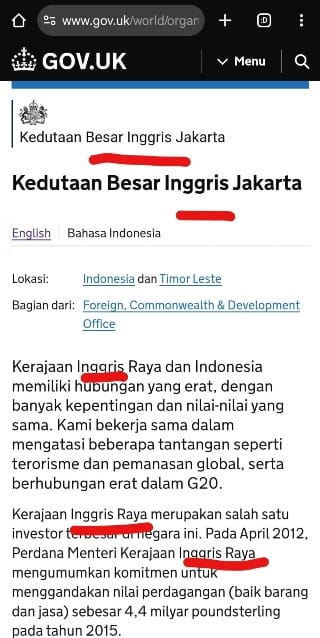
In Jakarta, that embassy presents itself to the world as Kedutaan Besar Inggris or the English Embassy. "Inggris" means "English" in Indonesian, originating from the Portuguese word "Inglês"; meaning “English”. In the very space where international standing is performed and recognised, Scotland vanishes under England's name. The so-called United Kingdom's diplomatic representation in one of the world's most populous countries identifies itself, to 280 million Indonesians, not as British, not as the United Kingdom's embassy but as the English Embassy. Scotland does not exist. Wales and Northern Ireland do not exist. England has simply taken the name of the state it colonised and calls itself the state.
I documented these episodes on X. I described them too in the founding post of this blog: "Decolonial Consciousness 2/3: On Opening Still Yours For Scotland. The Embassy That Named Scotland Out of Existence. A Personal Awakening and the Scholarship That Will Not Be Dismissed".
The English colonial state embassy in Indonesia is officially called the English/Inggris embassy in Indonesian on the official GOV.UK website of the English colonial state. It seems the page in Indonesian is currently suspended.
The Refusal to Correct: The Ambassador's Documented Response
When this was raised formally, correction was declined. Oxford Professor and Englishman Peter Carey; specialist of Prince Diponegoro, the Indonesian revolutionary hero who led the Java War (1825-1830) against Dutch colonial rule; formally protested the use of "Inggris" to the English colonial state's ambassador in Indonesia, Dominic Jermey, in February 2025. Carey even confirmed the issue with the specialist on Malay/Indonesian at the British Library in London. Carey had actually been using the word “Inggris” himself for decades, even for his books in their Indonesian versions to describe the “UK” state as a whole. It was I who had briefed Peter Carey about the issue; a colonised and discriminated Scot raising the colonial erasure of his own people's identity, then watching an English historian be given the central role in the story that followed as a containment strategy.
The ambassador's email response to Peter Carey; the original of which is in the author's possession, and which was also consulted and reported by BBC Indonesia; is documented and unambiguous:
"In Indonesian, we continue to use 'Inggris', more common among the public, in order to make our communication more accessible."
The embassy's spokesperson Faye Belnis confirmed to BBC Indonesia that "the term 'Inggris' can be used to refer to the United Kingdom, as it is widely accepted in Indonesia"; and declined to answer questions about what measures were being considered or what discussions were taking place with the Indonesian government.
As Peter Carey stated in the BBC Indonesia article, referring to receiving official correspondence addressed in England's name:
"We have reached a point where it is no longer acceptable to receive a letter or invitation sent 'in the name of England.' It is an offense against non-English populations."
As I stated myself in the BBC Indonesia coverage, the ambassador's justification, legitimising the use of "Inggris" in official emails on grounds of local comprehension, "is not merely a harmful bureaucratic decision. It is also a symptom of unjust representation." The BBC Indonesia article uses my words as its section heading, in the convention of direct-quote subheadings, the verdict that the ambassador's response is unacceptable: "Melecehkan" which means insulting, demeaning, disrespecting in Indonesian. The fact that the BBC Indonesia article chose this formulation as its section heading confirms that the documentary record, in its own structure, registers the refusal to correct as an act of active contempt rather than administrative convention.
The English Ambassador's Discriminatory Email as precious information for the public:
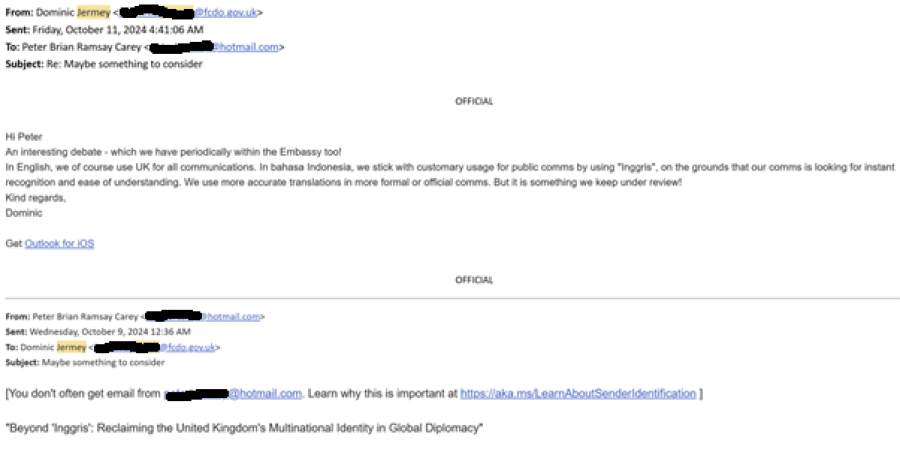
What is analytically decisive here is not merely the use of "Inggris". It is the documented refusal to correct it when challenged by an Oxford historian and a Scottish academic doctor in politics from Universitas Indonesia, the subsequent BBC journalistic verification, and the continuing deployment of the misidentification across official communications. This transforms the Indonesia case from a linguistic convention into a documented act of colonial epistemic management: the deliberate maintenance, against formal protest and journalistic scrutiny, of a naming practice that erases Scotland, Wales, and Northern Ireland from the informational environment of 280 million Indonesians. BBC Indonesia covered the story not in London, where it would have attracted attention within the English colonial state's domestic media environment, but only in Indonesia, in Indonesian, as a containment strategy; addressing the issue for the Indonesian audience while ensuring it did not reach the English-speaking world where its implications for Scotland's colonial status would be most legible.
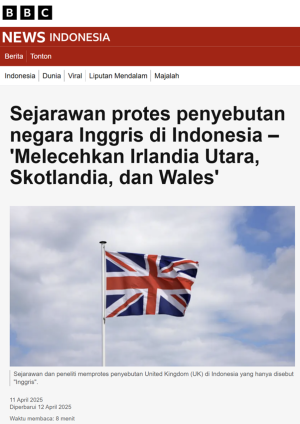
BBC Indonesia's long article on the matter, never covered in English by the BBC, :
Over 3 Billion People: The Global Scale of the Erasure
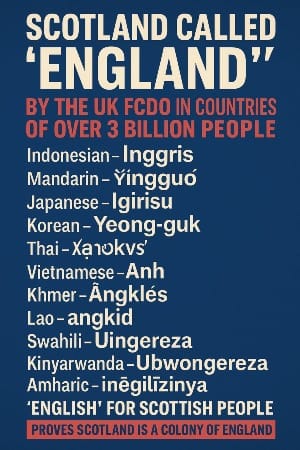
The Indonesia case is not an isolated linguistic convention. It is the most visible expression of a global colonial epistemic operation. Across languages representing these populations (my own calculation, verified through systematic research across official diplomatic and state media communications. It could be more. The BBC confirmed at least 2.8 billion people, the number I had given originally.), the English colonial state's diplomatic apparatus uses local-language terms meaning "English" or "England" to describe the United Kingdom, its institutions, its ambassador, and its supposed citizens. Scotland is erased from the consciousness of all of these populations through the deliberate maintenance of this naming practice.
The documented languages and terms are notably:
Asia:
- Indonesian: Inggris; English/England (280 million speakers)
- Mandarin: Yīngguó 英国; English country/England (over 1 billion speakers). In the case of China, it should be noted that China added another term to mean England too (英格兰, Yīnggélán), underlying it had understood the problem already and confirming it. China is always sensitive to this type of issue and smart at dealing with it. Yet, I still think the coloniality remains from the English colonial state. China cannot really be blamed here since it did try and find a solution.
- Japanese: Igirisu イギリス; English/England
- Korean: Yeongguk 영국; English/England
- Thai: Xạngkvss̄ อังกฤษ; English/England
- Vietnamese: Anh; English/England
- Khmer: Ângklés; English/England
- Lao: angkid; English/England
Africa:
- Swahili: Uingereza; England (over 200 million speakers across East Africa)
- Kinyarwanda: Ubwongereza; England (Rwanda)
- Amharic: inigilīzinya እንግሊዝኛ; English/England (Ethiopia)
In every one of these linguistic contexts; across Asia and Africa, across dozens of countries, addressed to these populations; the English colonial state's diplomatic apparatus identifies itself and describes itself using the local term for England and the English. Scotland does not exist. Welsh people and Northern Irish people do not exist. The "United Kingdom" is England. The British ambassador is the English ambassador. The Scottish people are the English people.
As I stated in the BBC Indonesia coverage at the time: "This linguistic elimination of Scotland, Wales, and Northern Ireland is not merely a betrayal of the (supposed) constitutional reality of the United Kingdom. It is also a violation of international law, diplomatic norms, and the human rights framework."
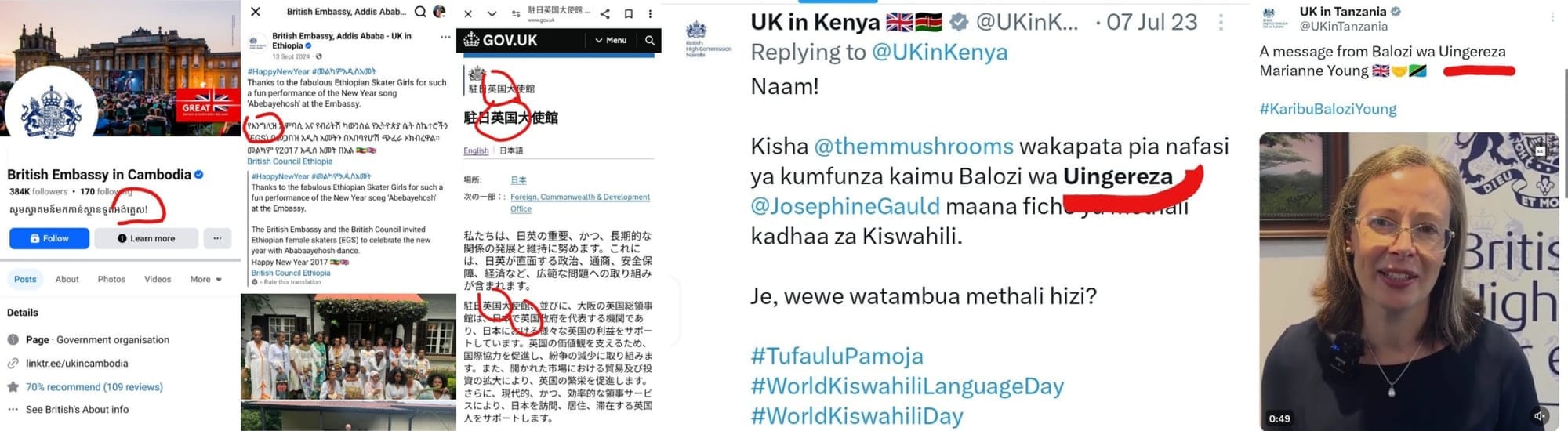
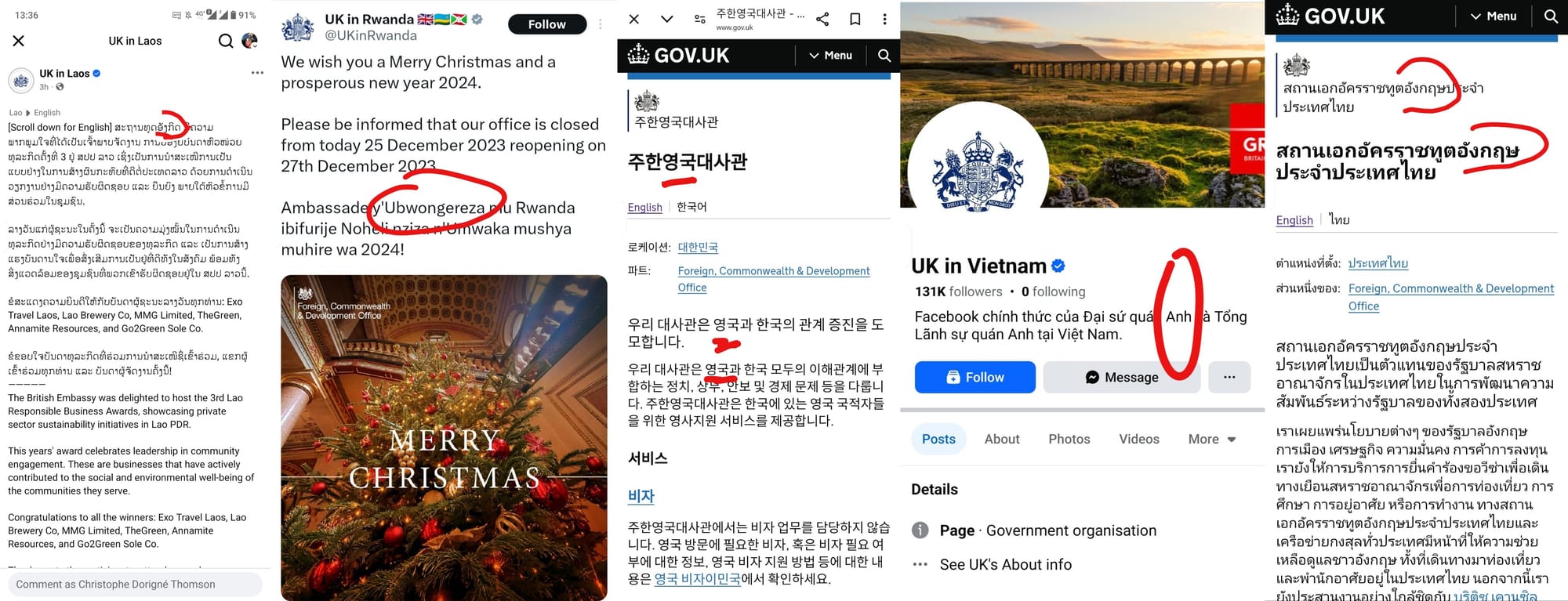
Examples of screenshots from official "UK" diplomatic communications systematically discriminating Scots, Irish and Welsh citizens by calling them English in foreign languages. Ten examples below from the English embassies in Cambodia, Ethiopia, Japan, Kenya, Tanzania, Laos, Rwanda, South Korea, Vietnam and Thailand. In most states, if not all, this situation would be an immense scandal; not for the English colonial state since Scotland is an English colony with no say in the matter.
The Colonial Linguistic Architecture: How "England" Became "the World"
The mechanism through which this global erasure operates is the colonial linguistic legacy; the centuries during which England was the dominant power whose name local languages developed terms for, terms that were then extended, without correction or modification, to describe the entirety of the "United Kingdom" that England subsequently created through the annexation of Scotland in 1707, Wales over preceding centuries, and Ireland in 1800. It is always good to remember that the Union with Ireland Act 1800 starts with the phrase "The Parliaments of England and Ireland have agreed upon the articles following:"; while the Parliament of England was supposed to have disappeared like the Scottish one.
English colonialist Thomas Babington Macaulay, designing the colonial education system for India in 1835, was explicit about the relationship between language and power. His Minute on Indian Education argued that colonial policy should create an intermediary class able to assist colonial administration from within; individuals "Indian in blood and colour, but English in taste, in opinions, in morals, and in intellect." What is rarely noted and demands to be named is that Macaulay applied the identical logic to Scotland. He served as Member of Parliament for Edinburgh from 1839, representing Scotland's capital at Westminster while simultaneously designing the colonial educational apparatus for India. His History of England, written in the same period, describes the Highland Scots in terms structurally identical to his characterisation of colonised peoples in India; as barbarous, uncivilised, primitive, requiring the transformative intervention of English language and culture to become legible within the framework of civilisation.
The post-Culloden colonial programme had already made this logic official English colonial policy. After 1746, the English colonial state concluded explicitly that Highland support for the Jacobite cause demonstrated that the Highlanders "had not been anglicised enough"; deploying the same civilisational deficiency argument that Macaulay would apply to India less than a century later. The Dress Act 1746, passed by the Westminster Parliament within months of the Battle of Culloden, banned Highland dress entirely; the kilt, the tartan, the plaid, the traditional weapons. Wearing tartan became a criminal offence punishable by six months imprisonment for a first offence and transportation to the colonies for seven years for a second. The pipes were banned. The clan system was systematically dismantled. Gaelic was suppressed. The cultural infrastructure of a distinct Scottish identity (its clothing, its music, its language, its social organisation) was criminalised by the English colonial state within living memory of the 1707 annexation whose "voluntary" character the colonial disinformation apparatus has been defending ever since. This is not the behaviour of a state managing a voluntary partnership but a colonial power eliminating the visible markers of the people it has colonised; identical in logic, function, aspect and consequence to the colonial cultural suppressions that Ngũgĩ wa Thiong'o documents in Kenya with the suppression of Kikuyu and Gikuyu in Kenyan colonial schools or Fanon analyses in Algeria, and that the entire apparatus of post-1707 Scottish anglicisation deployed against the Scottish people for three centuries. The erasure of Scotland's identity in diplomatic space across over 3 billion people is the twenty-first century expression of the same colonial project that banned the kilt in 1746. Nobody in the world seems to wonder how come Scottish Gaelic (Gàidhlig) is now an endangered Indigenous language with roughly 57,000 to 70,000 speakers remaining in Scotland, making up about 1% of the population. This is the result of texbook colonial linguistic and cultural suppression linked with genocide, ethnic cleansing, deportation, enslavement, etc. from the English colonial state against Scotland and Scots.
Scotland was the laboratory. India was the export. Macaulay, as Edinburgh's own MP, was the intellectual architect of both.
As pro-union historian T.M. Devine notes, there were no Scots in the East India Company before the 1707 annexation. The English colonial educational and linguistic apparatus was not Scotland's creation. It was the instrument of Scotland's absorption; tested in Scotland's Highlands before being applied across the empire that Scotland's annexation made possible.
Oxford historian Peter Carey captures the colonial linguistic mechanism with precision, citing the Roman principle: "Nomen est omen"; the name carries both an implicit and a hidden meaning. When the English colonial state's diplomatic apparatus calls itself the English Embassy to billions of people across Asia and Africa, it is not making an administrative error but performing a colonial act; the erasure of Scotland's identity from the global informational environment, maintained through the refusal to correct it even when formally challenged, and reproduced through the diplomatic apparatus of third-party states including France, whose specific complicity is documented in Part Two of this investigation.
What This Proves: The Colonial Analysis
The Refusal to Correct Is the Proof
The proof is structural. A state genuinely committed to accurate representation of the nations it claims to represent, in a supposedly 'voluntary union of equals', would immediatetly and urgently correct the misidentification. A colonial state declines correction and deploys its media apparatus to contain the exposure. A colonial state whose interest lies in maintaining the appearance that England and "the UK" are synonymous, that Scotland does not exist as a distinct entity with distinct rights and a distinct international legal status, declines correction and deploys its media apparatus to contain the exposure of the misidentification without addressing it. The BBC Indonesia coverage was the containment strategy; addressing the issue for the Indonesian audience while ensuring it did not circulate in the English-speaking world where its implications for Scotland's colonial status would be most visible.
The BBC Indonesia Article: Journalistic Verification and Colonial Containment
The BBC Indonesia article published on 11 April 2025 in Indonesian under the title "Sejarawan protes penyebutan negara Inggris di Indonesia; Melecehkan Irlandia Utara, Skotlandia, dan Wales" (A historian protests the naming of England as the country in Indonesia; Insulting Northern Ireland, Scotland, and Wales), addressed exclusively to an Indonesian readership in the Indonesian language, and never translated or republished in English by the BBC; is one of the most analytically significant documents in this entire investigation, for two entirely distinct and equally important reasons. First, because of what it confirms. Second, because of what it chose not to do.
The Indonesian title is devastating. "Penyebutan negara Inggris" means literally "the naming/designation of the country as England"; not merely the incidental use of the word "Inggris" in passing, but the active designation of the entire country as England. "Melecehkan"; insulting, demeaning, disrespecting; is a strong term. It carries the connotation of active contempt rather than merely causing offence. The BBC Indonesia's own headline thus confirms, in its Indonesian-language precision, that what the English colonial state is doing in Indonesia is an active insult to the people of Scotland, Wales, and Northern Ireland; a fact whose full significance the BBC chose to contain within the Indonesian language rather than transmit to the English-speaking world where its implications for Scotland's colonial status would have been most consequential. Given the links between the BBC and English colonial intelligence, described in our article on how the BBC spied on Liberation Scotland at the United Nations in Geneva, it is not surprising.
What It Confirms: The Facts Are Established
The BBC Indonesia article; published in Indonesian, addressed exclusively to an Indonesian readership; establishes the following facts through independent journalistic investigation, whose confirmation by an English news organisation places them beyond reasonable dispute.
The systematic use of "Inggris" is formally acknowledged by the English colonial state's own diplomatic apparatus. Embassy spokesperson Faye Belnis confirmed to BBC Indonesia in writing: "the term 'Inggris' can be used to refer to the United Kingdom, as it is widely accepted in Indonesia." This is the English colonial state's own official spokesperson confirming the erasure of Scotland's identity in Indonesian diplomatic communications and declining to commit to any correction.
The ambassador's refusal is in the documentary record; his email, quoted above, confirms the deliberate maintenance of the erasure. It is not administrative inertia. It is policy.
The BBC Indonesia article independently confirms Carey's etymological analysis and its central conclusion. Historical linguistic heritage does not justify continued official deployment of a colonial naming practice in the twenty-first century. Carey's additional statement in an email to the ambassador confirms the full scholarly basis: citing Russell Jones's Loan Words in Indonesian and Malay (Jakarta: Yayasan Obor, 2008), page 123, which documents "Inggris; English, England, Great Britain; from Portuguese dialect 'Ingrès'." The etymology is established. The choice to maintain it is deliberate.
My own analysis that I gave the BBC at the time is independently verified by the BBC Indonesia article. As quoted in the article, my calculation is confirmed, as is my characterisation; cited directly in the article; that "this linguistic elimination of Scotland, Wales, and Northern Ireland is not merely a betrayal of the (supposed) constitutional reality of the United Kingdom. It is also a violation of international law, diplomatic norms, and the human rights framework.”
The colonial comparison is explicitly made in the article. Carey's statement in the BBC Indonesia article is precise: "It is an offense against non-English populations". The comparative framework is stated directly: "The United Kingdom is not just England, just as Indonesia is not just Java. Java is certainly the most populous island and the economic centre of the country, but it does not represent all of Indonesia." The colonial analogy; England naming the entire UK just as Java might illegitimately name the entirety of Indonesia; is established in the BBC Indonesia article itself, by an Oxford historian, on the record.
What the Article Chose Not to Do: Colonial Containment Identified
This is where the BBC Indonesia article reveals its true function. What it confirms factually is significant. What it chose not to do is analytically decisive.
The Appropriation: A Scot's Discovery, an Englishman's Platform
Before analysing the BBC Indonesia article's containment function, a prior issue demands naming. The “discovery” of the "Inggris" problem or at least the lobbying against its use; the systematic erasure of Scotland's identity across these countries and populations, the formal protest to the English colonial state's diplomatic apparatus, the submissions to UN and European human rights mechanisms; was mine. I am a Scot. This is my people's identity being erased. I raised it, documented it, formally challenged it, and initiated the institutional responses.
Peter Carey is an English historian; the Laithwaite Fellow of Modern History at Trinity College Oxford from 1979 to 2008; who has spent part of his professional career in Indonesia and who was aware of the "Inggris" question. His scholarly contribution; the linguistic etymology from Russell Jones's Loan Words in Indonesian and Malay, the Roman nomen est omen formulation, the Java/Indonesia analogy (probably my analogy too); is genuine and valuable. His willingness to formally protest to English Ambassador Dominic Jermey deserves acknowledgement.
But the BBC Indonesia article gave Peter Carey the central role in a story that a Scot had originated, documented, lobbied for and formally pursued through international channels. The point on Madagascar in the article is also mine but is attributed to Carey (I have the message proving that). My name appears in the article. I explain that the problem exists across multiple countries and initiated the protest. But the article's narrative centre of gravity is Carey: his protest, his letter to the ambassador, his statements, his historical framework. The story of Scotland's erasure is told through the perspective of an English historian rather than through the perspective of the Scot who identified it as a colonial act and pursued it as such.
This is not a personal grievance but a structural observation with a precise colonial dimension. The English colonial state's media apparatus; the BBC; chose to centre an English voice, A loyal Brit, on a story about the erasure of Scottish identity, in a language and on a platform that contained its implications, rather than to centre the Scottish voice that had identified the colonial act and named it as such. The story of Scotland's colonial erasure became, in the BBC's framing, a story about an English historian's sensitivity to non-English “British” identity rather than a story about a Scot's formal documentation of his people's systematic disappearance from the consciousness of over 3 billion people, erased by the English colonial state’s foreign office.
The containment was not only geographic and linguistic. It was authorial; the colonial epistemic apparatus performing its subtlest function: not suppression but reframing, centring an English voice on a Scottish colonial story and removing from its centre the Scot whose analysis most directly challenges the English colonial state's constitutional position over Scotland. The BBC's scotophobia, and that of English colonial media in general, is well-established.
The article was published in Indonesian only. Not in English. Not on BBC News or BBC Scotland. Not on any platform that would reach the Scottish public, the international left readership, the UN system engaging with document United Nations Human Rights Council A/HRC/61/NGO/210, or the diplomatic community whose understanding of Scotland's colonial status might be shaped by knowing that the English colonial state's own diplomatic apparatus formally identifies itself as "the English Embassy" to 280 million Indonesians and refused to correct it when formally challenged by an Oxford historian. Several ambassadors of different countries told me this suppression of Scots and Scotland in diplomatic representation was shocking; informally of course since courage is not generally the most available virtue in those circles.
The BBC sent the article to Indonesia and stopped there. Three BBC World Service journalists, as this blog has documented, subsequently attended Liberation Scotland's UN conference in Geneva and broadcast nothing. The BBC Indonesia article was be seen as a first template. Cover the story in a language and on a platform that contains its implications, ensure it reaches parts of the local audience where the facts are already known, and prevent it from reaching the international English-language audience where its implications for Scotland's colonial status would be most consequential.
The article's framing treats the issue as a diplomatic nomenclature dispute rather than a colonial act. The BBC Indonesia article's headline; "A Historian protests against the use of the word 'Inggris' to designate the United Kingdom; 'An offense to Northern Ireland, Scotland and Wales'"; positions the story as a question of diplomatic sensitivity rather than a documented act of colonial epistemic management. It does not mention Scotland's decolonisation campaign or Liberation Scotland. It does not mention that the naming practice erases Scotland's identity from the consciousness of over 3 billion people. It covers the tree; the Indonesian nomenclature question; while concealing the forest: the global colonial epistemic operation of which Indonesia is only the most visible expression.
The BBC as colonial containment apparatus. This is the BBC performing the function that this blog has previously documented in detail; the gathering of intelligence and information about Scotland's liberation movement and its international dimensions, followed by the strategic deployment of partial coverage that addresses the surface issue in a contained linguistic and geographic context while preventing the full analytical implications from reaching the audiences for whom they would be most consequential. The BBC Indonesia article is the Geneva silence's journalistic predecessor; claim engagement, prevent visibility.
Peter Carey, in his documented additional statement, notes that since Brexit, identity debates around Scotland and Northern Ireland have intensified; and that the naming practice has become politically unacceptable in ways it was not before. This is analytically insufficient. There is not debate about Scotland and Ireland, which are the countries of the Scots and the Irish. Any perceived "debate" is created by the colonial situation by the English colonisers and their propaganda apparatus. What Carey frames as an intensification of identity debate is, in the decolonial framework this blog deploys, something categorically different; the exposure of a colonial act that was always a colonial act, now merely more visible because the colonial relationship's contradictions have become impossible to manage within the colonial constitutional framework.
The "Inggris" naming practice did not become colonial after Brexit. It was colonial from 1707, from the moment the English colonial state annexed Scotland, invented Great Britain then the "United Kingdom" as the name of England's colonial construction, and began telling the world that England and the UK were synonymous. Brexit did not create the colonial naming. It stripped away the European framework that had partially obscured it. The BBC Indonesia article covers the post-Brexit visibility of the colonial act. It does not name the colonial act itself because naming it would require the BBC to acknowledge what this blog, Liberation Scotland, and document United Nations Human Rights Council A/HRC/61/NGO/210 have established; that Scotland is a colonised nation whose identity has been systematically erased by the colonial state that annexed it, and whose inalienable right to self-determination is now formally before the Secretary-General of the United Nations. The BBC covers the symptom and suppresses the diagnosis. That diagnosis is what this blog exists to provide and what the English colonial state's diplomatic apparatus, from English Ambassador Jermey's email to the BBC World Service's Geneva silence, is deployed to prevent from reaching the world.
The International Legal Dimension
Scotland's right to self-determination is now formally before the United Nations and in the UN system. Part of Scotland's annexation by the English colonial state, the systematic erasure of Scotland's identity in the diplomatic communications of the English colonial state constitutes, under the principle of erga omnes obligations established by the ICJ in the Namibia Advisory Opinion (1971) and confirmed in the Chagos Advisory Opinion (2019), a continuing violation of Scotland's people's right to be recognised as a distinct people with an inalienable right to self-determination.
General Assembly Resolution 1514 (XV); the foundational 1960 Declaration on the Granting of Independence to Colonial Countries and Peoples; establishes that a colonised people has the right to have its distinct identity recognised without the interference of the colonising power. The English colonial state's systematic global erasure of Scotland's identity; telling billions of people in dozens of languages that Scotland is England; is the colonial state deploying its global institutional apparatus to prevent the international recognition of Scotland's colonial condition.
Sanjeev Sanyal, Senior Economic Advisor to the Prime Minister of India Narendra Modi, recently declared on X that Scotland is one of the world's last remaining colonies. He said it from within a country that itself broke free from English colonial domination and with the analytical authority of someone whose country has spent decades building the institutional and intellectual infrastructure of genuine independence from the same colonial power that continues to name Scotland out of existence across the world. The world sees it and names it. The English colonial state continues to decline correction. Colonisers refuse to change. To be fair, it cannot correct it since the "United Kingdom" is a colonial construction. Scottish people are not "British", which has always meant English.
Conclusion: The World Has Been Lied To About Scotland
The ambassador's email exists. The BBC's verdict is in its own headline: "Melecehkan"; insulting, demeaning, disrespecting. The English colonial state's refusal to correct the erasure of Scotland's identity from the consciousness of billions of people is colonial policy. Here a deeper analytical point demands to be named. The local-language terms that erase Scotland; "Inggris," "Igirisu," "Yeongguk," "Angkrit," "Uingereza", all meaning England or English; are not merely administrative errors. They are, in a precise and devastating sense, more truthful than the colonial fiction they nominally misrepresent. "United Kingdom" and "British" are themselves colonial veils; the English colonial state's preferred self-descriptions, designed to conceal the colonial relationship behind the language of partnership and union. When Indonesian, Japanese, Korean, Thai, and Swahili speakers call the UK "England," they are, mostly without knowing it, naming the colonial reality more accurately than the colonial state's own official terminology does. England is what it is. "United Kingdom" is what England calls itself to make the colonial relationship appear as a voluntary association. The local-language terms strip away the veil. The colonial state refuses to correct them not because they are inaccurate about the colonial relationship but because they are too accurate; because "Kedutaan Besar Inggris," the English Embassy, names with vernacular precision what "British High Commission/Embassy" is designed to obscure.
The world has been lied to about Scotland but the lie is more layered than it first appears. The world has been told that Scotland is England, through thousands of local-language diplomatic communications across dozens of countries. Simultaneously, the world has been told that England is "Britain" and "the United Kingdom" through the colonial state's own official self-description, whose function is to make the colonial relationship appear as a voluntary constitutional arrangement. Both lies serve the same colonial interest; the erasure of Scotland's distinct existence, first within the "UK" brand that absorbs it into England's name, and then within the "Inggris" naming that confirms, in vernacular truth, what the colonial brand conceals. The systematic, global, multi-linguistic erasure of Scotland's identity from the informational environment of billions of people; maintained through the English colonial state's documented refusal to correct it, contained through the BBC's strategic deployment of coverage only in Indonesia rather than in the English-speaking world where the implications would be most visible, reproduced through the diplomatic apparatus of third-party states whose specific complicity Part Two of this investigation documents, is not a departure from the colonial reality. It is the colonial reality, stated plainly, in the languages of the world.
Part Two documents France's specific and extensive complicity in this global colonial epistemic operation; including the French embassies in Indonesia, Thailand, Cambodia, Japan, and South Korea, and the French state broadcaster RFI's Swahili-language service; and what France's violations of its own constitutional principles in relation to Scotland's identity reveal about the international dimensions of Scotland's colonial condition.
References and Sources
Baird, Alf. Doun-Hauden: The Socio-Political Determinants of Scottish Independence. Edinburgh: Bàrd nan Eilean Press, 2023.
BBC Indonesia. "Sejarawan protes penyebutan negara Inggris di Indonesia - 'Melecehkan Irlandia Utara, Skotlandia, dan Wales'." [A Historian protests the naming of England as the country in Indonesia ; 'Insulting Northern Ireland, Scotland, and Wales'.] 11 April 2025. Available at: https://www.bbc.com/indonesia/articles/ckg8vkj9554o
Claim of Right Act 1689. Parliament of Scotland.
Dorigné-Thomson, Christophe. "Decolonial Consciousness 2/3: On Opening Still Yours For Scotland. The Embassy That Named Scotland Out of Existence." Still Yours For Scotland, 8 April 2026. Available at: https://www.decolonise.scot/decolonial-consciousness-on-opening-still-yours-for-scotland-awareness-is-the-beginning-of-everything-1-3-2/
Fanon, Frantz. The Wretched of the Earth. Paris: François Maspero, 1961. Translated by Richard Philcox. New York: Grove Press, 2004.
International Court of Justice. Legal Consequences of the Separation of the Chagos Archipelago from Mauritius in 1965. Advisory Opinion of 25 February 2019. ICJ Reports 2019, p. 95.
International Court of Justice. Legal Consequences for States of the Continued Presence of South Africa in Namibia (South West Africa) notwithstanding Security Council Resolution 276 (1970). Advisory Opinion of 21 June 1971. ICJ Reports 1971, p. 16.
Jermey, Dominic (English Ambassador to Indonesia). Email response to Peter Carey on use of "Inggris" in official diplomatic communications. February 2025. Original email in possession of the author. Also reported in: BBC Indonesia. "Sejarawan protes penyebutan negara Inggris di Indonesia ; Melecehkan Irlandia Utara, Skotlandia, dan Wales." 11 April 2025. Available at: https://www.bbc.com/indonesia/articles/ckg8vkj9554o
Macaulay, Thomas Babington. Minute on Indian Education. 2 February 1835.
Mignolo, Walter D. Local Histories/Global Designs: Coloniality, Subaltern Knowledges, and Border Thinking. Princeton: Princeton University Press, 2000.
Ngũgĩ wa Thiong'o. Decolonising the Mind: The Politics of Language in African Literature. London: James Currey, 1986.
Salyers, Sara. "The Claim of Right." Salvo. Available at: https://salvo.scot/the-claim-of-right/
UN General Assembly. Declaration on the Granting of Independence to Colonial Countries and Peoples. Resolution 1514 (XV). 14 December 1960.
UN General Assembly. Principles Which Should Guide Members in Determining Whether or Not an Obligation Exists to Transmit the Information Called for under Article 73e of the Charter. Resolution 1541 (XV). 15 December 1960.
United Nations Human Rights Council. Document A/HRC/61/NGO/210. Submitted by IPLSA and Liberation Scotland. 61st Session, 2026.
Member discussion